

evaporates, salt crystals form. As these crystals gradually
grow larger, they weaken the rock by pushing apart the
surrounding grains or enlarging tiny cracks.
This same process can contribute to crumbling roadways where salt is spread to melt snow and ice in winter.
The salt dissolves in water and seeps into cracks that quite
likely originated from frost action. When the water
evaporates, the growth of salt crystals further breaks
the pavement.
Sheeting
When large masses of igneous rock, particularly granite,
are exposed by erosion, concentric slabs begin to break
loose. The process generating these onionlike layers is
called sheeting. It is thought that this occurs, at least in
part, because of the great reduction in pressure when the
overlying rock is eroded away, a process called unloading.
Accompanying this unloading, the outer layers expand
more than the rock below and thus separate from the rock
body (FIGURE 5.5). Continued weathering eventually causes
the slabs to separate and spall off, creating exfoliation
domes. Excellent examples of exfoliation domes include Stone Mountain, Georgia, and
Half Dome (Figure 5.5C), and Liberty Cap in Yosemite National Park.
Deep underground mining provides us with another example of how rocks behave
once the confining pressure is removed. Large rock slabs sometimes explode off the walls
of newly cut mine tunnels because of the abruptly reduced pressure. Evidence of this type,
plus the fact that fracturing occurs parallel to the floor of a quarry when large blocks of
rock are removed, strongly supports the process of unloading as the cause of sheeting.
Although many fractures are created by expansion, others are produced by contraction
as igneous materials cool (see Figure 4.31, p. 112), and still others by tectonic forces during
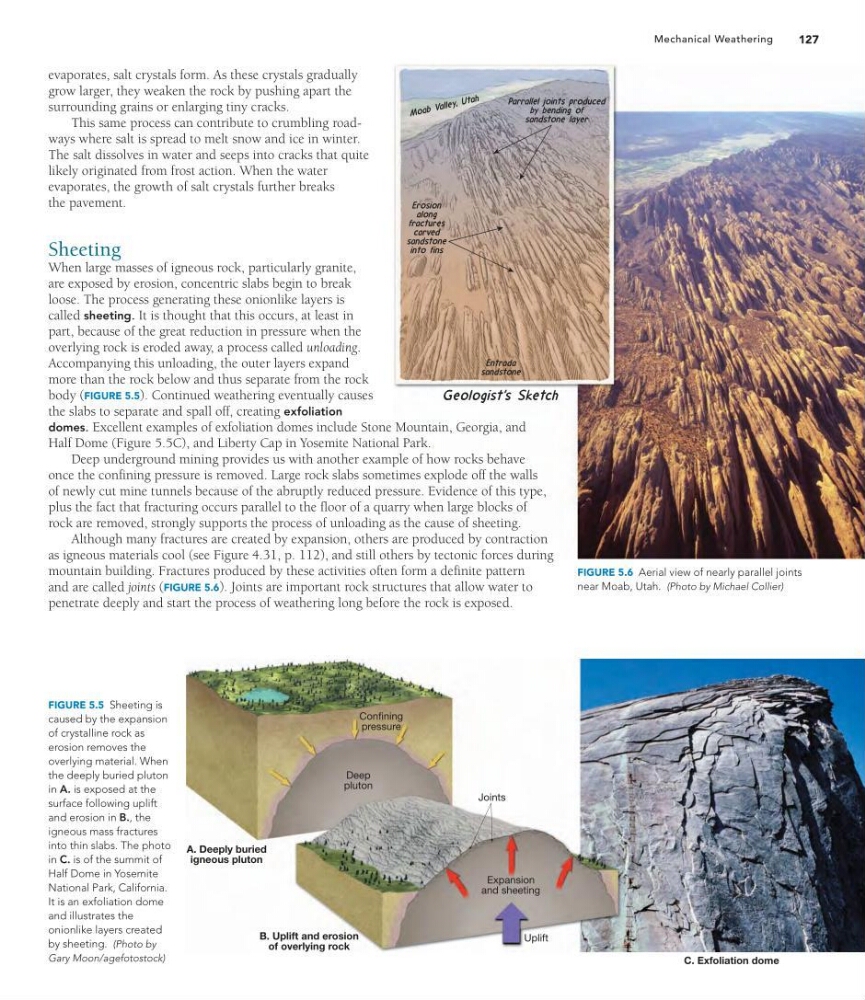
mountain building. Fractures produced by these activities often form a definite pattern
and are called joints (FIGURE 5.6). Joints are important rock structures that allow water to
penetrate deeply and start the process of weathering long before the rock is exposed.
127
Mechanical Weathering
Deep
pluton
Confining
pressure
Joints
Uplift
Expansion
and sheeting
A. Deeply buried
igneous pluton
B. Uplift and erosion
of overlying rock
C. Exfoliation dome
FIGURE 5.5 Sheeting is
caused by the expansion
of crystalline rock as
erosion removes the
overlying material. When
the deeply buried pluton
in A. is exposed at the
surface following uplift
and erosion in B., the
igneous mass fractures
into thin slabs. The photo
in C. is of the summit of
Half Dome in Yosemite
National Park, California.
It is an exfoliation dome
and illustrates the
onionlike layers created
by sheeting. (Photo by
Gary Moon/agefotostock)
FIGURE 5.6 Aerial view of nearly parallel joints
near Moab, Utah. (Photo by Michael Collier)
grow larger, they weaken the rock by pushing apart the
surrounding grains or enlarging tiny cracks.
This same process can contribute to crumbling roadways where salt is spread to melt snow and ice in winter.
The salt dissolves in water and seeps into cracks that quite
likely originated from frost action. When the water
evaporates, the growth of salt crystals further breaks
the pavement.
Sheeting
When large masses of igneous rock, particularly granite,
are exposed by erosion, concentric slabs begin to break
loose. The process generating these onionlike layers is
called sheeting. It is thought that this occurs, at least in
part, because of the great reduction in pressure when the
overlying rock is eroded away, a process called unloading.
Accompanying this unloading, the outer layers expand
more than the rock below and thus separate from the rock
body (FIGURE 5.5). Continued weathering eventually causes
the slabs to separate and spall off, creating exfoliation
domes. Excellent examples of exfoliation domes include Stone Mountain, Georgia, and
Half Dome (Figure 5.5C), and Liberty Cap in Yosemite National Park.
Deep underground mining provides us with another example of how rocks behave
once the confining pressure is removed. Large rock slabs sometimes explode off the walls
of newly cut mine tunnels because of the abruptly reduced pressure. Evidence of this type,
plus the fact that fracturing occurs parallel to the floor of a quarry when large blocks of
rock are removed, strongly supports the process of unloading as the cause of sheeting.
Although many fractures are created by expansion, others are produced by contraction
as igneous materials cool (see Figure 4.31, p. 112), and still others by tectonic forces during
mountain building. Fractures produced by these activities often form a definite pattern
and are called joints (FIGURE 5.6). Joints are important rock structures that allow water to
penetrate deeply and start the process of weathering long before the rock is exposed.
127
Mechanical Weathering
Deep
pluton
Confining
pressure
Joints
Uplift
Expansion
and sheeting
A. Deeply buried
igneous pluton
B. Uplift and erosion
of overlying rock
C. Exfoliation dome
FIGURE 5.5 Sheeting is
caused by the expansion
of crystalline rock as
erosion removes the
overlying material. When
the deeply buried pluton
in A. is exposed at the
surface following uplift
and erosion in B., the
igneous mass fractures
into thin slabs. The photo
in C. is of the summit of
Half Dome in Yosemite
National Park, California.
It is an exfoliation dome
and illustrates the
onionlike layers created
by sheeting. (Photo by
Gary Moon/agefotostock)
FIGURE 5.6 Aerial view of nearly parallel joints
near Moab, Utah. (Photo by Michael Collier)