

CHAPTER 5 Weathering and Soils
132
Climate
Climatic factors, particularly temperature and moisture, are crucial to the rate of rock
weathering. One important example from mechanical weathering is that the frequency of
freeze–thaw cycles greatly affects the amount of frost wedging.
Temperature and moisture also exert a strong influence on rates of chemical weathering and on the
kind and amount of vegetation present. Regions
with lush vegetation generally have a thick mantle
of soil rich in decayed organic matter from which
chemically active fluids such as carbonic and
humic acids are derived.
The optimal environment for chemical weathering is a combination of warm temperatures and
abundant moisture. In polar regions chemical
weathering is ineffective because frigid temperatures keep the available moisture locked up as ice,
whereas in arid regions there is insufficient
moisture to foster rapid chemical weathering.
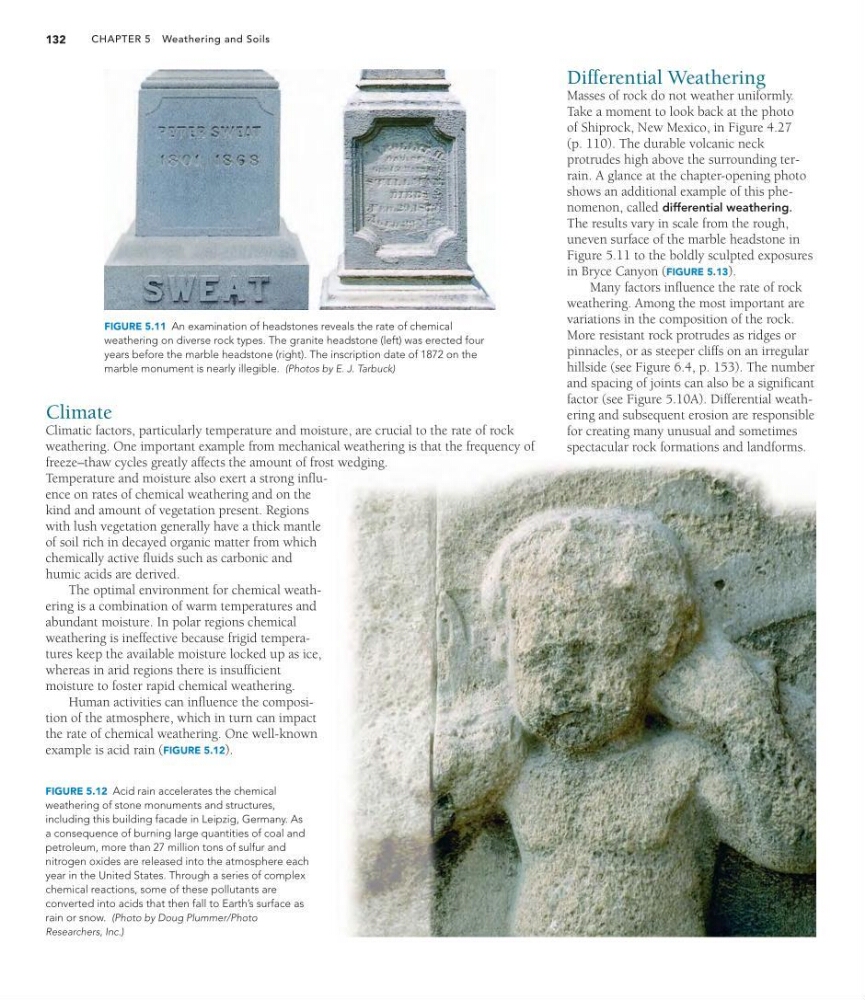
Human activities can influence the composition of the atmosphere, which in turn can impact
the rate of chemical weathering. One well-known
example is acid rain (FIGURE 5.12).
FIGURE 5.12 Acid rain accelerates the chemical
weathering of stone monuments and structures,
including this building facade in Leipzig, Germany. As
a consequence of burning large quantities of coal and
petroleum, more than 27 million tons of sulfur and
nitrogen oxides are released into the atmosphere each
year in the United States. Through a series of complex
chemical reactions, some of these pollutants are
converted into acids that then fall to Earth’s surface as
rain or snow. (Photo by Doug Plummer/Photo
Researchers, Inc.)
FIGURE 5.11 An examination of headstones reveals the rate of chemical
weathering on diverse rock types. The granite headstone (left) was erected four
years before the marble headstone (right). The inscription date of 1872 on the
marble monument is nearly illegible. (Photos by E. J. Tarbuck)
Differential Weathering
Masses of rock do not weather uniformly.
Take a moment to look back at the photo
of Shiprock, New Mexico, in Figure 4.27
(p. 110). The durable volcanic neck
protrudes high above the surrounding terrain. A glance at the chapter-opening photo
shows an additional example of this phenomenon, called differential weathering.
The results vary in scale from the rough,
uneven surface of the marble headstone in
Figure 5.11 to the boldly sculpted exposures
in Bryce Canyon (FIGURE 5.13).
Many factors influence the rate of rock
weathering. Among the most important are
variations in the composition of the rock.
More resistant rock protrudes as ridges or
pinnacles, or as steeper cliffs on an irregular
hillside (see Figure 6.4, p. 153). The number
and spacing of joints can also be a significant
factor (see Figure 5.10A). Differential weathering and subsequent erosion are responsible
for creating many unusual and sometimes
spectacular rock formations and landforms.
132
Climate
Climatic factors, particularly temperature and moisture, are crucial to the rate of rock
weathering. One important example from mechanical weathering is that the frequency of
freeze–thaw cycles greatly affects the amount of frost wedging.
Temperature and moisture also exert a strong influence on rates of chemical weathering and on the
kind and amount of vegetation present. Regions
with lush vegetation generally have a thick mantle
of soil rich in decayed organic matter from which
chemically active fluids such as carbonic and
humic acids are derived.
The optimal environment for chemical weathering is a combination of warm temperatures and
abundant moisture. In polar regions chemical
weathering is ineffective because frigid temperatures keep the available moisture locked up as ice,
whereas in arid regions there is insufficient
moisture to foster rapid chemical weathering.
Human activities can influence the composition of the atmosphere, which in turn can impact
the rate of chemical weathering. One well-known
example is acid rain (FIGURE 5.12).
FIGURE 5.12 Acid rain accelerates the chemical
weathering of stone monuments and structures,
including this building facade in Leipzig, Germany. As
a consequence of burning large quantities of coal and
petroleum, more than 27 million tons of sulfur and
nitrogen oxides are released into the atmosphere each
year in the United States. Through a series of complex
chemical reactions, some of these pollutants are
converted into acids that then fall to Earth’s surface as
rain or snow. (Photo by Doug Plummer/Photo
Researchers, Inc.)
FIGURE 5.11 An examination of headstones reveals the rate of chemical
weathering on diverse rock types. The granite headstone (left) was erected four
years before the marble headstone (right). The inscription date of 1872 on the
marble monument is nearly illegible. (Photos by E. J. Tarbuck)
Differential Weathering
Masses of rock do not weather uniformly.
Take a moment to look back at the photo
of Shiprock, New Mexico, in Figure 4.27
(p. 110). The durable volcanic neck
protrudes high above the surrounding terrain. A glance at the chapter-opening photo
shows an additional example of this phenomenon, called differential weathering.
The results vary in scale from the rough,
uneven surface of the marble headstone in
Figure 5.11 to the boldly sculpted exposures
in Bryce Canyon (FIGURE 5.13).
Many factors influence the rate of rock
weathering. Among the most important are
variations in the composition of the rock.
More resistant rock protrudes as ridges or
pinnacles, or as steeper cliffs on an irregular
hillside (see Figure 6.4, p. 153). The number
and spacing of joints can also be a significant
factor (see Figure 5.10A). Differential weathering and subsequent erosion are responsible
for creating many unusual and sometimes
spectacular rock formations and landforms.