

The overriding goal of all monitoring is
to discover precursors that may warn of an
imminent eruption. This is accomplished
by first diagnosing the current condition of
a volcano and then using this baseline data
C O N C E P T C H E C K 4 . 8
Describe four natural hazards associated
with volcanoes.
What are the four changes in a volcanic
area that are monitored in order to detect
the migration of magma?
2
1
to predict its future behavior. Stated
another way, a volcano must be
observed over an extended period to
recognize significant changes from its
“resting state.”
CHAPTER 4 Volcanoes and Volcanic Hazards
120
Key Terms
C H A P T E R
F O U R
Volcanoes and Volcanic Hazards
in Review
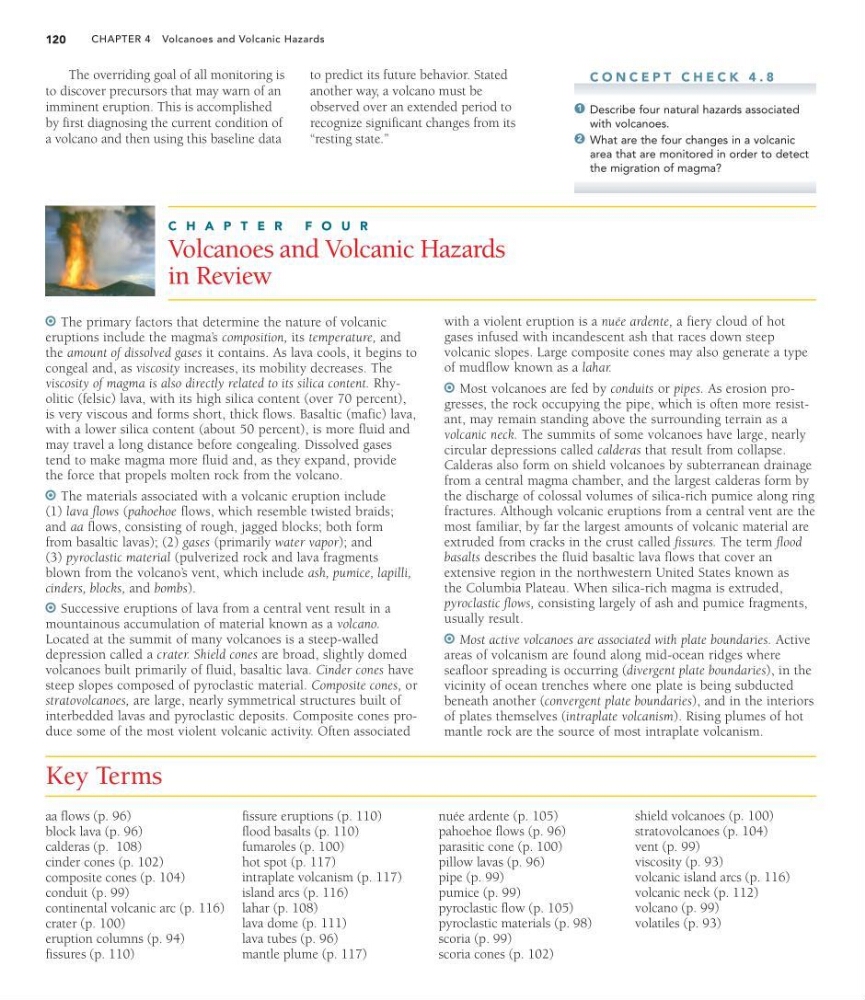
The primary factors that determine the nature of volcanic
eruptions include the magma’ s composition, its temperature, and
the amount of dissolved gases it contains. As lava cools, it begins to
congeal and, as viscosity increases, its mobility decreases. The
viscosity of magma is also directly related to its silica content. Rhyolitic (felsic) lava, with its high silica content (over 70 percent),
is very viscous and forms short, thick flows. Basaltic (mafic) lava,
with a lower silica content (about 50 percent), is more fluid and
may travel a long distance before congealing. Dissolved gases
tend to make magma more fluid and, as they expand, provide
the force that propels molten rock from the volcano.
The materials associated with a volcanic eruption include
(1) lava flows (pahoehoe flows, which resemble twisted braids;
and aa flows, consisting of rough, jagged blocks; both form
from basaltic lavas); (2) gases (primarily water vapor); and
(3) pyroclastic material (pulverized rock and lava fragments
blown from the volcano’ s vent, which include ash, pumice, lapilli,
cinders, blocks, and bombs).
Successive eruptions of lava from a central vent result in a
mountainous accumulation of material known as a volcano.
Located at the summit of many volcanoes is a steep-walled
depression called a crater. Shield cones are broad, slightly domed
volcanoes built primarily of fluid, basaltic lava. Cinder cones have
steep slopes composed of pyroclastic material. Composite cones, or
stratovolcanoes, are large, nearly symmetrical structures built of
interbedded lavas and pyroclastic deposits. Composite cones produce some of the most violent volcanic activity. Often associated
with a violent eruption is a nuée ardente, a fiery cloud of hot
gases infused with incandescent ash that races down steep
volcanic slopes. Large composite cones may also generate a type
of mudflow known as a lahar.
Most volcanoes are fed by conduits or pipes. As erosion progresses, the rock occupying the pipe, which is often more resistant, may remain standing above the surrounding terrain as a
volcanic neck. The summits of some volcanoes have large, nearly
circular depressions called calderas that result from collapse.
Calderas also form on shield volcanoes by subterranean drainage
from a central magma chamber, and the largest calderas form by
the discharge of colossal volumes of silica-rich pumice along ring
fractures. Although volcanic eruptions from a central vent are the
most familiar, by far the largest amounts of volcanic material are
extruded from cracks in the crust called fissures. The term flood
basalts describes the fluid basaltic lava flows that cover an
extensive region in the northwestern United States known as
the Columbia Plateau. When silica-rich magma is extruded,
pyroclastic flows, consisting largely of ash and pumice fragments,
usually result.
Most active volcanoes are associated with plate boundaries. Active
areas of volcanism are found along mid-ocean ridges where
seafloor spreading is occurring (divergent plate boundaries), in the
vicinity of ocean trenches where one plate is being subducted
beneath another (convergent plate boundaries), and in the interiors
of plates themselves (intraplate volcanism). Rising plumes of hot
mantle rock are the source of most intraplate volcanism.
aa flows (p. 96)
block lava (p. 96)
calderas (p. 108)
cinder cones (p. 102)
composite cones (p. 104)
conduit (p. 99)
continental volcanic arc (p. 116)
crater (p. 100)
eruption columns (p. 94)
fissures (p. 110)
fissure eruptions (p. 110)
flood basalts (p. 110)
fumaroles (p. 100)
hot spot (p. 117)
intraplate volcanism (p. 117)
island arcs (p. 116)
lahar (p. 108)
lava dome (p. 111)
lava tubes (p. 96)
mantle plume (p. 117)
nuée ardente (p. 105)
pahoehoe flows (p. 96)
parasitic cone (p. 100)
pillow lavas (p. 96)
pipe (p. 99)
pumice (p. 99)
pyroclastic flow (p. 105)
pyroclastic materials (p. 98)
scoria (p. 99)
scoria cones (p. 102)
shield volcanoes (p. 100)
stratovolcanoes (p. 104)
vent (p. 99)
viscosity (p. 93)
volcanic island arcs (p. 116)
volcanic neck (p. 112)
volcano (p. 99)
volatiles (p. 93)
to discover precursors that may warn of an
imminent eruption. This is accomplished
by first diagnosing the current condition of
a volcano and then using this baseline data
C O N C E P T C H E C K 4 . 8
Describe four natural hazards associated
with volcanoes.
What are the four changes in a volcanic
area that are monitored in order to detect
the migration of magma?
2
1
to predict its future behavior. Stated
another way, a volcano must be
observed over an extended period to
recognize significant changes from its
“resting state.”
CHAPTER 4 Volcanoes and Volcanic Hazards
120
Key Terms
C H A P T E R
F O U R
Volcanoes and Volcanic Hazards
in Review
The primary factors that determine the nature of volcanic
eruptions include the magma’ s composition, its temperature, and
the amount of dissolved gases it contains. As lava cools, it begins to
congeal and, as viscosity increases, its mobility decreases. The
viscosity of magma is also directly related to its silica content. Rhyolitic (felsic) lava, with its high silica content (over 70 percent),
is very viscous and forms short, thick flows. Basaltic (mafic) lava,
with a lower silica content (about 50 percent), is more fluid and
may travel a long distance before congealing. Dissolved gases
tend to make magma more fluid and, as they expand, provide
the force that propels molten rock from the volcano.
The materials associated with a volcanic eruption include
(1) lava flows (pahoehoe flows, which resemble twisted braids;
and aa flows, consisting of rough, jagged blocks; both form
from basaltic lavas); (2) gases (primarily water vapor); and
(3) pyroclastic material (pulverized rock and lava fragments
blown from the volcano’ s vent, which include ash, pumice, lapilli,
cinders, blocks, and bombs).
Successive eruptions of lava from a central vent result in a
mountainous accumulation of material known as a volcano.
Located at the summit of many volcanoes is a steep-walled
depression called a crater. Shield cones are broad, slightly domed
volcanoes built primarily of fluid, basaltic lava. Cinder cones have
steep slopes composed of pyroclastic material. Composite cones, or
stratovolcanoes, are large, nearly symmetrical structures built of
interbedded lavas and pyroclastic deposits. Composite cones produce some of the most violent volcanic activity. Often associated
with a violent eruption is a nuée ardente, a fiery cloud of hot
gases infused with incandescent ash that races down steep
volcanic slopes. Large composite cones may also generate a type
of mudflow known as a lahar.
Most volcanoes are fed by conduits or pipes. As erosion progresses, the rock occupying the pipe, which is often more resistant, may remain standing above the surrounding terrain as a
volcanic neck. The summits of some volcanoes have large, nearly
circular depressions called calderas that result from collapse.
Calderas also form on shield volcanoes by subterranean drainage
from a central magma chamber, and the largest calderas form by
the discharge of colossal volumes of silica-rich pumice along ring
fractures. Although volcanic eruptions from a central vent are the
most familiar, by far the largest amounts of volcanic material are
extruded from cracks in the crust called fissures. The term flood
basalts describes the fluid basaltic lava flows that cover an
extensive region in the northwestern United States known as
the Columbia Plateau. When silica-rich magma is extruded,
pyroclastic flows, consisting largely of ash and pumice fragments,
usually result.
Most active volcanoes are associated with plate boundaries. Active
areas of volcanism are found along mid-ocean ridges where
seafloor spreading is occurring (divergent plate boundaries), in the
vicinity of ocean trenches where one plate is being subducted
beneath another (convergent plate boundaries), and in the interiors
of plates themselves (intraplate volcanism). Rising plumes of hot
mantle rock are the source of most intraplate volcanism.
aa flows (p. 96)
block lava (p. 96)
calderas (p. 108)
cinder cones (p. 102)
composite cones (p. 104)
conduit (p. 99)
continental volcanic arc (p. 116)
crater (p. 100)
eruption columns (p. 94)
fissures (p. 110)
fissure eruptions (p. 110)
flood basalts (p. 110)
fumaroles (p. 100)
hot spot (p. 117)
intraplate volcanism (p. 117)
island arcs (p. 116)
lahar (p. 108)
lava dome (p. 111)
lava tubes (p. 96)
mantle plume (p. 117)
nuée ardente (p. 105)
pahoehoe flows (p. 96)
parasitic cone (p. 100)
pillow lavas (p. 96)
pipe (p. 99)
pumice (p. 99)
pyroclastic flow (p. 105)
pyroclastic materials (p. 98)
scoria (p. 99)
scoria cones (p. 102)
shield volcanoes (p. 100)
stratovolcanoes (p. 104)
vent (p. 99)
viscosity (p. 93)
volcanic island arcs (p. 116)
volcanic neck (p. 112)
volcano (p. 99)
volatiles (p. 93)