

121
Companion Website
A.
B.
D.
C.
Match each of these volcanic regions with one of the three zones of
volcanism (convergent plate boundaries, divergent plate boundaries, or intraplate volcanism):
1
For each of the accompanying four sketches, identify the geologic
setting (zone of volcanism). Which of these settings will most likely
generate explosive eruptions? Which will produce outpouring of
fluid basaltic lavas?
5
G I V E I T S O M E T H O U G H T
a. Crater Lake
b. Hawaii’s Kilauea
c. Mount St. Helens
d. East African Rift
e. Yellowstone
f. Vesuvius
g. Deccan Plateau
h. Mount Etna
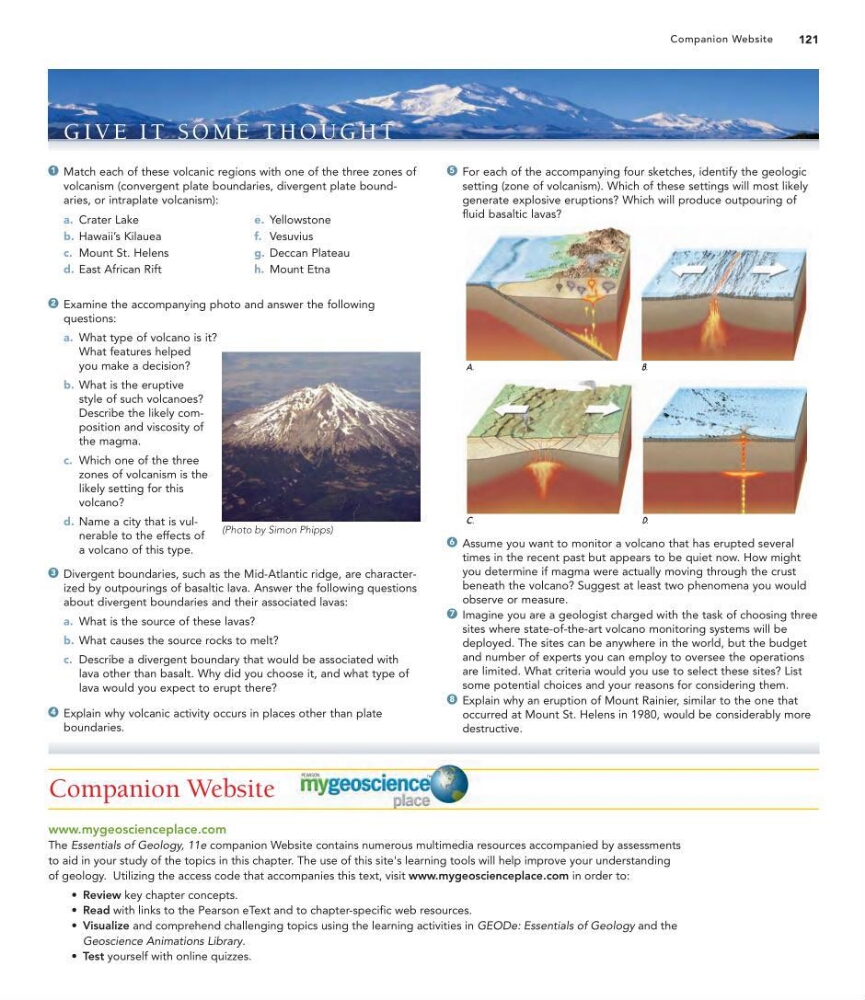
Examine the accompanying photo and answer the following
questions:
a. What type of volcano is it?
What features helped
you make a decision?
b. What is the eruptive
style of such volcanoes?
Describe the likely composition and viscosity of
the magma.
c. Which one of the three
zones of volcanism is the
likely setting for this
volcano?
d. Name a city that is vulnerable to the effects of
a volcano of this type.
Divergent boundaries, such as the Mid-Atlantic ridge, are characterized by outpourings of basaltic lava. Answer the following questions
about divergent boundaries and their associated lavas:
a. What is the source of these lavas?
b. What causes the source rocks to melt?
c. Describe a divergent boundary that would be associated with
lava other than basalt. Why did you choose it, and what type of
lava would you expect to erupt there?
Explain why volcanic activity occurs in places other than plate
boundaries.
4
3
2
Assume you want to monitor a volcano that has erupted several
times in the recent past but appears to be quiet now. How might
you determine if magma were actually moving through the crust
beneath the volcano? Suggest at least two phenomena you would
observe or measure.
Imagine you are a geologist charged with the task of choosing three
sites where state-of-the-art volcano monitoring systems will be
deployed. The sites can be anywhere in the world, but the budget
and number of experts you can employ to oversee the operations
are limited. What criteria would you use to select these sites? List
some potential choices and your reasons for considering them.
Explain why an eruption of Mount Rainier, similar to the one that
occurred at Mount St. Helens in 1980, would be considerably more
destructive.
8
7
6
(Photo by Simon Phipps)
Companion Website
www.mygeoscienceplace.com
The Essentials of Geology, 11e companion Website contains numerous multimedia resources accompanied by assessments
to aid in your study of the topics in this chapter. The use of this site's learning tools will help improve your understanding
of geology. Utilizing the access code that accompanies this text, visit www.mygeoscienceplace.com in order to:
• Review key chapter concepts.
• Read with links to the Pearson eText and to chapter-specific web resources.
• Visualize and comprehend challenging topics using the learning activities in GEODe: Essentials of Geology and the
Geoscience Animations Library.
• Test yourself with online quizzes.
Companion Website
A.
B.
D.
C.
Match each of these volcanic regions with one of the three zones of
volcanism (convergent plate boundaries, divergent plate boundaries, or intraplate volcanism):
1
For each of the accompanying four sketches, identify the geologic
setting (zone of volcanism). Which of these settings will most likely
generate explosive eruptions? Which will produce outpouring of
fluid basaltic lavas?
5
G I V E I T S O M E T H O U G H T
a. Crater Lake
b. Hawaii’s Kilauea
c. Mount St. Helens
d. East African Rift
e. Yellowstone
f. Vesuvius
g. Deccan Plateau
h. Mount Etna
Examine the accompanying photo and answer the following
questions:
a. What type of volcano is it?
What features helped
you make a decision?
b. What is the eruptive
style of such volcanoes?
Describe the likely composition and viscosity of
the magma.
c. Which one of the three
zones of volcanism is the
likely setting for this
volcano?
d. Name a city that is vulnerable to the effects of
a volcano of this type.
Divergent boundaries, such as the Mid-Atlantic ridge, are characterized by outpourings of basaltic lava. Answer the following questions
about divergent boundaries and their associated lavas:
a. What is the source of these lavas?
b. What causes the source rocks to melt?
c. Describe a divergent boundary that would be associated with
lava other than basalt. Why did you choose it, and what type of
lava would you expect to erupt there?
Explain why volcanic activity occurs in places other than plate
boundaries.
4
3
2
Assume you want to monitor a volcano that has erupted several
times in the recent past but appears to be quiet now. How might
you determine if magma were actually moving through the crust
beneath the volcano? Suggest at least two phenomena you would
observe or measure.
Imagine you are a geologist charged with the task of choosing three
sites where state-of-the-art volcano monitoring systems will be
deployed. The sites can be anywhere in the world, but the budget
and number of experts you can employ to oversee the operations
are limited. What criteria would you use to select these sites? List
some potential choices and your reasons for considering them.
Explain why an eruption of Mount Rainier, similar to the one that
occurred at Mount St. Helens in 1980, would be considerably more
destructive.
8
7
6
(Photo by Simon Phipps)
Companion Website
www.mygeoscienceplace.com
The Essentials of Geology, 11e companion Website contains numerous multimedia resources accompanied by assessments
to aid in your study of the topics in this chapter. The use of this site's learning tools will help improve your understanding
of geology. Utilizing the access code that accompanies this text, visit www.mygeoscienceplace.com in order to:
• Review key chapter concepts.
• Read with links to the Pearson eText and to chapter-specific web resources.
• Visualize and comprehend challenging topics using the learning activities in GEODe: Essentials of Geology and the
Geoscience Animations Library.
• Test yourself with online quizzes.