

Living with Volcanoes
About 10 percent of Earth’ s population lives in the vicinity of an active volcano. In fact, several major cities including Seattle, Washington; Mexico City, Mexico; Tokyo, Japan; Naples,
Italy; and Quito, Ecuador are located on or near a volcano (FIGURE 4.36).
Until recently, the dominant view of western societies was that humans possess the
wherewithal to subdue volcanoes and other types of catastrophic natural hazards. Today it
is apparent that volcanoes are not only very destructive but unpredictable as well. With this
awareness, a new attitude is developing—“How do we live
with volcanoes?”
Volcanic Hazards
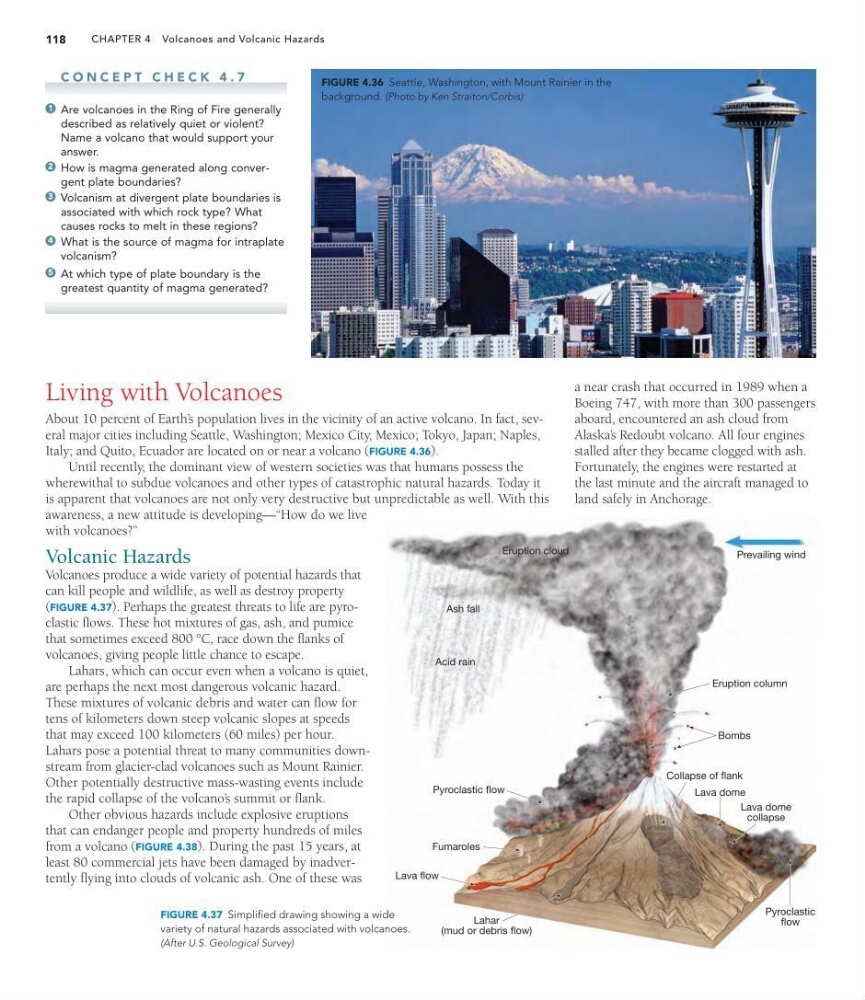
Volcanoes produce a wide variety of potential hazards that
can kill people and wildlife, as well as destroy property
(FIGURE 4.37). Perhaps the greatest threats to life are pyroclastic flows. These hot mixtures of gas, ash, and pumice
that sometimes exceed 800 °C, race down the flanks of
volcanoes, giving people little chance to escape.
Lahars, which can occur even when a volcano is quiet,
are perhaps the next most dangerous volcanic hazard.
These mixtures of volcanic debris and water can flow for
tens of kilometers down steep volcanic slopes at speeds
that may exceed 100 kilometers (60 miles) per hour.
Lahars pose a potential threat to many communities downstream from glacier-clad volcanoes such as Mount Rainier.
Other potentially destructive mass-wasting events include
the rapid collapse of the volcano’ s summit or flank.
Other obvious hazards include explosive eruptions
that can endanger people and property hundreds of miles
from a volcano (FIGURE 4.38). During the past 15 years, at
least 80 commercial jets have been damaged by inadvertently flying into clouds of volcanic ash. One of these was
CHAPTER 4 Volcanoes and Volcanic Hazards
118
FIGURE 4.36 Seattle, Washington, with Mount Rainier in the
background. (Photo by Ken Straiton/Corbis)
Prevailing wind
Eruption cloud
Eruption column
Ash fall
Acid rain
Lava flow
Lahar
(mud or debris flow)
Fumaroles
Pyroclastic flow
Pyroclastic
flow
Bombs
Collapse of flank
Lava dome
Lava dome
collapse
FIGURE 4.37 Simplified drawing showing a wide
variety of natural hazards associated with volcanoes.
(After U.S. Geological Survey)
C O N C E P T C H E C K 4 . 7
Are volcanoes in the Ring of Fire generally
described as relatively quiet or violent?
Name a volcano that would support your
answer.
How is magma generated along convergent plate boundaries?
Volcanism at divergent plate boundaries is
associated with which rock type? What
causes rocks to melt in these regions?
What is the source of magma for intraplate
volcanism?
At which type of plate boundary is the
greatest quantity of magma generated?
5
4
3
2
1
a near crash that occurred in 1989 when a
Boeing 747, with more than 300 passengers
aboard, encountered an ash cloud from
Alaska’ s Redoubt volcano. All four engines
stalled after they became clogged with ash.
Fortunately, the engines were restarted at
the last minute and the aircraft managed to
land safely in Anchorage.
About 10 percent of Earth’ s population lives in the vicinity of an active volcano. In fact, several major cities including Seattle, Washington; Mexico City, Mexico; Tokyo, Japan; Naples,
Italy; and Quito, Ecuador are located on or near a volcano (FIGURE 4.36).
Until recently, the dominant view of western societies was that humans possess the
wherewithal to subdue volcanoes and other types of catastrophic natural hazards. Today it
is apparent that volcanoes are not only very destructive but unpredictable as well. With this
awareness, a new attitude is developing—“How do we live
with volcanoes?”
Volcanic Hazards
Volcanoes produce a wide variety of potential hazards that
can kill people and wildlife, as well as destroy property
(FIGURE 4.37). Perhaps the greatest threats to life are pyroclastic flows. These hot mixtures of gas, ash, and pumice
that sometimes exceed 800 °C, race down the flanks of
volcanoes, giving people little chance to escape.
Lahars, which can occur even when a volcano is quiet,
are perhaps the next most dangerous volcanic hazard.
These mixtures of volcanic debris and water can flow for
tens of kilometers down steep volcanic slopes at speeds
that may exceed 100 kilometers (60 miles) per hour.
Lahars pose a potential threat to many communities downstream from glacier-clad volcanoes such as Mount Rainier.
Other potentially destructive mass-wasting events include
the rapid collapse of the volcano’ s summit or flank.
Other obvious hazards include explosive eruptions
that can endanger people and property hundreds of miles
from a volcano (FIGURE 4.38). During the past 15 years, at
least 80 commercial jets have been damaged by inadvertently flying into clouds of volcanic ash. One of these was
CHAPTER 4 Volcanoes and Volcanic Hazards
118
FIGURE 4.36 Seattle, Washington, with Mount Rainier in the
background. (Photo by Ken Straiton/Corbis)
Prevailing wind
Eruption cloud
Eruption column
Ash fall
Acid rain
Lava flow
Lahar
(mud or debris flow)
Fumaroles
Pyroclastic flow
Pyroclastic
flow
Bombs
Collapse of flank
Lava dome
Lava dome
collapse
FIGURE 4.37 Simplified drawing showing a wide
variety of natural hazards associated with volcanoes.
(After U.S. Geological Survey)
C O N C E P T C H E C K 4 . 7
Are volcanoes in the Ring of Fire generally
described as relatively quiet or violent?
Name a volcano that would support your
answer.
How is magma generated along convergent plate boundaries?
Volcanism at divergent plate boundaries is
associated with which rock type? What
causes rocks to melt in these regions?
What is the source of magma for intraplate
volcanism?
At which type of plate boundary is the
greatest quantity of magma generated?
5
4
3
2
1
a near crash that occurred in 1989 when a
Boeing 747, with more than 300 passengers
aboard, encountered an ash cloud from
Alaska’ s Redoubt volcano. All four engines
stalled after they became clogged with ash.
Fortunately, the engines were restarted at
the last minute and the aircraft managed to
land safely in Anchorage.