

Dike
(along with diamond inclusions) through
150 kilometers of solid rock is exceptional.
This fact accounts for the scarcity of natural
diamonds.
Volcanoes on land are continually being
lowered by weathering and erosion. Cinder
cones are easily eroded because they are
composed of unconsolidated materials.
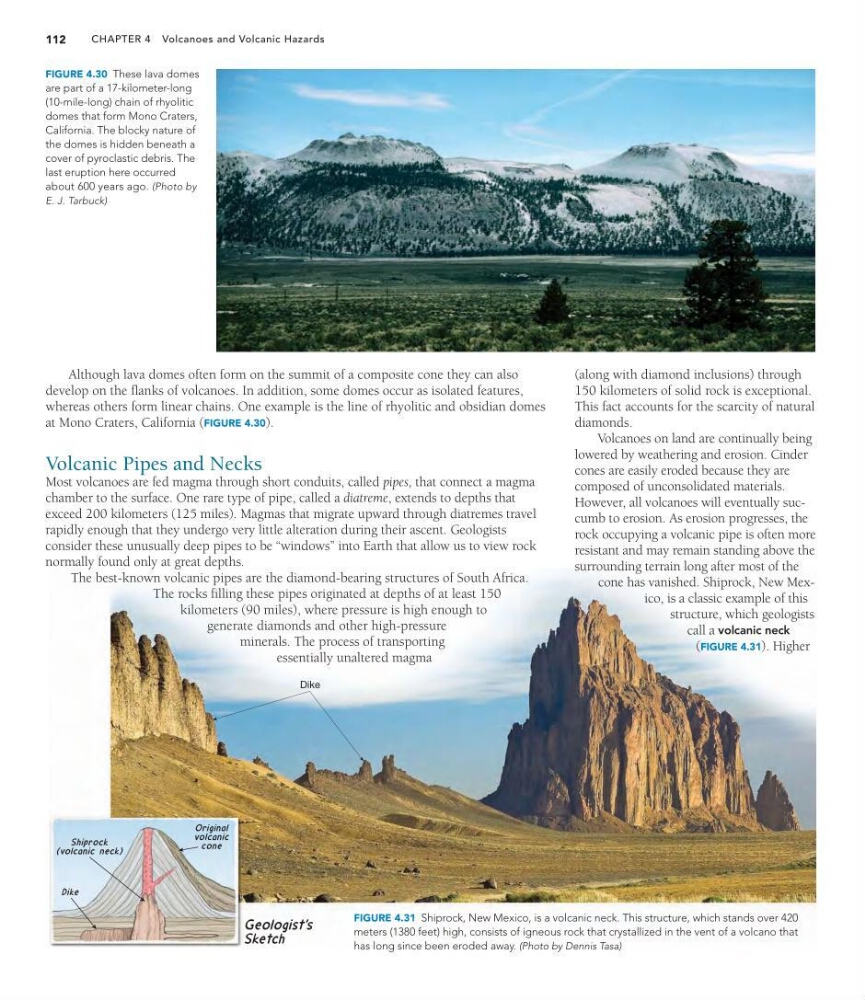
However, all volcanoes will eventually succumb to erosion. As erosion progresses, the
rock occupying a volcanic pipe is often more
resistant and may remain standing above the
surrounding terrain long after most of the
cone has vanished. Shiprock, New Mexico, is a classic example of this
structure, which geologists
call a volcanic neck
(FIGURE 4.31). Higher
Although lava domes often form on the summit of a composite cone they can also
develop on the flanks of volcanoes. In addition, some domes occur as isolated features,
whereas others form linear chains. One example is the line of rhyolitic and obsidian domes
at Mono Craters, California (FIGURE 4.30).
Volcanic Pipes and Necks
Most volcanoes are fed magma through short conduits, called pipes, that connect a magma
chamber to the surface. One rare type of pipe, called a diatreme, extends to depths that
exceed 200 kilometers (125 miles). Magmas that migrate upward through diatremes travel
rapidly enough that they undergo very little alteration during their ascent. Geologists
consider these unusually deep pipes to be “windows” into Earth that allow us to view rock
normally found only at great depths.
The best-known volcanic pipes are the diamond-bearing structures of South Africa.
The rocks filling these pipes originated at depths of at least 150
kilometers (90 miles), where pressure is high enough to
generate diamonds and other high-pressure
minerals. The process of transporting
essentially unaltered magma
CHAPTER 4 Volcanoes and Volcanic Hazards
112
FIGURE 4.30 These lava domes
are part of a 17-kilometer-long
(10-mile-long) chain of rhyolitic
domes that form Mono Craters,
California. The blocky nature of
the domes is hidden beneath a
cover of pyroclastic debris. The
last eruption here occurred
about 600 years ago. (Photo by
E. J. Tarbuck)
FIGURE 4.31 Shiprock, New Mexico, is a volcanic neck. This structure, which stands over 420
meters (1380 feet) high, consists of igneous rock that crystallized in the vent of a volcano that
has long since been eroded away. (Photo by Dennis Tasa)
(along with diamond inclusions) through
150 kilometers of solid rock is exceptional.
This fact accounts for the scarcity of natural
diamonds.
Volcanoes on land are continually being
lowered by weathering and erosion. Cinder
cones are easily eroded because they are
composed of unconsolidated materials.
However, all volcanoes will eventually succumb to erosion. As erosion progresses, the
rock occupying a volcanic pipe is often more
resistant and may remain standing above the
surrounding terrain long after most of the
cone has vanished. Shiprock, New Mexico, is a classic example of this
structure, which geologists
call a volcanic neck
(FIGURE 4.31). Higher
Although lava domes often form on the summit of a composite cone they can also
develop on the flanks of volcanoes. In addition, some domes occur as isolated features,
whereas others form linear chains. One example is the line of rhyolitic and obsidian domes
at Mono Craters, California (FIGURE 4.30).
Volcanic Pipes and Necks
Most volcanoes are fed magma through short conduits, called pipes, that connect a magma
chamber to the surface. One rare type of pipe, called a diatreme, extends to depths that
exceed 200 kilometers (125 miles). Magmas that migrate upward through diatremes travel
rapidly enough that they undergo very little alteration during their ascent. Geologists
consider these unusually deep pipes to be “windows” into Earth that allow us to view rock
normally found only at great depths.
The best-known volcanic pipes are the diamond-bearing structures of South Africa.
The rocks filling these pipes originated at depths of at least 150
kilometers (90 miles), where pressure is high enough to
generate diamonds and other high-pressure
minerals. The process of transporting
essentially unaltered magma
CHAPTER 4 Volcanoes and Volcanic Hazards
112
FIGURE 4.30 These lava domes
are part of a 17-kilometer-long
(10-mile-long) chain of rhyolitic
domes that form Mono Craters,
California. The blocky nature of
the domes is hidden beneath a
cover of pyroclastic debris. The
last eruption here occurred
about 600 years ago. (Photo by
E. J. Tarbuck)
FIGURE 4.31 Shiprock, New Mexico, is a volcanic neck. This structure, which stands over 420
meters (1380 feet) high, consists of igneous rock that crystallized in the vent of a volcano that
has long since been eroded away. (Photo by Dennis Tasa)