

CHAPTER 4 Volcanoes and Volcanic Hazards
110
Unlike calderas associated with shield volcanoes or composite
cones, these depressions are so large and poorly defined that many
remained undetected until high-quality aerial and satellite images
became available. Other examples of large calderas located in the United
States are California’ s Long Valley caldera, LaGarita caldera, located in
the San Juan Mountains of southern Colorado, and the Valles caldera
west of Los Alamos, New Mexico. These and similar calderas found
around the globe are the largest volcanic structures on Earth. Volcanologists have compared their destructive force with that of the impact of a
small asteroid. Fortunately, no eruption of this type has occurred in
historic times.
Fissure Eruptions and Basalt Plateaus
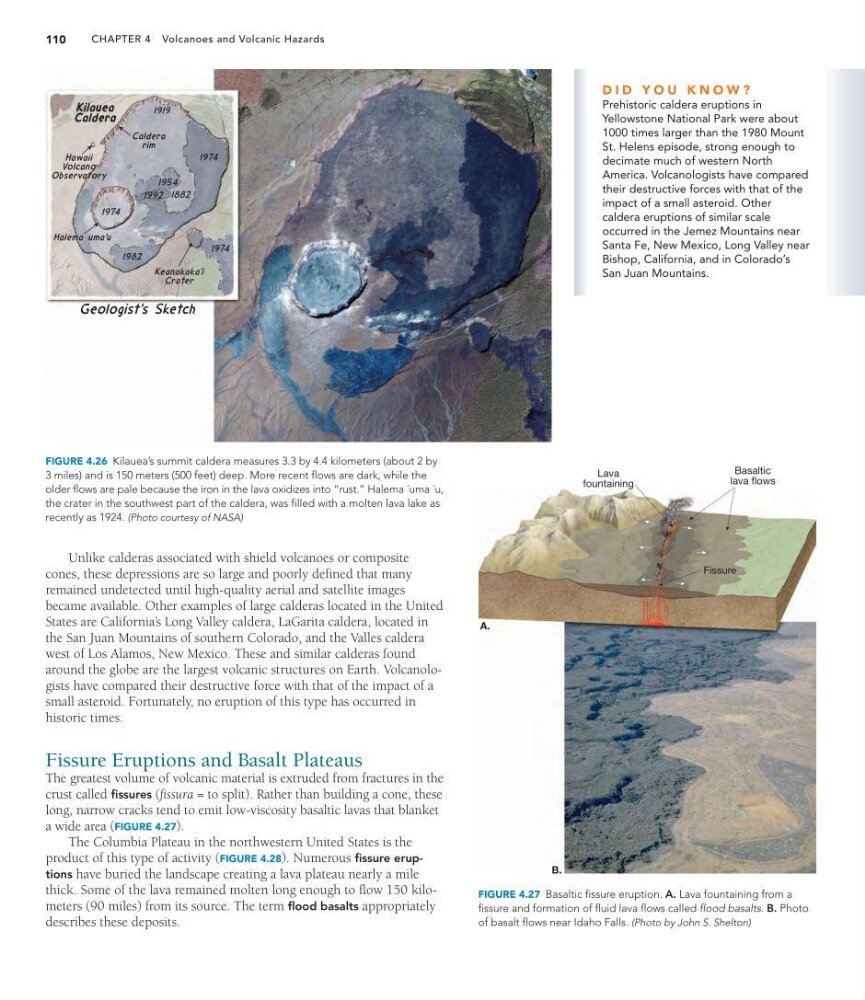
The greatest volume of volcanic material is extruded from fractures in the
crust called fissures (fissura = to split). Rather than building a cone, these
long, narrow cracks tend to emit low-viscosity basaltic lavas that blanket
a wide area (FIGURE 4.27).
The Columbia Plateau in the northwestern United States is the
product of this type of activity (FIGURE 4.28). Numerous fissure eruptions have buried the landscape creating a lava plateau nearly a mile
thick. Some of the lava remained molten long enough to flow 150 kilometers (90 miles) from its source. The term flood basalts appropriately
describes these deposits.
FIGURE 4.26 Kilauea’s summit caldera measures 3.3 by 4.4 kilometers (about 2 by
3 miles) and is 150 meters (500 feet) deep. More recent flows are dark, while the
older flows are pale because the iron in the lava oxidizes into “rust.” Halema ´uma ´u,
the crater in the southwest part of the caldera, was filled with a molten lava lake as
recently as 1924. (Photo courtesy of NASA)
D I D Y O U K N O W ?
Prehistoric caldera eruptions in
Yellowstone National Park were about
1000 times larger than the 1980 Mount
St. Helens episode, strong enough to
decimate much of western North
America. Volcanologists have compared
their destructive forces with that of the
impact of a small asteroid. Other
caldera eruptions of similar scale
occurred in the Jemez Mountains near
Santa Fe, New Mexico, Long Valley near
Bishop, California, and in Colorado’s
San Juan Mountains.
Lava
fountaining
Fissure
Basaltic
lava flows
A.
B.
FIGURE 4.27 Basaltic fissure eruption. A. Lava fountaining from a
fissure and formation of fluid lava flows called flood basalts. B. Photo
of basalt flows near Idaho Falls. (Photo by John S. Shelton)
110
Unlike calderas associated with shield volcanoes or composite
cones, these depressions are so large and poorly defined that many
remained undetected until high-quality aerial and satellite images
became available. Other examples of large calderas located in the United
States are California’ s Long Valley caldera, LaGarita caldera, located in
the San Juan Mountains of southern Colorado, and the Valles caldera
west of Los Alamos, New Mexico. These and similar calderas found
around the globe are the largest volcanic structures on Earth. Volcanologists have compared their destructive force with that of the impact of a
small asteroid. Fortunately, no eruption of this type has occurred in
historic times.
Fissure Eruptions and Basalt Plateaus
The greatest volume of volcanic material is extruded from fractures in the
crust called fissures (fissura = to split). Rather than building a cone, these
long, narrow cracks tend to emit low-viscosity basaltic lavas that blanket
a wide area (FIGURE 4.27).
The Columbia Plateau in the northwestern United States is the
product of this type of activity (FIGURE 4.28). Numerous fissure eruptions have buried the landscape creating a lava plateau nearly a mile
thick. Some of the lava remained molten long enough to flow 150 kilometers (90 miles) from its source. The term flood basalts appropriately
describes these deposits.
FIGURE 4.26 Kilauea’s summit caldera measures 3.3 by 4.4 kilometers (about 2 by
3 miles) and is 150 meters (500 feet) deep. More recent flows are dark, while the
older flows are pale because the iron in the lava oxidizes into “rust.” Halema ´uma ´u,
the crater in the southwest part of the caldera, was filled with a molten lava lake as
recently as 1924. (Photo courtesy of NASA)
D I D Y O U K N O W ?
Prehistoric caldera eruptions in
Yellowstone National Park were about
1000 times larger than the 1980 Mount
St. Helens episode, strong enough to
decimate much of western North
America. Volcanologists have compared
their destructive forces with that of the
impact of a small asteroid. Other
caldera eruptions of similar scale
occurred in the Jemez Mountains near
Santa Fe, New Mexico, Long Valley near
Bishop, California, and in Colorado’s
San Juan Mountains.
Lava
fountaining
Fissure
Basaltic
lava flows
A.
B.
FIGURE 4.27 Basaltic fissure eruption. A. Lava fountaining from a
fissure and formation of fluid lava flows called flood basalts. B. Photo
of basalt flows near Idaho Falls. (Photo by John S. Shelton)