

109
Other Volcanic Landforms
(500 feet) deep (FIGURE 4.26). The walls of
this caldera are almost vertical, and as a
result it looks like a vast, nearly flatbotomed pit. Kilauea’ s caldera formed by
gradual subsidence as magma slowly
drained laterally from the underlying
magma chamber to the East Rift Zone,
leaving the summit unsupported.
YELLOWSTONE-TYPE CALDERAS.
Historic and destructive eruptions such as
Mount St. Helens and Vesuvius pale in
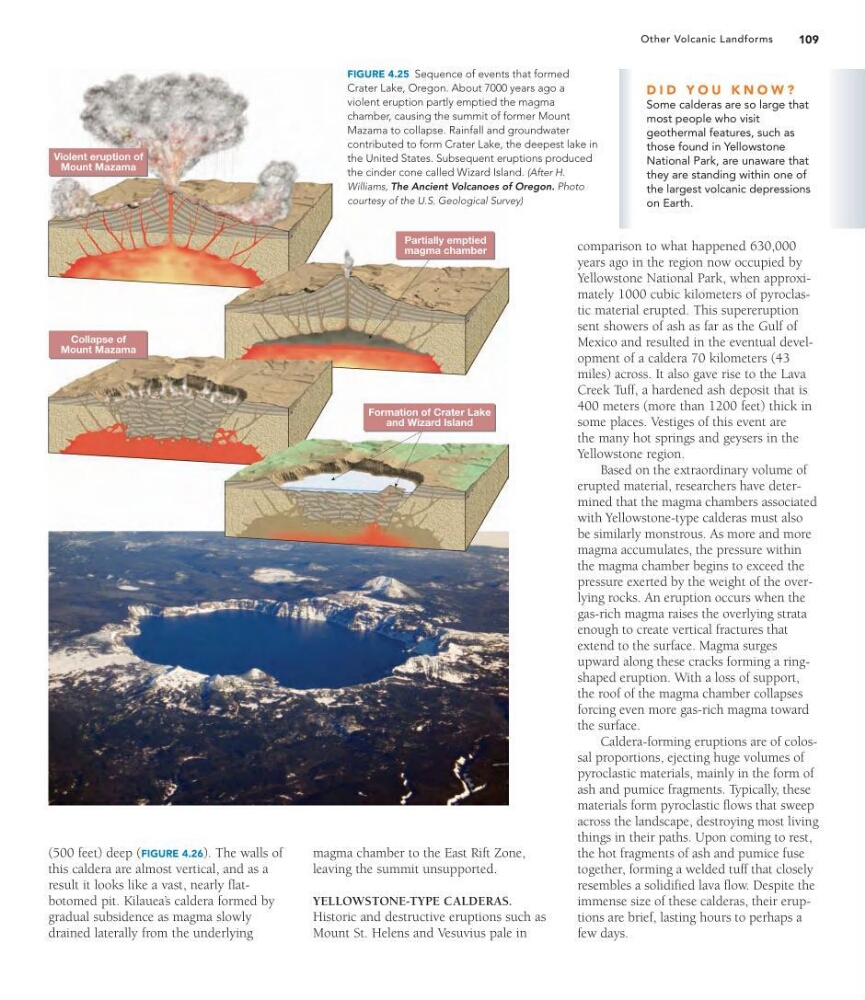
Violent eruption of
Mount Mazama
Partially emptied
magma chamber
Collapse of
Mount Mazama
Formation of Crater Lake
and Wizard Island
FIGURE 4.25 Sequence of events that formed
Crater Lake, Oregon. About 7000 years ago a
violent eruption partly emptied the magma
chamber, causing the summit of former Mount
Mazama to collapse. Rainfall and groundwater
contributed to form Crater Lake, the deepest lake in
the United States. Subsequent eruptions produced
the cinder cone called Wizard Island. (After H.
Williams, The Ancient Volcanoes of Oregon. Photo
courtesy of the U.S. Geological Survey)
D I D Y O U K N O W ?
Some calderas are so large that
most people who visit
geothermal features, such as
those found in Yellowstone
National Park, are unaware that
they are standing within one of
the largest volcanic depressions
on Earth.
comparison to what happened 630,000
years ago in the region now occupied by
Yellowstone National Park, when approximately 1000 cubic kilometers of pyroclastic material erupted. This supereruption
sent showers of ash as far as the Gulf of
Mexico and resulted in the eventual development of a caldera 70 kilometers (43
miles) across. It also gave rise to the Lava
Creek Tuff, a hardened ash deposit that is
400 meters (more than 1200 feet) thick in
some places. Vestiges of this event are
the many hot springs and geysers in the
Yellowstone region.
Based on the extraordinary volume of
erupted material, researchers have determined that the magma chambers associated
with Yellowstone-type calderas must also
be similarly monstrous. As more and more
magma accumulates, the pressure within
the magma chamber begins to exceed the
pressure exerted by the weight of the overlying rocks. An eruption occurs when the
gas-rich magma raises the overlying strata
enough to create vertical fractures that
extend to the surface. Magma surges
upward along these cracks forming a ringshaped eruption. With a loss of support,
the roof of the magma chamber collapses
forcing even more gas-rich magma toward
the surface.
Caldera-forming eruptions are of colossal proportions, ejecting huge volumes of
pyroclastic materials, mainly in the form of
ash and pumice fragments. Typically, these
materials form pyroclastic flows that sweep
across the landscape, destroying most living
things in their paths. Upon coming to rest,
the hot fragments of ash and pumice fuse
together, forming a welded tuff that closely
resembles a solidified lava flow. Despite the
immense size of these calderas, their eruptions are brief, lasting hours to perhaps a
few days.
Other Volcanic Landforms
(500 feet) deep (FIGURE 4.26). The walls of
this caldera are almost vertical, and as a
result it looks like a vast, nearly flatbotomed pit. Kilauea’ s caldera formed by
gradual subsidence as magma slowly
drained laterally from the underlying
magma chamber to the East Rift Zone,
leaving the summit unsupported.
YELLOWSTONE-TYPE CALDERAS.
Historic and destructive eruptions such as
Mount St. Helens and Vesuvius pale in
Violent eruption of
Mount Mazama
Partially emptied
magma chamber
Collapse of
Mount Mazama
Formation of Crater Lake
and Wizard Island
FIGURE 4.25 Sequence of events that formed
Crater Lake, Oregon. About 7000 years ago a
violent eruption partly emptied the magma
chamber, causing the summit of former Mount
Mazama to collapse. Rainfall and groundwater
contributed to form Crater Lake, the deepest lake in
the United States. Subsequent eruptions produced
the cinder cone called Wizard Island. (After H.
Williams, The Ancient Volcanoes of Oregon. Photo
courtesy of the U.S. Geological Survey)
D I D Y O U K N O W ?
Some calderas are so large that
most people who visit
geothermal features, such as
those found in Yellowstone
National Park, are unaware that
they are standing within one of
the largest volcanic depressions
on Earth.
comparison to what happened 630,000
years ago in the region now occupied by
Yellowstone National Park, when approximately 1000 cubic kilometers of pyroclastic material erupted. This supereruption
sent showers of ash as far as the Gulf of
Mexico and resulted in the eventual development of a caldera 70 kilometers (43
miles) across. It also gave rise to the Lava
Creek Tuff, a hardened ash deposit that is
400 meters (more than 1200 feet) thick in
some places. Vestiges of this event are
the many hot springs and geysers in the
Yellowstone region.
Based on the extraordinary volume of
erupted material, researchers have determined that the magma chambers associated
with Yellowstone-type calderas must also
be similarly monstrous. As more and more
magma accumulates, the pressure within
the magma chamber begins to exceed the
pressure exerted by the weight of the overlying rocks. An eruption occurs when the
gas-rich magma raises the overlying strata
enough to create vertical fractures that
extend to the surface. Magma surges
upward along these cracks forming a ringshaped eruption. With a loss of support,
the roof of the magma chamber collapses
forcing even more gas-rich magma toward
the surface.
Caldera-forming eruptions are of colossal proportions, ejecting huge volumes of
pyroclastic materials, mainly in the form of
ash and pumice fragments. Typically, these
materials form pyroclastic flows that sweep
across the landscape, destroying most living
things in their paths. Upon coming to rest,
the hot fragments of ash and pumice fuse
together, forming a welded tuff that closely
resembles a solidified lava flow. Despite the
immense size of these calderas, their eruptions are brief, lasting hours to perhaps a
few days.