

A.
B.
107
One historical record of the eruption states
that some people tied pillows to their heads
in order to fend off the flying fragments.
The rain of pumice continued for several hours, accumulating at the rate of 12 to
15 centimeters (5 to 6 inches) per hour.
Most of the roofs in Pompeii eventually
gave way. Despite the accumulation of more
than 2 meters of pumice, many of the people that had not evacuated Pompeii were
probably still alive the next morning. Then,
suddenly and unexpectedly, a surge of searing hot ash and gas swept rapidly down the
flanks of Vesuvius. This deadly pyroclastic
flow killed an estimated 2000 people who
had somehow managed to survive the
pumice fall. Most died instantly as a result
of inhaling the hot, ash-laden gases. Their
remains were quickly buried by the falling
ash. Rain then caused the ash to become
rock hard before their bodies had time to
decay. The subsequent decomposition of
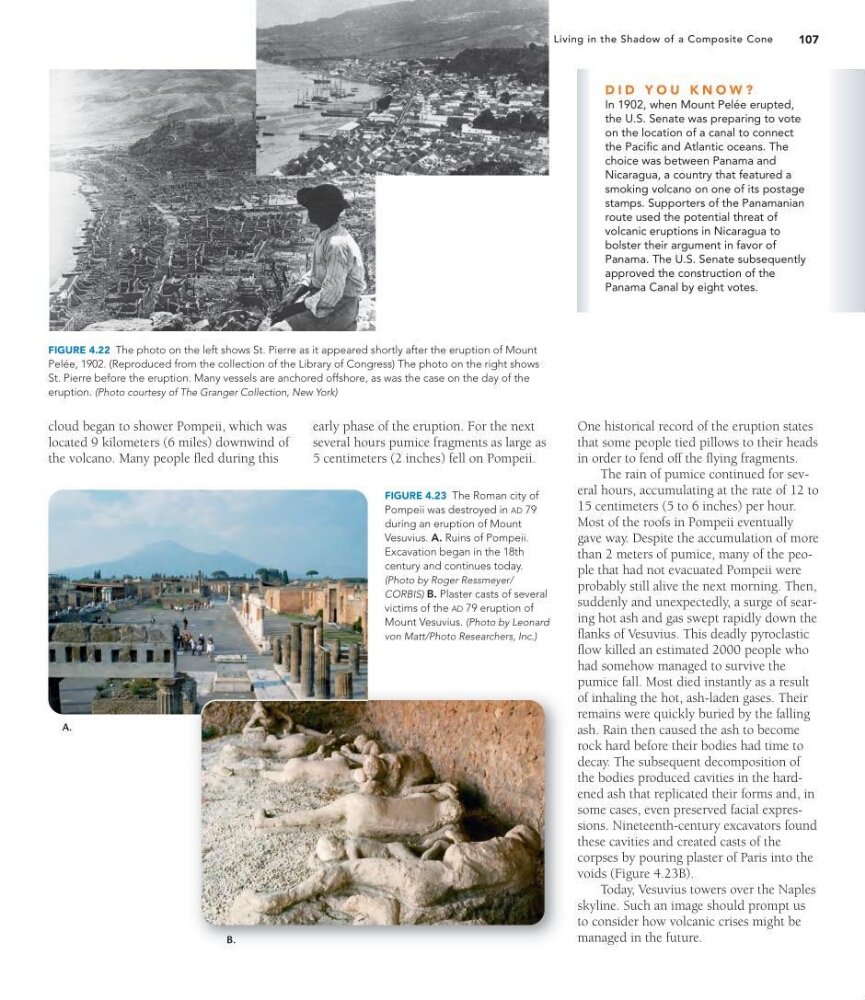
the bodies produced cavities in the hardened ash that replicated their forms and, in
some cases, even preserved facial expressions. Nineteenth-century excavators found
these cavities and created casts of the
corpses by pouring plaster of Paris into the
voids (Figure 4.23B).
Today, Vesuvius towers over the Naples
skyline. Such an image should prompt us
to consider how volcanic crises might be
managed in the future.
FIGURE 4.22 The photo on the left shows St. Pierre as it appeared shortly after the eruption of Mount
Pelée, 1902. (Reproduced from the collection of the Library of Congress) The photo on the right shows
St. Pierre before the eruption. Many vessels are anchored offshore, as was the case on the day of the
eruption. (Photo courtesy of The Granger Collection, New York)
FIGURE 4.23 The Roman city of
Pompeii was destroyed in AD 79
during an eruption of Mount
Vesuvius. A. Ruins of Pompeii.
Excavation began in the 18th
century and continues today.
(Photo by Roger Ressmeyer/
CORBIS) B. Plaster casts of several
victims of the AD 79 eruption of
Mount Vesuvius. (Photo by Leonard
von Matt/Photo Researchers, Inc.)
cloud began to shower Pompeii, which was
located 9 kilometers (6 miles) downwind of
the volcano. Many people fled during this
early phase of the eruption. For the next
several hours pumice fragments as large as
5 centimeters (2 inches) fell on Pompeii.
D I D Y O U K N O W ?
In 1902, when Mount Pelée erupted,
the U.S. Senate was preparing to vote
on the location of a canal to connect
the Pacific and Atlantic oceans. The
choice was between Panama and
Nicaragua, a country that featured a
smoking volcano on one of its postage
stamps. Supporters of the Panamanian
route used the potential threat of
volcanic eruptions in Nicaragua to
bolster their argument in favor of
Panama. The U.S. Senate subsequently
approved the construction of the
Panama Canal by eight votes.
Living in the Shadow of a Composite Cone
B.
107
One historical record of the eruption states
that some people tied pillows to their heads
in order to fend off the flying fragments.
The rain of pumice continued for several hours, accumulating at the rate of 12 to
15 centimeters (5 to 6 inches) per hour.
Most of the roofs in Pompeii eventually
gave way. Despite the accumulation of more
than 2 meters of pumice, many of the people that had not evacuated Pompeii were
probably still alive the next morning. Then,
suddenly and unexpectedly, a surge of searing hot ash and gas swept rapidly down the
flanks of Vesuvius. This deadly pyroclastic
flow killed an estimated 2000 people who
had somehow managed to survive the
pumice fall. Most died instantly as a result
of inhaling the hot, ash-laden gases. Their
remains were quickly buried by the falling
ash. Rain then caused the ash to become
rock hard before their bodies had time to
decay. The subsequent decomposition of
the bodies produced cavities in the hardened ash that replicated their forms and, in
some cases, even preserved facial expressions. Nineteenth-century excavators found
these cavities and created casts of the
corpses by pouring plaster of Paris into the
voids (Figure 4.23B).
Today, Vesuvius towers over the Naples
skyline. Such an image should prompt us
to consider how volcanic crises might be
managed in the future.
FIGURE 4.22 The photo on the left shows St. Pierre as it appeared shortly after the eruption of Mount
Pelée, 1902. (Reproduced from the collection of the Library of Congress) The photo on the right shows
St. Pierre before the eruption. Many vessels are anchored offshore, as was the case on the day of the
eruption. (Photo courtesy of The Granger Collection, New York)
FIGURE 4.23 The Roman city of
Pompeii was destroyed in AD 79
during an eruption of Mount
Vesuvius. A. Ruins of Pompeii.
Excavation began in the 18th
century and continues today.
(Photo by Roger Ressmeyer/
CORBIS) B. Plaster casts of several
victims of the AD 79 eruption of
Mount Vesuvius. (Photo by Leonard
von Matt/Photo Researchers, Inc.)
cloud began to shower Pompeii, which was
located 9 kilometers (6 miles) downwind of
the volcano. Many people fled during this
early phase of the eruption. For the next
several hours pumice fragments as large as
5 centimeters (2 inches) fell on Pompeii.
D I D Y O U K N O W ?
In 1902, when Mount Pelée erupted,
the U.S. Senate was preparing to vote
on the location of a canal to connect
the Pacific and Atlantic oceans. The
choice was between Panama and
Nicaragua, a country that featured a
smoking volcano on one of its postage
stamps. Supporters of the Panamanian
route used the potential threat of
volcanic eruptions in Nicaragua to
bolster their argument in favor of
Panama. The U.S. Senate subsequently
approved the construction of the
Panama Canal by eight votes.
Living in the Shadow of a Composite Cone