

Prevailing
wind
A.
Pyroclastic
flow
Ash fall
Eruption
column
Bombs
CHAPTER 4 Volcanoes and Volcanic Hazards
106
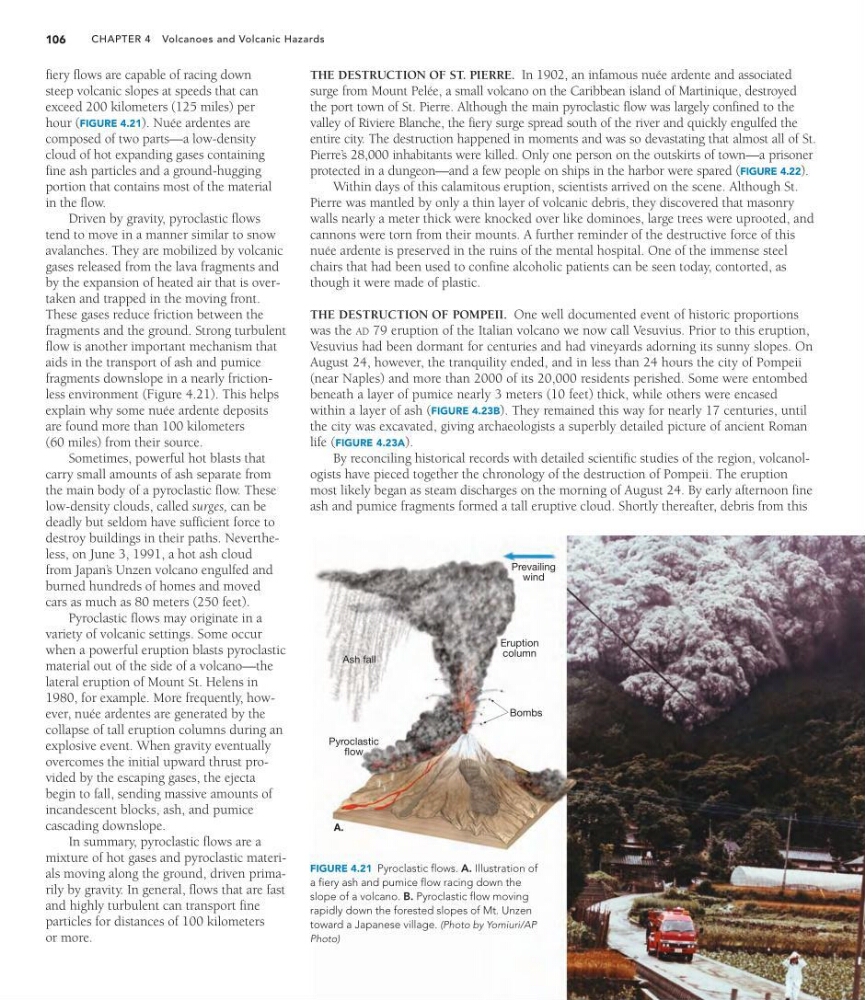
fiery flows are capable of racing down
steep volcanic slopes at speeds that can
exceed 200 kilometers (125 miles) per
hour (FIGURE 4.21). Nuée ardentes are
composed of two parts—a low-density
cloud of hot expanding gases containing
fine ash particles and a ground-hugging
portion that contains most of the material
in the flow.
Driven by gravity, pyroclastic flows
tend to move in a manner similar to snow
avalanches. They are mobilized by volcanic
gases released from the lava fragments and
by the expansion of heated air that is overtaken and trapped in the moving front.
These gases reduce friction between the
fragments and the ground. Strong turbulent
flow is another important mechanism that
aids in the transport of ash and pumice
fragments downslope in a nearly frictionless environment (Figure 4.21). This helps
explain why some nuée ardente deposits
are found more than 100 kilometers
(60 miles) from their source.
Sometimes, powerful hot blasts that
carry small amounts of ash separate from
the main body of a pyroclastic flow. These
low-density clouds, called surges, can be
deadly but seldom have sufficient force to
destroy buildings in their paths. Nevertheless, on June 3, 1991, a hot ash cloud
from Japan’ s Unzen volcano engulfed and
burned hundreds of homes and moved
cars as much as 80 meters (250 feet).
Pyroclastic flows may originate in a
variety of volcanic settings. Some occur
when a powerful eruption blasts pyroclastic
material out of the side of a volcano—the
lateral eruption of Mount St. Helens in
1980, for example. More frequently, however, nuée ardentes are generated by the
collapse of tall eruption columns during an
explosive event. When gravity eventually
overcomes the initial upward thrust provided by the escaping gases, the ejecta
begin to fall, sending massive amounts of
incandescent blocks, ash, and pumice
cascading downslope.
In summary, pyroclastic flows are a
mixture of hot gases and pyroclastic materials moving along the ground, driven primarily by gravity. In general, flows that are fast
and highly turbulent can transport fine
particles for distances of 100 kilometers
or more.
THE DESTRUCTION OF ST. PIERRE. In 1902, an infamous nuée ardente and associated
surge from Mount Pelée, a small volcano on the Caribbean island of Martinique, destroyed
the port town of St. Pierre. Although the main pyroclastic flow was largely confined to the
valley of Riviere Blanche, the fiery surge spread south of the river and quickly engulfed the
entire city. The destruction happened in moments and was so devastating that almost all of St.
Pierre’ s 28,000 inhabitants were killed. Only one person on the outskirts of town—a prisoner
protected in a dungeon—and a few people on ships in the harbor were spared (FIGURE 4.22).
Within days of this calamitous eruption, scientists arrived on the scene. Although St.
Pierre was mantled by only a thin layer of volcanic debris, they discovered that masonry
walls nearly a meter thick were knocked over like dominoes, large trees were uprooted, and
cannons were torn from their mounts. A further reminder of the destructive force of this
nuée ardente is preserved in the ruins of the mental hospital. One of the immense steel
chairs that had been used to confine alcoholic patients can be seen today, contorted, as
though it were made of plastic.
THE DESTRUCTION OF POMPEII. One well documented event of historic proportions
was the AD 79 eruption of the Italian volcano we now call Vesuvius. Prior to this eruption,
Vesuvius had been dormant for centuries and had vineyards adorning its sunny slopes. On
August 24, however, the tranquility ended, and in less than 24 hours the city of Pompeii
(near Naples) and more than 2000 of its 20,000 residents perished. Some were entombed
beneath a layer of pumice nearly 3 meters (10 feet) thick, while others were encased
within a layer of ash (FIGURE 4.23B). They remained this way for nearly 17 centuries, until
the city was excavated, giving archaeologists a superbly detailed picture of ancient Roman
life (FIGURE 4.23A).
By reconciling historical records with detailed scientific studies of the region, volcanologists have pieced together the chronology of the destruction of Pompeii. The eruption
most likely began as steam discharges on the morning of August 24. By early afternoon fine
ash and pumice fragments formed a tall eruptive cloud. Shortly thereafter, debris from this
FIGURE 4.21 Pyroclastic flows. A. Illustration of
a fiery ash and pumice flow racing down the
slope of a volcano. B. Pyroclastic flow moving
rapidly down the forested slopes of Mt. Unzen
toward a Japanese village. (Photo by Yomiuri/AP
Photo)
wind
A.
Pyroclastic
flow
Ash fall
Eruption
column
Bombs
CHAPTER 4 Volcanoes and Volcanic Hazards
106
fiery flows are capable of racing down
steep volcanic slopes at speeds that can
exceed 200 kilometers (125 miles) per
hour (FIGURE 4.21). Nuée ardentes are
composed of two parts—a low-density
cloud of hot expanding gases containing
fine ash particles and a ground-hugging
portion that contains most of the material
in the flow.
Driven by gravity, pyroclastic flows
tend to move in a manner similar to snow
avalanches. They are mobilized by volcanic
gases released from the lava fragments and
by the expansion of heated air that is overtaken and trapped in the moving front.
These gases reduce friction between the
fragments and the ground. Strong turbulent
flow is another important mechanism that
aids in the transport of ash and pumice
fragments downslope in a nearly frictionless environment (Figure 4.21). This helps
explain why some nuée ardente deposits
are found more than 100 kilometers
(60 miles) from their source.
Sometimes, powerful hot blasts that
carry small amounts of ash separate from
the main body of a pyroclastic flow. These
low-density clouds, called surges, can be
deadly but seldom have sufficient force to
destroy buildings in their paths. Nevertheless, on June 3, 1991, a hot ash cloud
from Japan’ s Unzen volcano engulfed and
burned hundreds of homes and moved
cars as much as 80 meters (250 feet).
Pyroclastic flows may originate in a
variety of volcanic settings. Some occur
when a powerful eruption blasts pyroclastic
material out of the side of a volcano—the
lateral eruption of Mount St. Helens in
1980, for example. More frequently, however, nuée ardentes are generated by the
collapse of tall eruption columns during an
explosive event. When gravity eventually
overcomes the initial upward thrust provided by the escaping gases, the ejecta
begin to fall, sending massive amounts of
incandescent blocks, ash, and pumice
cascading downslope.
In summary, pyroclastic flows are a
mixture of hot gases and pyroclastic materials moving along the ground, driven primarily by gravity. In general, flows that are fast
and highly turbulent can transport fine
particles for distances of 100 kilometers
or more.
THE DESTRUCTION OF ST. PIERRE. In 1902, an infamous nuée ardente and associated
surge from Mount Pelée, a small volcano on the Caribbean island of Martinique, destroyed
the port town of St. Pierre. Although the main pyroclastic flow was largely confined to the
valley of Riviere Blanche, the fiery surge spread south of the river and quickly engulfed the
entire city. The destruction happened in moments and was so devastating that almost all of St.
Pierre’ s 28,000 inhabitants were killed. Only one person on the outskirts of town—a prisoner
protected in a dungeon—and a few people on ships in the harbor were spared (FIGURE 4.22).
Within days of this calamitous eruption, scientists arrived on the scene. Although St.
Pierre was mantled by only a thin layer of volcanic debris, they discovered that masonry
walls nearly a meter thick were knocked over like dominoes, large trees were uprooted, and
cannons were torn from their mounts. A further reminder of the destructive force of this
nuée ardente is preserved in the ruins of the mental hospital. One of the immense steel
chairs that had been used to confine alcoholic patients can be seen today, contorted, as
though it were made of plastic.
THE DESTRUCTION OF POMPEII. One well documented event of historic proportions
was the AD 79 eruption of the Italian volcano we now call Vesuvius. Prior to this eruption,
Vesuvius had been dormant for centuries and had vineyards adorning its sunny slopes. On
August 24, however, the tranquility ended, and in less than 24 hours the city of Pompeii
(near Naples) and more than 2000 of its 20,000 residents perished. Some were entombed
beneath a layer of pumice nearly 3 meters (10 feet) thick, while others were encased
within a layer of ash (FIGURE 4.23B). They remained this way for nearly 17 centuries, until
the city was excavated, giving archaeologists a superbly detailed picture of ancient Roman
life (FIGURE 4.23A).
By reconciling historical records with detailed scientific studies of the region, volcanologists have pieced together the chronology of the destruction of Pompeii. The eruption
most likely began as steam discharges on the morning of August 24. By early afternoon fine
ash and pumice fragments formed a tall eruptive cloud. Shortly thereafter, debris from this
FIGURE 4.21 Pyroclastic flows. A. Illustration of
a fiery ash and pumice flow racing down the
slope of a volcano. B. Pyroclastic flow moving
rapidly down the forested slopes of Mt. Unzen
toward a Japanese village. (Photo by Yomiuri/AP
Photo)