

CHAPTER 4 Volcanoes and Volcanic Hazards
102
formed as red-hot lava was ejected skyward
(FIGURE 4.15). When the activity became
localized, a cinder and spatter cone, given
the Hawaiian name Puu Oo, was built. Over
the next 3 years the general eruptive pattern consisted of short periods (hours to
days) when fountains of gas-rich lava
sprayed skyward. Each event was followed
by nearly a month of inactivity.
By the summer of 1986 a new vent
opened 3 kilometers downrift. Here
smooth-surfaced pahoehoe lava formed a
lava lake. Occasionally the lake overflowed,
but more often lava escaped through tunnels to feed flows that moved down the
southeastern flank of the volcano toward
the sea. These flows destroyed nearly a
hundred rural homes, covered a major
roadway, and eventually reached the sea.
Lava has been intermittently pouring into
the ocean ever since, adding new land to
the island of Hawaii.
Cinder Cones
As the name suggests, cinder cones (also
called scoria cones) are built from ejected
lava fragments that take on the appearance
of cinders or clinkers as they begin to
harden in flight (FIGURE 4.16). These pyroclastic fragments range in size from fine ash
to bombs that may exceed a meter in diameter. However, most of the volume of a cinder cone consists of pea- to walnut-sized
lapilli that are markedly vesicular and have
a black to reddish-brown color. (Recall that
these vesicular rock fragments are called
scoria.) Although cinder cones are composed mostly of loose pyroclastic material,
they sometimes extrude lava. On such occasions the discharges most often come from
vents located at or near the base rather than
from the summit crater.
Cinder cones have very simple, distinctive shapes determined by the slope that
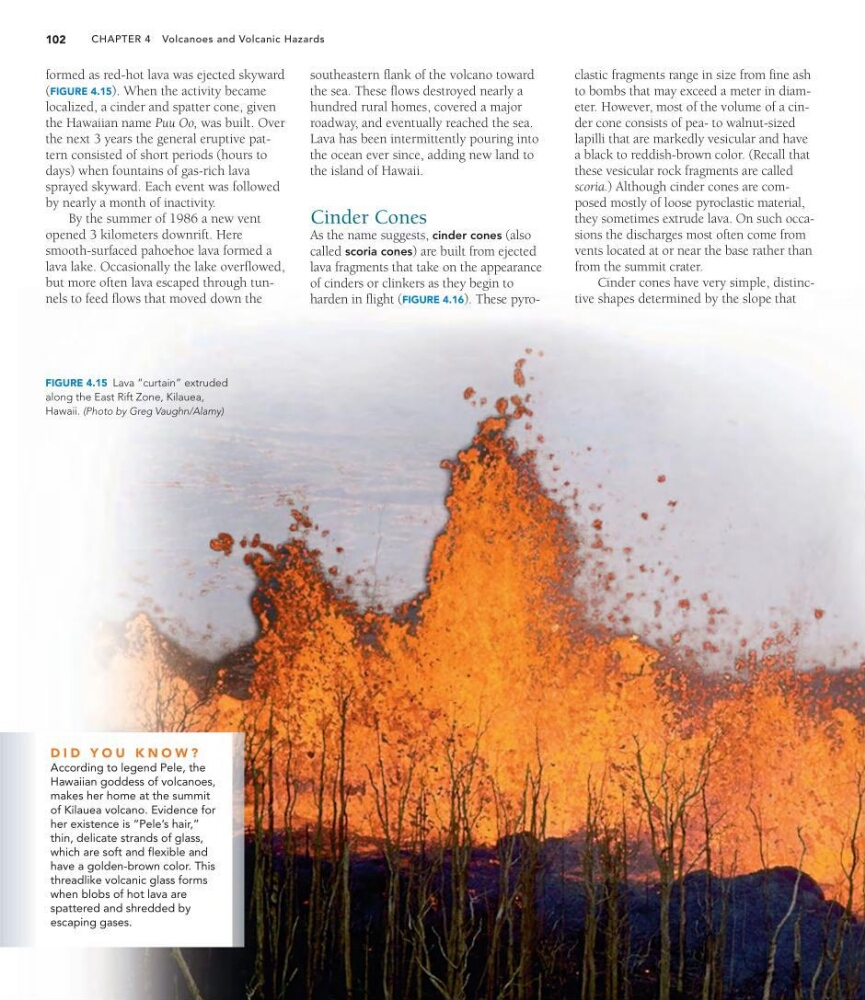
FIGURE 4.15 Lava “curtain” extruded
along the East Rift Zone, Kilauea,
Hawaii. (Photo by Greg Vaughn/Alamy)
D I D Y O U K N O W ?
According to legend Pele, the
Hawaiian goddess of volcanoes,
makes her home at the summit
of Kilauea volcano. Evidence for
her existence is “Pele’s hair,”
thin, delicate strands of glass,
which are soft and flexible and
have a golden-brown color. This
threadlike volcanic glass forms
when blobs of hot lava are
spattered and shredded by
escaping gases.
102
formed as red-hot lava was ejected skyward
(FIGURE 4.15). When the activity became
localized, a cinder and spatter cone, given
the Hawaiian name Puu Oo, was built. Over
the next 3 years the general eruptive pattern consisted of short periods (hours to
days) when fountains of gas-rich lava
sprayed skyward. Each event was followed
by nearly a month of inactivity.
By the summer of 1986 a new vent
opened 3 kilometers downrift. Here
smooth-surfaced pahoehoe lava formed a
lava lake. Occasionally the lake overflowed,
but more often lava escaped through tunnels to feed flows that moved down the
southeastern flank of the volcano toward
the sea. These flows destroyed nearly a
hundred rural homes, covered a major
roadway, and eventually reached the sea.
Lava has been intermittently pouring into
the ocean ever since, adding new land to
the island of Hawaii.
Cinder Cones
As the name suggests, cinder cones (also
called scoria cones) are built from ejected
lava fragments that take on the appearance
of cinders or clinkers as they begin to
harden in flight (FIGURE 4.16). These pyroclastic fragments range in size from fine ash
to bombs that may exceed a meter in diameter. However, most of the volume of a cinder cone consists of pea- to walnut-sized
lapilli that are markedly vesicular and have
a black to reddish-brown color. (Recall that
these vesicular rock fragments are called
scoria.) Although cinder cones are composed mostly of loose pyroclastic material,
they sometimes extrude lava. On such occasions the discharges most often come from
vents located at or near the base rather than
from the summit crater.
Cinder cones have very simple, distinctive shapes determined by the slope that
FIGURE 4.15 Lava “curtain” extruded
along the East Rift Zone, Kilauea,
Hawaii. (Photo by Greg Vaughn/Alamy)
D I D Y O U K N O W ?
According to legend Pele, the
Hawaiian goddess of volcanoes,
makes her home at the summit
of Kilauea volcano. Evidence for
her existence is “Pele’s hair,”
thin, delicate strands of glass,
which are soft and flexible and
have a golden-brown color. This
threadlike volcanic glass forms
when blobs of hot lava are
spattered and shredded by
escaping gases.