

101
Volcanic Structures and Eruptive Styles
H A W A I I
H A W A I I
H A W A I I
A.
B.
Hualalai Hualalai
Kohala Kohala
Mauna Loa
Mauna Loa
Kilauea lauea
Loihi
Mauna Kea
Mauna Kea
Hualalai
Kohala
Mauna Loa
Mauna Loa
Mauna Loa
Mauna Loa
Kilauea
Mauna Kea
Flank eruption
Summit caldera
Magma chamber
Fluid lava flow
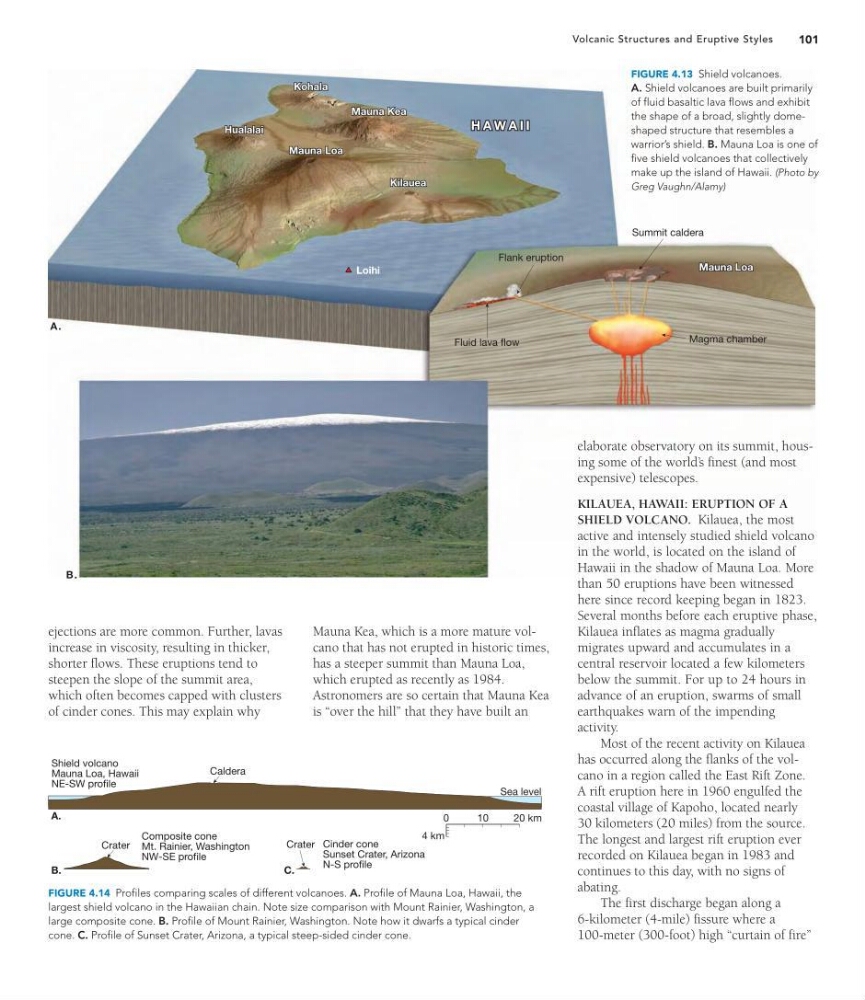
FIGURE 4.13 Shield volcanoes.
A. Shield volcanoes are built primarily
of fluid basaltic lava flows and exhibit
the shape of a broad, slightly domeshaped structure that resembles a
warrior’s shield. B. Mauna Loa is one of
five shield volcanoes that collectively
make up the island of Hawaii. (Photo by
Greg Vaughn/Alamy)
Mauna Kea, which is a more mature volcano that has not erupted in historic times,
has a steeper summit than Mauna Loa,
which erupted as recently as 1984.
Astronomers are so certain that Mauna Kea
is “over the hill” that they have built an
C.
B.
Sea level
A.
20 km
Shield volcano
Mauna Loa, Hawaii
NE-SW profile
Composite cone
Mt. Rainier, Washington
NW-SE profile
Cinder cone
Sunset Crater, Arizona
N-S profile
Caldera
0
1 0
4 km
Crater
Crater
FIGURE 4.14 Profiles comparing scales of different volcanoes. A. Profile of Mauna Loa, Hawaii, the
largest shield volcano in the Hawaiian chain. Note size comparison with Mount Rainier, Washington, a
large composite cone. B. Profile of Mount Rainier, Washington. Note how it dwarfs a typical cinder
cone. C. Profile of Sunset Crater, Arizona, a typical steep-sided cinder cone.
ejections are more common. Further, lavas
increase in viscosity, resulting in thicker,
shorter flows. These eruptions tend to
steepen the slope of the summit area,
which often becomes capped with clusters
of cinder cones. This may explain why
elaborate observatory on its summit, housing some of the world’ s finest (and most
expensive) telescopes.
KILAUEA, HAWAII: ERUPTION OF A
SHIELD VOLCANO. Kilauea, the most
active and intensely studied shield volcano
in the world, is located on the island of
Hawaii in the shadow of Mauna Loa. More
than 50 eruptions have been witnessed
here since record keeping began in 1823.
Several months before each eruptive phase,
Kilauea inflates as magma gradually
migrates upward and accumulates in a
central reservoir located a few kilometers
below the summit. For up to 24 hours in
advance of an eruption, swarms of small
earthquakes warn of the impending
activity.
Most of the recent activity on Kilauea
has occurred along the flanks of the volcano in a region called the East Rift Zone.
A rift eruption here in 1960 engulfed the
coastal village of Kapoho, located nearly
30 kilometers (20 miles) from the source.
The longest and largest rift eruption ever
recorded on Kilauea began in 1983 and
continues to this day, with no signs of
abating.
The first discharge began along a
6-kilometer (4-mile) fissure where a
100-meter (300-foot) high “curtain of fire”
Volcanic Structures and Eruptive Styles
H A W A I I
H A W A I I
H A W A I I
A.
B.
Hualalai Hualalai
Kohala Kohala
Mauna Loa
Mauna Loa
Kilauea lauea
Loihi
Mauna Kea
Mauna Kea
Hualalai
Kohala
Mauna Loa
Mauna Loa
Mauna Loa
Mauna Loa
Kilauea
Mauna Kea
Flank eruption
Summit caldera
Magma chamber
Fluid lava flow
FIGURE 4.13 Shield volcanoes.
A. Shield volcanoes are built primarily
of fluid basaltic lava flows and exhibit
the shape of a broad, slightly domeshaped structure that resembles a
warrior’s shield. B. Mauna Loa is one of
five shield volcanoes that collectively
make up the island of Hawaii. (Photo by
Greg Vaughn/Alamy)
Mauna Kea, which is a more mature volcano that has not erupted in historic times,
has a steeper summit than Mauna Loa,
which erupted as recently as 1984.
Astronomers are so certain that Mauna Kea
is “over the hill” that they have built an
C.
B.
Sea level
A.
20 km
Shield volcano
Mauna Loa, Hawaii
NE-SW profile
Composite cone
Mt. Rainier, Washington
NW-SE profile
Cinder cone
Sunset Crater, Arizona
N-S profile
Caldera
0
1 0
4 km
Crater
Crater
FIGURE 4.14 Profiles comparing scales of different volcanoes. A. Profile of Mauna Loa, Hawaii, the
largest shield volcano in the Hawaiian chain. Note size comparison with Mount Rainier, Washington, a
large composite cone. B. Profile of Mount Rainier, Washington. Note how it dwarfs a typical cinder
cone. C. Profile of Sunset Crater, Arizona, a typical steep-sided cinder cone.
ejections are more common. Further, lavas
increase in viscosity, resulting in thicker,
shorter flows. These eruptions tend to
steepen the slope of the summit area,
which often becomes capped with clusters
of cinder cones. This may explain why
elaborate observatory on its summit, housing some of the world’ s finest (and most
expensive) telescopes.
KILAUEA, HAWAII: ERUPTION OF A
SHIELD VOLCANO. Kilauea, the most
active and intensely studied shield volcano
in the world, is located on the island of
Hawaii in the shadow of Mauna Loa. More
than 50 eruptions have been witnessed
here since record keeping began in 1823.
Several months before each eruptive phase,
Kilauea inflates as magma gradually
migrates upward and accumulates in a
central reservoir located a few kilometers
below the summit. For up to 24 hours in
advance of an eruption, swarms of small
earthquakes warn of the impending
activity.
Most of the recent activity on Kilauea
has occurred along the flanks of the volcano in a region called the East Rift Zone.
A rift eruption here in 1960 engulfed the
coastal village of Kapoho, located nearly
30 kilometers (20 miles) from the source.
The longest and largest rift eruption ever
recorded on Kilauea began in 1983 and
continues to this day, with no signs of
abating.
The first discharge began along a
6-kilometer (4-mile) fissure where a
100-meter (300-foot) high “curtain of fire”