

Ash
Block Block
Bombs
Block
Bombs
Lapilli
(pumice)
A.
B.
C.
CHAPTER 4 Volcanoes and Volcanic Hazards
98
Pyroclastic Materials
When volcanoes erupt energetically they eject pulverized rock, lava, and glass fragments
from the vent. The particles produced are referred to as pyroclastic materials (pyro = fire,
clast = fragment). These fragments range in size from very fine dust and sand-sized volcanic
ash (less than 2 millimeters) to pieces that weigh several tons.
Ash and dust particles are produced when gas-rich viscous magma erupts explosively
(see Figure 4.5). As magma moves up in the vent, the gases rapidly expand, generating a
melt that resembles the froth that flows from a bottle of champagne. As the hot gases
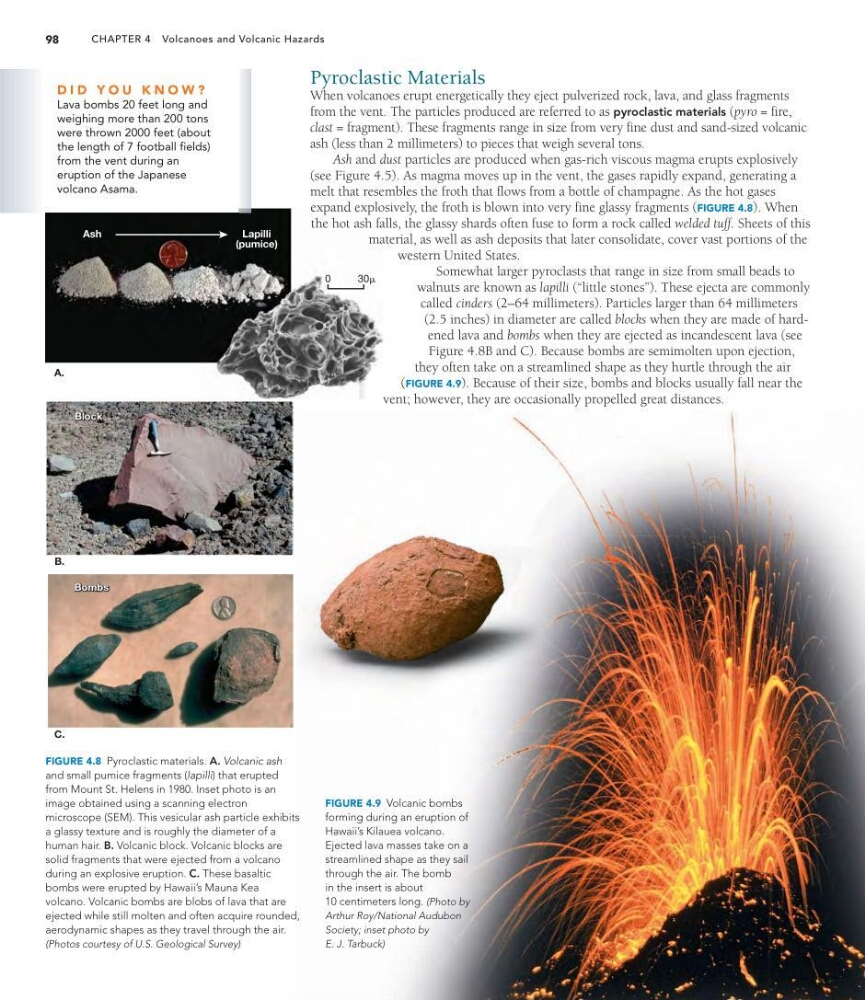
expand explosively, the froth is blown into very fine glassy fragments (FIGURE 4.8). When
the hot ash falls, the glassy shards often fuse to form a rock called welded tuff. Sheets of this
material, as well as ash deposits that later consolidate, cover vast portions of the
western United States.
Somewhat larger pyroclasts that range in size from small beads to
walnuts are known as lapilli (“little stones”). These ejecta are commonly
called cinders (2–64 millimeters). Particles larger than 64 millimeters
(2.5 inches) in diameter are called blocks when they are made of hardened lava and bombs when they are ejected as incandescent lava (see
Figure 4.8B and C). Because bombs are semimolten upon ejection,
they often take on a streamlined shape as they hurtle through the air
(FIGURE 4.9). Because of their size, bombs and blocks usually fall near the
vent; however, they are occasionally propelled great distances.
D I D Y O U K N O W ?
Lava bombs 20 feet long and
weighing more than 200 tons
were thrown 2000 feet (about
the length of 7 football fields)
from the vent during an
eruption of the Japanese
volcano Asama.
FIGURE 4.8 Pyroclastic materials. A. Volcanic ash
and small pumice fragments (lapilli) that erupted
from Mount St. Helens in 1980. Inset photo is an
image obtained using a scanning electron
microscope (SEM). This vesicular ash particle exhibits
a glassy texture and is roughly the diameter of a
human hair. B. Volcanic block. Volcanic blocks are
solid fragments that were ejected from a volcano
during an explosive eruption. C. These basaltic
bombs were erupted by Hawaii’s Mauna Kea
volcano. Volcanic bombs are blobs of lava that are
ejected while still molten and often acquire rounded,
aerodynamic shapes as they travel through the air.
(Photos courtesy of U.S. Geological Survey)
FIGURE 4.9 Volcanic bombs
forming during an eruption of
Hawaii’s Kilauea volcano.
Ejected lava masses take on a
streamlined shape as they sail
through the air. The bomb
in the insert is about
10 centimeters long. (Photo by
Arthur Roy/National Audubon
Society; inset photo by
E. J. Tarbuck)
Block Block
Bombs
Block
Bombs
Lapilli
(pumice)
A.
B.
C.
CHAPTER 4 Volcanoes and Volcanic Hazards
98
Pyroclastic Materials
When volcanoes erupt energetically they eject pulverized rock, lava, and glass fragments
from the vent. The particles produced are referred to as pyroclastic materials (pyro = fire,
clast = fragment). These fragments range in size from very fine dust and sand-sized volcanic
ash (less than 2 millimeters) to pieces that weigh several tons.
Ash and dust particles are produced when gas-rich viscous magma erupts explosively
(see Figure 4.5). As magma moves up in the vent, the gases rapidly expand, generating a
melt that resembles the froth that flows from a bottle of champagne. As the hot gases
expand explosively, the froth is blown into very fine glassy fragments (FIGURE 4.8). When
the hot ash falls, the glassy shards often fuse to form a rock called welded tuff. Sheets of this
material, as well as ash deposits that later consolidate, cover vast portions of the
western United States.
Somewhat larger pyroclasts that range in size from small beads to
walnuts are known as lapilli (“little stones”). These ejecta are commonly
called cinders (2–64 millimeters). Particles larger than 64 millimeters
(2.5 inches) in diameter are called blocks when they are made of hardened lava and bombs when they are ejected as incandescent lava (see
Figure 4.8B and C). Because bombs are semimolten upon ejection,
they often take on a streamlined shape as they hurtle through the air
(FIGURE 4.9). Because of their size, bombs and blocks usually fall near the
vent; however, they are occasionally propelled great distances.
D I D Y O U K N O W ?
Lava bombs 20 feet long and
weighing more than 200 tons
were thrown 2000 feet (about
the length of 7 football fields)
from the vent during an
eruption of the Japanese
volcano Asama.
FIGURE 4.8 Pyroclastic materials. A. Volcanic ash
and small pumice fragments (lapilli) that erupted
from Mount St. Helens in 1980. Inset photo is an
image obtained using a scanning electron
microscope (SEM). This vesicular ash particle exhibits
a glassy texture and is roughly the diameter of a
human hair. B. Volcanic block. Volcanic blocks are
solid fragments that were ejected from a volcano
during an explosive eruption. C. These basaltic
bombs were erupted by Hawaii’s Mauna Kea
volcano. Volcanic bombs are blobs of lava that are
ejected while still molten and often acquire rounded,
aerodynamic shapes as they travel through the air.
(Photos courtesy of U.S. Geological Survey)
FIGURE 4.9 Volcanic bombs
forming during an eruption of
Hawaii’s Kilauea volcano.
Ejected lava masses take on a
streamlined shape as they sail
through the air. The bomb
in the insert is about
10 centimeters long. (Photo by
Arthur Roy/National Audubon
Society; inset photo by
E. J. Tarbuck)