

A.
B.
CHAPTER 4 Volcanoes and Volcanic Hazards
96
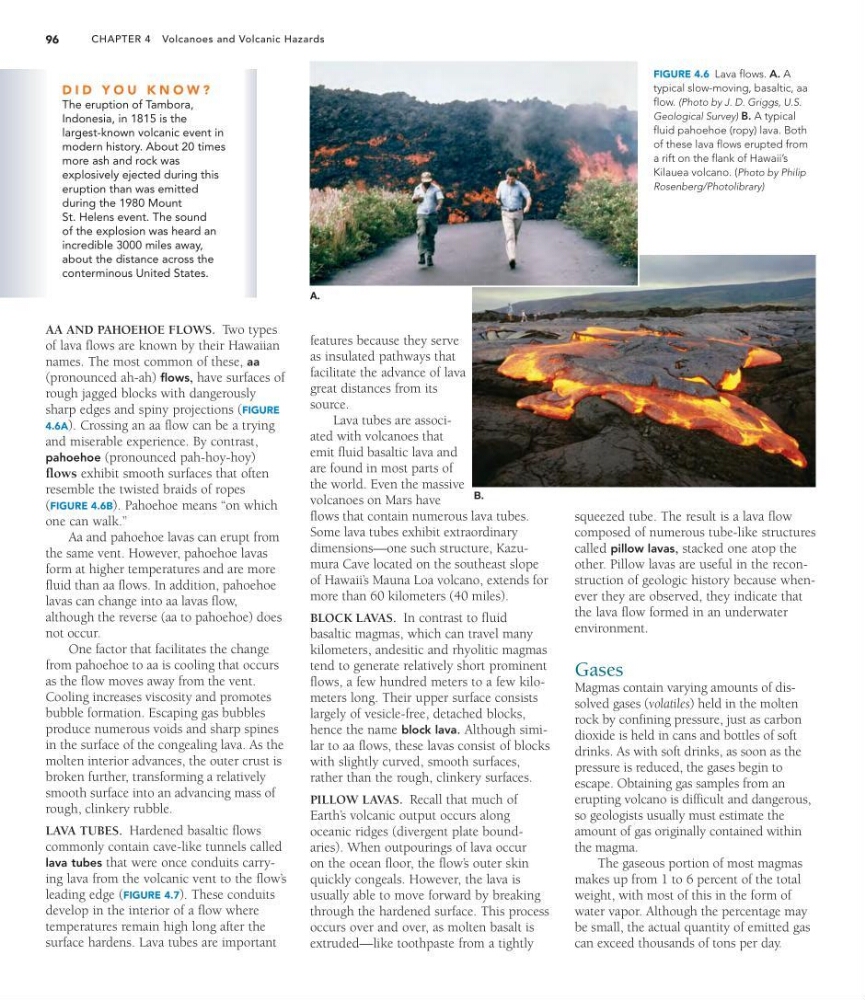
AA AND PAHOEHOE FLOWS. Two types
of lava flows are known by their Hawaiian
names. The most common of these, aa
(pronounced ah-ah) flows, have surfaces of
rough jagged blocks with dangerously
sharp edges and spiny projections (FIGURE
4.6A). Crossing an aa flow can be a trying
and miserable experience. By contrast,
pahoehoe (pronounced pah-hoy-hoy)
flows exhibit smooth surfaces that often
resemble the twisted braids of ropes
(FIGURE 4.6B). Pahoehoe means “on which
one can walk.”
Aa and pahoehoe lavas can erupt from
the same vent. However, pahoehoe lavas
form at higher temperatures and are more
fluid than aa flows. In addition, pahoehoe
lavas can change into aa lavas flow,
although the reverse (aa to pahoehoe) does
not occur.
One factor that facilitates the change
from pahoehoe to aa is cooling that occurs
as the flow moves away from the vent.
Cooling increases viscosity and promotes
bubble formation. Escaping gas bubbles
produce numerous voids and sharp spines
in the surface of the congealing lava. As the
molten interior advances, the outer crust is
broken further, transforming a relatively
smooth surface into an advancing mass of
rough, clinkery rubble.
LAVA TUBES. Hardened basaltic flows
commonly contain cave-like tunnels called
lava tubes that were once conduits carrying lava from the volcanic vent to the flow’ s
leading edge (FIGURE 4.7). These conduits
develop in the interior of a flow where
temperatures remain high long after the
surface hardens. Lava tubes are important
features because they serve
as insulated pathways that
facilitate the advance of lava
great distances from its
source.
Lava tubes are associated with volcanoes that
emit fluid basaltic lava and
are found in most parts of
the world. Even the massive
volcanoes on Mars have
flows that contain numerous lava tubes.
Some lava tubes exhibit extraordinary
dimensions—one such structure, Kazumura Cave located on the southeast slope
of Hawaii’ s Mauna Loa volcano, extends for
more than 60 kilometers (40 miles).
BLOCK LAVAS. In contrast to fluid
basaltic magmas, which can travel many
kilometers, andesitic and rhyolitic magmas
tend to generate relatively short prominent
flows, a few hundred meters to a few kilometers long. Their upper surface consists
largely of vesicle-free, detached blocks,
hence the name block lava. Although similar to aa flows, these lavas consist of blocks
with slightly curved, smooth surfaces,
rather than the rough, clinkery surfaces.
PILLOW LAVAS. Recall that much of
Earth’ s volcanic output occurs along
oceanic ridges (divergent plate boundaries). When outpourings of lava occur
on the ocean floor, the flow’ s outer skin
quickly congeals. However, the lava is
usually able to move forward by breaking
through the hardened surface. This process
occurs over and over, as molten basalt is
extruded—like toothpaste from a tightly
D I D Y O U K N O W ?
The eruption of Tambora,
Indonesia, in 1815 is the
largest-known volcanic event in
modern history. About 20 times
more ash and rock was
explosively ejected during this
eruption than was emitted
during the 1980 Mount
St. Helens event. The sound
of the explosion was heard an
incredible 3000 miles away,
about the distance across the
conterminous United States.
FIGURE 4.6 Lava flows. A. A
typical slow-moving, basaltic, aa
flow. (Photo by J. D. Griggs, U.S.
Geological Survey) B. A typical
fluid pahoehoe (ropy) lava. Both
of these lava flows erupted from
a rift on the flank of Hawaii’s
Kilauea volcano. (Photo by Philip
Rosenberg/Photolibrary)
squeezed tube. The result is a lava flow
composed of numerous tube-like structures
called pillow lavas, stacked one atop the
other. Pillow lavas are useful in the reconstruction of geologic history because whenever they are observed, they indicate that
the lava flow formed in an underwater
environment.
Gases
Magmas contain varying amounts of dissolved gases (volatiles) held in the molten
rock by confining pressure, just as carbon
dioxide is held in cans and bottles of soft
drinks. As with soft drinks, as soon as the
pressure is reduced, the gases begin to
escape. Obtaining gas samples from an
erupting volcano is difficult and dangerous,
so geologists usually must estimate the
amount of gas originally contained within
the magma.
The gaseous portion of most magmas
makes up from 1 to 6 percent of the total
weight, with most of this in the form of
water vapor. Although the percentage may
be small, the actual quantity of emitted gas
can exceed thousands of tons per day.
B.
CHAPTER 4 Volcanoes and Volcanic Hazards
96
AA AND PAHOEHOE FLOWS. Two types
of lava flows are known by their Hawaiian
names. The most common of these, aa
(pronounced ah-ah) flows, have surfaces of
rough jagged blocks with dangerously
sharp edges and spiny projections (FIGURE
4.6A). Crossing an aa flow can be a trying
and miserable experience. By contrast,
pahoehoe (pronounced pah-hoy-hoy)
flows exhibit smooth surfaces that often
resemble the twisted braids of ropes
(FIGURE 4.6B). Pahoehoe means “on which
one can walk.”
Aa and pahoehoe lavas can erupt from
the same vent. However, pahoehoe lavas
form at higher temperatures and are more
fluid than aa flows. In addition, pahoehoe
lavas can change into aa lavas flow,
although the reverse (aa to pahoehoe) does
not occur.
One factor that facilitates the change
from pahoehoe to aa is cooling that occurs
as the flow moves away from the vent.
Cooling increases viscosity and promotes
bubble formation. Escaping gas bubbles
produce numerous voids and sharp spines
in the surface of the congealing lava. As the
molten interior advances, the outer crust is
broken further, transforming a relatively
smooth surface into an advancing mass of
rough, clinkery rubble.
LAVA TUBES. Hardened basaltic flows
commonly contain cave-like tunnels called
lava tubes that were once conduits carrying lava from the volcanic vent to the flow’ s
leading edge (FIGURE 4.7). These conduits
develop in the interior of a flow where
temperatures remain high long after the
surface hardens. Lava tubes are important
features because they serve
as insulated pathways that
facilitate the advance of lava
great distances from its
source.
Lava tubes are associated with volcanoes that
emit fluid basaltic lava and
are found in most parts of
the world. Even the massive
volcanoes on Mars have
flows that contain numerous lava tubes.
Some lava tubes exhibit extraordinary
dimensions—one such structure, Kazumura Cave located on the southeast slope
of Hawaii’ s Mauna Loa volcano, extends for
more than 60 kilometers (40 miles).
BLOCK LAVAS. In contrast to fluid
basaltic magmas, which can travel many
kilometers, andesitic and rhyolitic magmas
tend to generate relatively short prominent
flows, a few hundred meters to a few kilometers long. Their upper surface consists
largely of vesicle-free, detached blocks,
hence the name block lava. Although similar to aa flows, these lavas consist of blocks
with slightly curved, smooth surfaces,
rather than the rough, clinkery surfaces.
PILLOW LAVAS. Recall that much of
Earth’ s volcanic output occurs along
oceanic ridges (divergent plate boundaries). When outpourings of lava occur
on the ocean floor, the flow’ s outer skin
quickly congeals. However, the lava is
usually able to move forward by breaking
through the hardened surface. This process
occurs over and over, as molten basalt is
extruded—like toothpaste from a tightly
D I D Y O U K N O W ?
The eruption of Tambora,
Indonesia, in 1815 is the
largest-known volcanic event in
modern history. About 20 times
more ash and rock was
explosively ejected during this
eruption than was emitted
during the 1980 Mount
St. Helens event. The sound
of the explosion was heard an
incredible 3000 miles away,
about the distance across the
conterminous United States.
FIGURE 4.6 Lava flows. A. A
typical slow-moving, basaltic, aa
flow. (Photo by J. D. Griggs, U.S.
Geological Survey) B. A typical
fluid pahoehoe (ropy) lava. Both
of these lava flows erupted from
a rift on the flank of Hawaii’s
Kilauea volcano. (Photo by Philip
Rosenberg/Photolibrary)
squeezed tube. The result is a lava flow
composed of numerous tube-like structures
called pillow lavas, stacked one atop the
other. Pillow lavas are useful in the reconstruction of geologic history because whenever they are observed, they indicate that
the lava flow formed in an underwater
environment.
Gases
Magmas contain varying amounts of dissolved gases (volatiles) held in the molten
rock by confining pressure, just as carbon
dioxide is held in cans and bottles of soft
drinks. As with soft drinks, as soon as the
pressure is reduced, the gases begin to
escape. Obtaining gas samples from an
erupting volcano is difficult and dangerous,
so geologists usually must estimate the
amount of gas originally contained within
the magma.
The gaseous portion of most magmas
makes up from 1 to 6 percent of the total
weight, with most of this in the form of
water vapor. Although the percentage may
be small, the actual quantity of emitted gas
can exceed thousands of tons per day.