

76
3 PARTICLES, PORES, AND PERMEABILITY
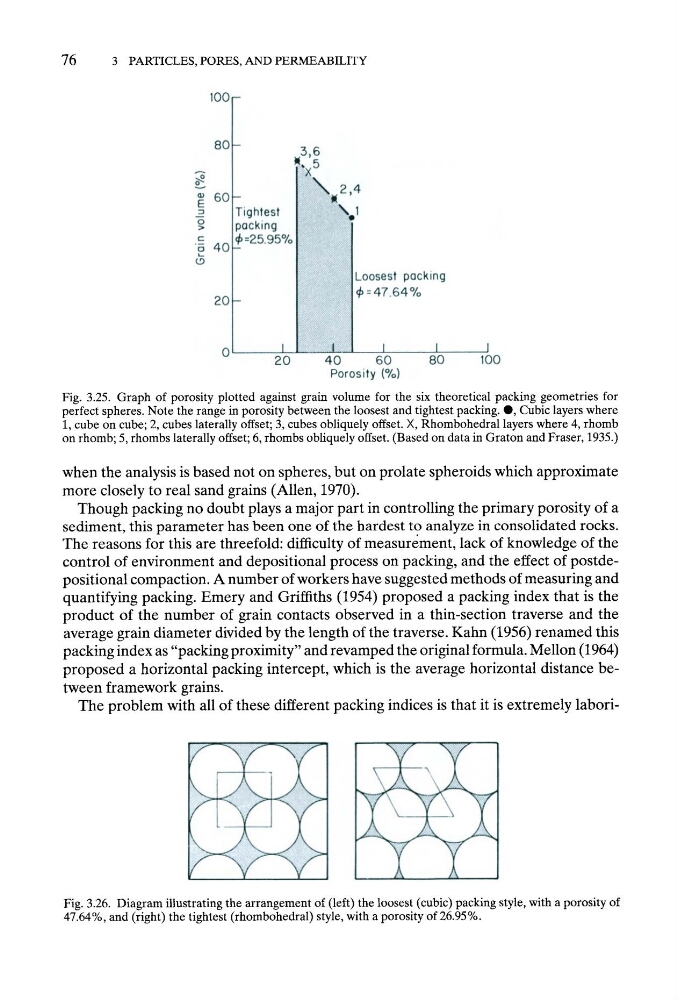
Fig. 3.25. Graph of porosity plotted against grain volume for the six theoretical packing geometries for
perfect spheres. Note the range in porosity between the loosest and tightest packing. O, Cubic layers where
1, cube on cube; 2, cubes laterally offset; 3, cubes obliquely offset. X, Rhombohedral layers where 4, rhomb
on rhomb; 5, rhombs laterally offset; 6, rhombs obliquely offset. (Based on data in Graton and Fraser, 1935.)
when the analysis is based not on spheres, but on prolate spheroids which approximate
more closely to real sand grains (Allen, 1970).
Though packing no doubt plays a major part in controlling the primary porosity of a
sediment, this parameter has been one of the hardest to analyze in consolidated rocks.
The reasons for this are threefold: difficulty of measurement, lack of knowledge of the
control of environment and depositional process on packing, and the effect of postdepositional compaction. A number of workers have suggested methods of measuring and
quantifying packing. Emery and Griffiths (1954) proposed a packing index that is the
product of the number of grain contacts observed in a thin-section traverse and the
average grain diameter divided by the length of the traverse. Kahn (1956) renamed this
packing index as "packing proximity" and revamped the original formula. Mellon (1964)
proposed a horizontal packing intercept, which is the average horizontal distance between framework grains.
The problem with all of these different packing indices is that it is extremely laboriFig. 3.26. Diagram illustrating the arrangement of (left) the loosest (cubic) packing style, with a porosity of
47.64 %, and (right) the tightest (rhombohedral) style, with a porosity of 26.95 %.
3 PARTICLES, PORES, AND PERMEABILITY
Fig. 3.25. Graph of porosity plotted against grain volume for the six theoretical packing geometries for
perfect spheres. Note the range in porosity between the loosest and tightest packing. O, Cubic layers where
1, cube on cube; 2, cubes laterally offset; 3, cubes obliquely offset. X, Rhombohedral layers where 4, rhomb
on rhomb; 5, rhombs laterally offset; 6, rhombs obliquely offset. (Based on data in Graton and Fraser, 1935.)
when the analysis is based not on spheres, but on prolate spheroids which approximate
more closely to real sand grains (Allen, 1970).
Though packing no doubt plays a major part in controlling the primary porosity of a
sediment, this parameter has been one of the hardest to analyze in consolidated rocks.
The reasons for this are threefold: difficulty of measurement, lack of knowledge of the
control of environment and depositional process on packing, and the effect of postdepositional compaction. A number of workers have suggested methods of measuring and
quantifying packing. Emery and Griffiths (1954) proposed a packing index that is the
product of the number of grain contacts observed in a thin-section traverse and the
average grain diameter divided by the length of the traverse. Kahn (1956) renamed this
packing index as "packing proximity" and revamped the original formula. Mellon (1964)
proposed a horizontal packing intercept, which is the average horizontal distance between framework grains.
The problem with all of these different packing indices is that it is extremely laboriFig. 3.26. Diagram illustrating the arrangement of (left) the loosest (cubic) packing style, with a porosity of
47.64 %, and (right) the tightest (rhombohedral) style, with a porosity of 26.95 %.