

3.2 POROSITY AND PERMEABILITY
77
ous to measure large enough samples, and sufficient specimens, to produce enough data
to manipulate. Furthermore, these measures of packing are determined from lithified
thin sections. It is possible to impregnate and thin section unconsolidated sand, but it is
unlikely that this can be done without disturbing the original packing. In addition, Morrow (1971) has pointed out how the packing of a sediment fabric will change from type
to type within and between adjacent laminae. Because of these problems little is known
of the relationship between packing and primary depositional porosity.
Intuitively one might expect pelagic muds, turbidites, and grain flows to be deposited
with a looser packing than traction deposits. Perhaps cross-bedded sands tend to be
more loosely packed than flat-bedded sand. There are few data to support these speculations. Pryor (1973) has shown that modern river sands are more loosely packed than
beach and eolian dunes. The fact is that postdepositional compaction so modifies sand
grains that packing can have little influence on the porosity of lithified sediment (Lundegard, 1992).
Grain orientation. The orientation of sediment particles is generally discussed with reference to the axis of sediment transport (the flow direction) and to the horizontal plane.
The orientation of pebble fabrics is tolerably well known because their large size makes
them relatively easy to measure. Sand-grain orientation has, until recently, been less well
understood, possibly because it is more complex, but probably because it is harder to
measure and quantify.
One of the most common features of gravel fabrics is "imbrication" in which the
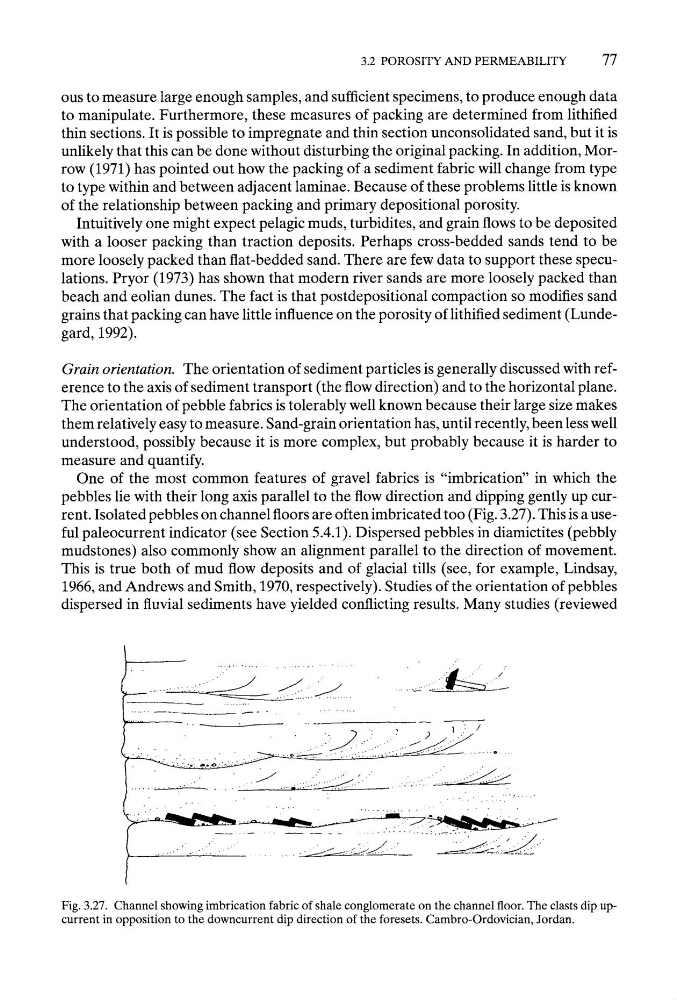
pebbles lie with their long axis parallel to the flow direction and dipping gently up current. Isolated pebbles on channel floors are often imbricated too (Fig. 3.27). This is a useful paleocurrent indicator (see Section 5.4.1). Dispersed pebbles in diamictites (pebbly
mudstones) also commonly show an alignment parallel to the direction of movement.
This is true both of mud flow deposits and of glacial tills (see, for example, Lindsay,
1966, and Andrews and Smith, 1970, respectively). Studies of the orientation of pebbles
dispersed in fluvial sediments have yielded conflicting results. Many studies (reviewed
[
Fig. 3.27. Channel showing imbrication fabric of shale conglomerate on the channel floor. The clasts dip upcurrent in opposition to the downcurrent dip direction of the foresets. Cambro-Ordovician, Jordan.
77
ous to measure large enough samples, and sufficient specimens, to produce enough data
to manipulate. Furthermore, these measures of packing are determined from lithified
thin sections. It is possible to impregnate and thin section unconsolidated sand, but it is
unlikely that this can be done without disturbing the original packing. In addition, Morrow (1971) has pointed out how the packing of a sediment fabric will change from type
to type within and between adjacent laminae. Because of these problems little is known
of the relationship between packing and primary depositional porosity.
Intuitively one might expect pelagic muds, turbidites, and grain flows to be deposited
with a looser packing than traction deposits. Perhaps cross-bedded sands tend to be
more loosely packed than flat-bedded sand. There are few data to support these speculations. Pryor (1973) has shown that modern river sands are more loosely packed than
beach and eolian dunes. The fact is that postdepositional compaction so modifies sand
grains that packing can have little influence on the porosity of lithified sediment (Lundegard, 1992).
Grain orientation. The orientation of sediment particles is generally discussed with reference to the axis of sediment transport (the flow direction) and to the horizontal plane.
The orientation of pebble fabrics is tolerably well known because their large size makes
them relatively easy to measure. Sand-grain orientation has, until recently, been less well
understood, possibly because it is more complex, but probably because it is harder to
measure and quantify.
One of the most common features of gravel fabrics is "imbrication" in which the
pebbles lie with their long axis parallel to the flow direction and dipping gently up current. Isolated pebbles on channel floors are often imbricated too (Fig. 3.27). This is a useful paleocurrent indicator (see Section 5.4.1). Dispersed pebbles in diamictites (pebbly
mudstones) also commonly show an alignment parallel to the direction of movement.
This is true both of mud flow deposits and of glacial tills (see, for example, Lindsay,
1966, and Andrews and Smith, 1970, respectively). Studies of the orientation of pebbles
dispersed in fluvial sediments have yielded conflicting results. Many studies (reviewed
[
Fig. 3.27. Channel showing imbrication fabric of shale conglomerate on the channel floor. The clasts dip upcurrent in opposition to the downcurrent dip direction of the foresets. Cambro-Ordovician, Jordan.