

3.2 POROSITY AND PERMEABILITY
75
2"i
-
; '1~ MEDIUI~
"' ,.
'
104
E
, ~r~ FINE
>"/' i
10 3
-----.
i
rn
i
<
G RAIN SIZI"
I j
~
0 2
rr 1
U.!
10
0.1
0
10
20
30
40
50
POROSITY % BV
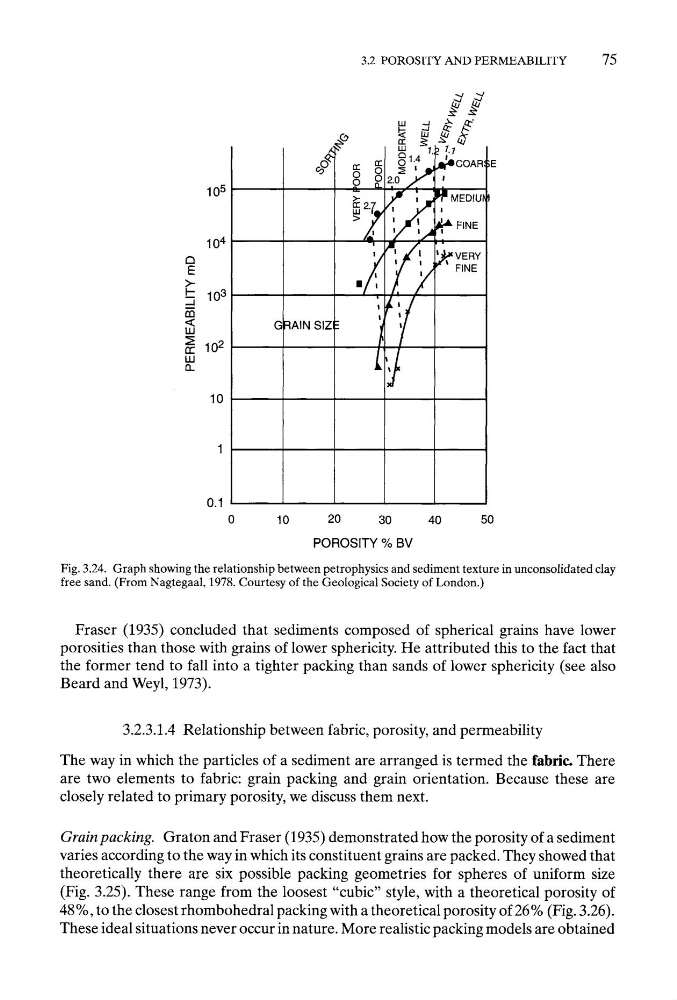
Fig. 3.24. Graph showing the relationship between petrophysics and sediment texture in unconsolidated clay
free sand. (From Nagtegaal, 1978. Courtesy of the Geological Society of London.)
Fraser (1935) concluded that sediments composed of spherical grains have lower
porosities than those with grains of lower sphericity. He attributed this to the fact that
the former tend to fall into a tighter packing than sands of lower sphericity (see also
Beard and Weyl, 1973).
3.2.3.1.4 Relationship between fabric, porosity, and permeability
The way in which the particles of a sediment are arranged is termed the fabric. There
are two elements to fabric: grain packing and grain orientation. Because these are
closely related to primary porosity, we discuss them next.
Grain packing. Graton and Fraser (1935) demonstrated how the porosity of a sediment
varies according to the way in which its constituent grains are packed. They showed that
theoretically there are six possible packing geometries for spheres of uniform size
(Fig. 3.25). These range from the loosest "cubic" style, with a theoretical porosity of
48%, to the closest rhombohedral packing with a theoretical porosity of 26 % (Fig. 3.26).
These ideal situations never occur in nature. More realistic packing models are obtained
75
2"i
-
; '1~ MEDIUI~
"' ,.
'
104
E
, ~r~ FINE
>"/' i
10 3
-----.
i
rn
i
<
G RAIN SIZI"
I j
~
0 2
rr 1
U.!
10
0.1
0
10
20
30
40
50
POROSITY % BV
Fig. 3.24. Graph showing the relationship between petrophysics and sediment texture in unconsolidated clay
free sand. (From Nagtegaal, 1978. Courtesy of the Geological Society of London.)
Fraser (1935) concluded that sediments composed of spherical grains have lower
porosities than those with grains of lower sphericity. He attributed this to the fact that
the former tend to fall into a tighter packing than sands of lower sphericity (see also
Beard and Weyl, 1973).
3.2.3.1.4 Relationship between fabric, porosity, and permeability
The way in which the particles of a sediment are arranged is termed the fabric. There
are two elements to fabric: grain packing and grain orientation. Because these are
closely related to primary porosity, we discuss them next.
Grain packing. Graton and Fraser (1935) demonstrated how the porosity of a sediment
varies according to the way in which its constituent grains are packed. They showed that
theoretically there are six possible packing geometries for spheres of uniform size
(Fig. 3.25). These range from the loosest "cubic" style, with a theoretical porosity of
48%, to the closest rhombohedral packing with a theoretical porosity of 26 % (Fig. 3.26).
These ideal situations never occur in nature. More realistic packing models are obtained