

3.1 PHYSICAL PROPERTIES OF PARTICLES
47
Plane of
thin section
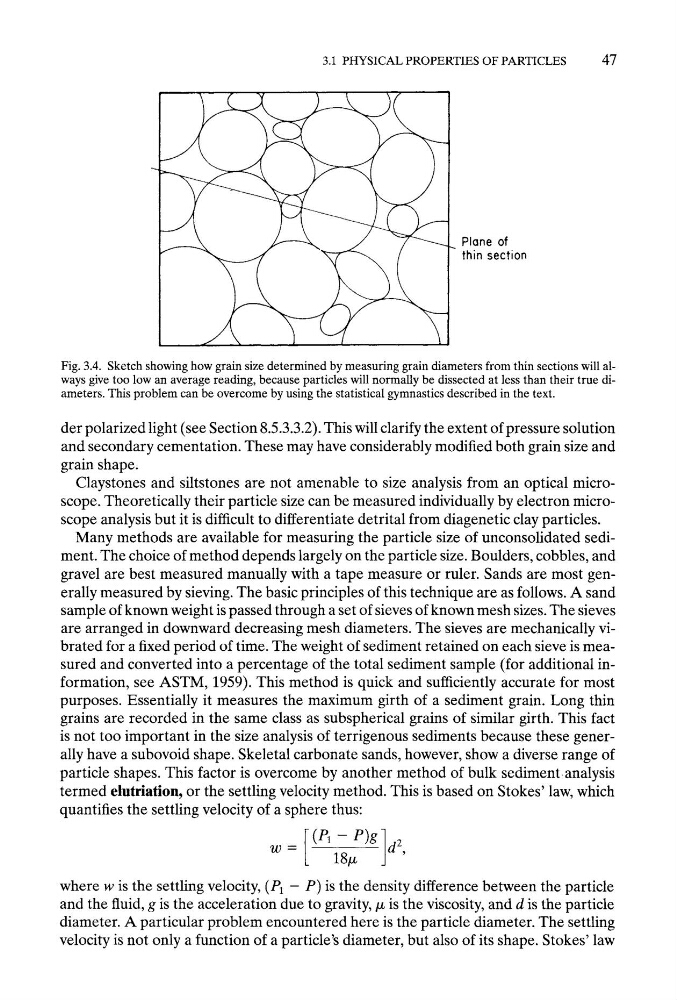
Fig. 3.4. Sketch showing how grain size determined by measuring grain diameters from thin sections will always give too low an average reading, because particles will normally be dissected at less than their true diameters. This problem can be overcome by using the statistical gymnastics described in the text.
der polarized light (see Section 8.5.3.3.2). This will clarify the extent of pressure solution
and secondary cementation. These may have considerably modified both grain size and
grain shape.
Claystones and siltstones are not amenable to size analysis from an optical microscope. Theoretically their particle size can be measured individually by electron microscope analysis but it is difficult to differentiate detrital from diagenetic clay particles.
Many methods are available for measuring the particle size of unconsolidated sediment. The choice of method depends largely on the particle size. Boulders, cobbles, and
gravel are best measured manually with a tape measure or ruler. Sands are most generally measured by sieving. The basic principles of this technique are as follows. A sand
sample of known weight is passed through a set of sieves of known mesh sizes. The sieves
are arranged in downward decreasing mesh diameters. The sieves are mechanically vibrated for a fixed period of time. The weight of sediment retained on each sieve is measured and converted into a percentage of the total sediment sample (for additional information, see ASTM, 1959). This method is quick and sufficiently accurate for most
purposes. Essentially it measures the maximum girth of a sediment grain. Long thin
grains are recorded in the same class as subspherical grains of similar girth. This fact
is not too important in the size analysis of terrigenous sediments because these generally have a subovoid shape. Skeletal carbonate sands, however, show a diverse range of
particle shapes. This factor is overcome by another method of bulk sediment,analysis
termed elutriation, or the settling velocity method. This is based on Stokes' law, which
quantifies the settling velocity of a sphere thus:
'W =
18/2,
d2'
where w is the settling velocity, (P1 - P) is the density difference between the particle
and the fluid, g is the acceleration due to gravity,/z is the viscosity, and d is the particle
diameter. A particular problem encountered here is the particle diameter. The settling
velocity is not only a function of a particle's diameter, but also of its shape. Stokes' law
47
Plane of
thin section
Fig. 3.4. Sketch showing how grain size determined by measuring grain diameters from thin sections will always give too low an average reading, because particles will normally be dissected at less than their true diameters. This problem can be overcome by using the statistical gymnastics described in the text.
der polarized light (see Section 8.5.3.3.2). This will clarify the extent of pressure solution
and secondary cementation. These may have considerably modified both grain size and
grain shape.
Claystones and siltstones are not amenable to size analysis from an optical microscope. Theoretically their particle size can be measured individually by electron microscope analysis but it is difficult to differentiate detrital from diagenetic clay particles.
Many methods are available for measuring the particle size of unconsolidated sediment. The choice of method depends largely on the particle size. Boulders, cobbles, and
gravel are best measured manually with a tape measure or ruler. Sands are most generally measured by sieving. The basic principles of this technique are as follows. A sand
sample of known weight is passed through a set of sieves of known mesh sizes. The sieves
are arranged in downward decreasing mesh diameters. The sieves are mechanically vibrated for a fixed period of time. The weight of sediment retained on each sieve is measured and converted into a percentage of the total sediment sample (for additional information, see ASTM, 1959). This method is quick and sufficiently accurate for most
purposes. Essentially it measures the maximum girth of a sediment grain. Long thin
grains are recorded in the same class as subspherical grains of similar girth. This fact
is not too important in the size analysis of terrigenous sediments because these generally have a subovoid shape. Skeletal carbonate sands, however, show a diverse range of
particle shapes. This factor is overcome by another method of bulk sediment,analysis
termed elutriation, or the settling velocity method. This is based on Stokes' law, which
quantifies the settling velocity of a sphere thus:
'W =
18/2,
d2'
where w is the settling velocity, (P1 - P) is the density difference between the particle
and the fluid, g is the acceleration due to gravity,/z is the viscosity, and d is the particle
diameter. A particular problem encountered here is the particle diameter. The settling
velocity is not only a function of a particle's diameter, but also of its shape. Stokes' law