

10.2 SEDIMENTARY BASINS CLASSIFIED AND DESCRIBED
481
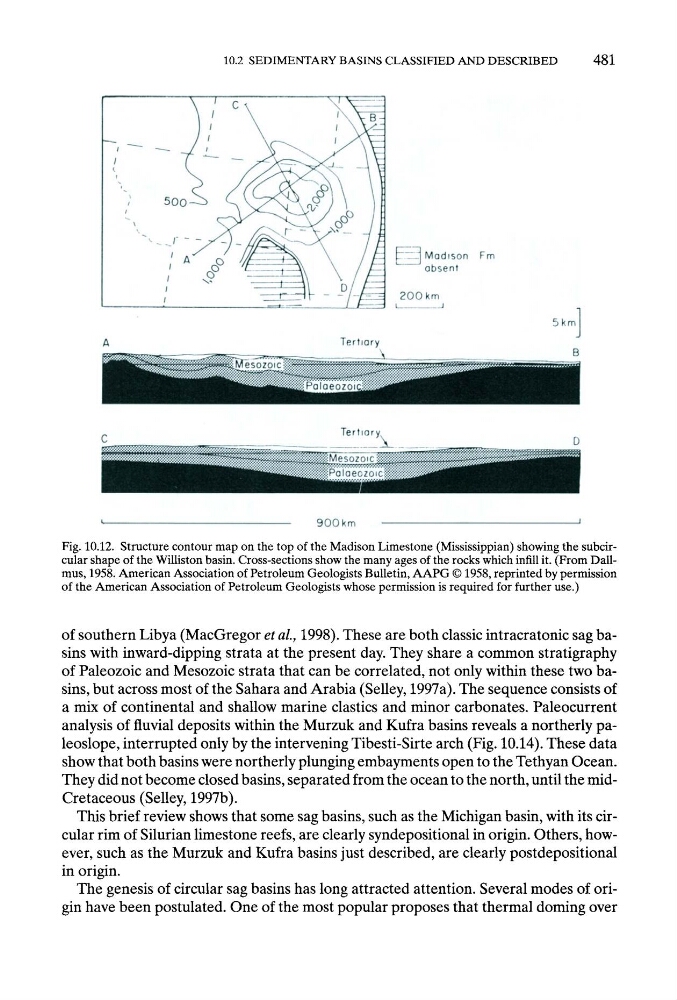
Fig. 10.12. Structure contour map on the top of the Madison Limestone (Mississippian) showing the subcircular shape of the Williston basin. Cross-sections show the many ages of the rocks which infill it. (From Dallmus, 1958. American Association of Petroleum Geologists Bulletin, AAPG 9 1958, reprinted by permission
of the American Association of Petroleum Geologists whose permission is required for further use.)
of southern Libya (MacGregor et al., 1998). These are both classic intracratonic sag basins with inward-dipping strata at the present day. They share a common stratigraphy
of Paleozoic and Mesozoic strata that can be correlated, not only within these two basins, but across most of the Sahara and Arabia (Selley, 1997a). The sequence consists of
a mix of continental and shallow marine clastics and minor carbonates. Paleocurrent
analysis of fluvial deposits within the Murzuk and Kufra basins reveals a northerly paleoslope, interrupted only by the intervening Tibesti-Sirte arch (Fig. 10.14). These data
show that both basins were northerly plunging embayments open to the Tethyan Ocean.
They did not become closed basins, separated from the ocean to the north, until the midCretaceous (Selley, 1997b).
This brief review shows that some sag basins, such as the Michigan basin, with its circular rim of Silurian limestone reefs, are clearly syndepositional in origin. Others, however, such as the Murzuk and Kufra basins just described, are clearly postdepositional
in origin.
The genesis of circular sag basins has long attracted attention. Several modes of origin have been postulated. One of the most popular proposes that thermal doming over
481
Fig. 10.12. Structure contour map on the top of the Madison Limestone (Mississippian) showing the subcircular shape of the Williston basin. Cross-sections show the many ages of the rocks which infill it. (From Dallmus, 1958. American Association of Petroleum Geologists Bulletin, AAPG 9 1958, reprinted by permission
of the American Association of Petroleum Geologists whose permission is required for further use.)
of southern Libya (MacGregor et al., 1998). These are both classic intracratonic sag basins with inward-dipping strata at the present day. They share a common stratigraphy
of Paleozoic and Mesozoic strata that can be correlated, not only within these two basins, but across most of the Sahara and Arabia (Selley, 1997a). The sequence consists of
a mix of continental and shallow marine clastics and minor carbonates. Paleocurrent
analysis of fluvial deposits within the Murzuk and Kufra basins reveals a northerly paleoslope, interrupted only by the intervening Tibesti-Sirte arch (Fig. 10.14). These data
show that both basins were northerly plunging embayments open to the Tethyan Ocean.
They did not become closed basins, separated from the ocean to the north, until the midCretaceous (Selley, 1997b).
This brief review shows that some sag basins, such as the Michigan basin, with its circular rim of Silurian limestone reefs, are clearly syndepositional in origin. Others, however, such as the Murzuk and Kufra basins just described, are clearly postdepositional
in origin.
The genesis of circular sag basins has long attracted attention. Several modes of origin have been postulated. One of the most popular proposes that thermal doming over