

480
lO SEDIMENTARY BASINS
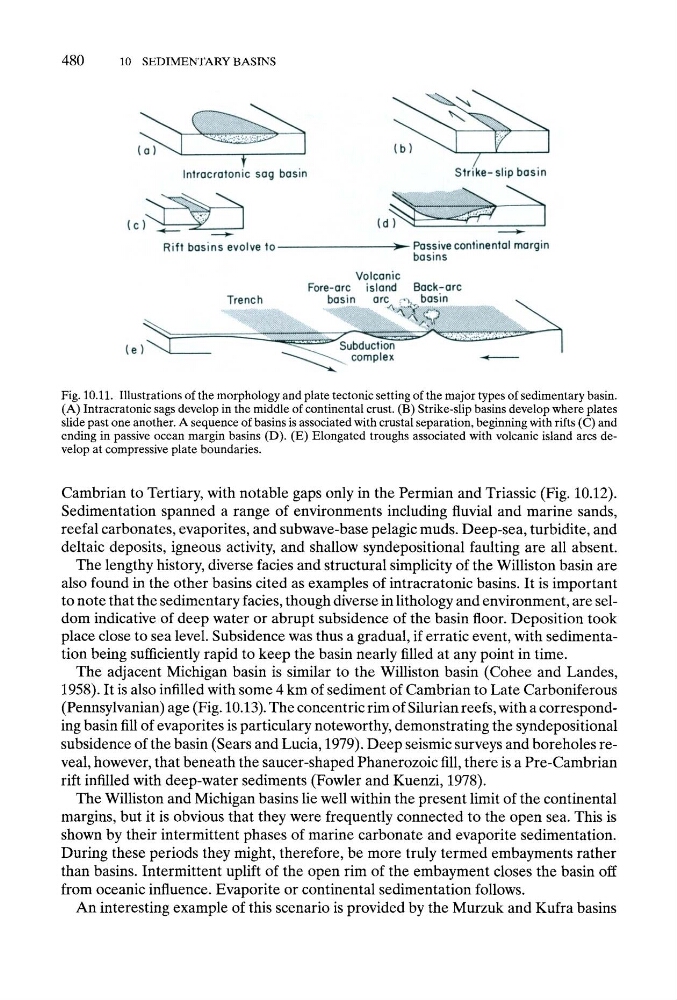
Fig. 10.11. Illustrations of the morphology and plate tectonic setting of the major types of sedimentary basin.
(A) Intracratonic sags develop in the middle of continental crust. (B) Strike-slip basins develop where plates
slide past one another. A sequence of basins is associated with crustal separation, beginning with rifts (C) and
ending in passive ocean margin basins (D). (E) Elongated troughs associated with volcanic island arcs develop at compressive plate boundaries.
Cambrian to Tertiary, with notable gaps only in the Permian and Triassic (Fig. 10.12).
Sedimentation spanned a range of environments including fluvial and marine sands,
reefal carbonates, evaporites, and subwave-base pelagic muds. Deep-sea, turbidite, and
deltaic deposits, igneous activity, and shallow syndepositional faulting are all absent.
The lengthy history, diverse facies and structural simplicity of the Williston basin are
also found in the other basins cited as examples of intracratonic basins. It is important
to note that the sedimentary facies, though diverse in lithology and environment, are seldom indicative of deep water or abrupt subsidence of the basin floor. Deposition took
place close to sea level. Subsidence was thus a gradual, if erratic event, with sedimentation being sufficiently rapid to keep the basin nearly filled at any point in time.
The adjacent Michigan basin is similar to the Williston basin (Cohee and Landes,
1958). It is also infilled with some 4 km of sediment of Cambrian to Late Carboniferous
(Pennsylvanian) age (Fig. 10.13). The concentric rim of Silurian reefs, with a corresponding basin fill of evaporites is particulary noteworthy, demonstrating the syndepositional
subsidence of the basin (Sears and Lucia, 1979). Deep seismic surveys and boreholes reveal, however, that beneath the saucer-shaped Phanerozoic fill, there is a Pre-Cambrian
rift infilled with deep-water sediments (Fowler and Kuenzi, 1978).
The Williston and Michigan basins lie well within the present limit of the continental
margins, but it is obvious that they were frequently connected to the open sea. This is
shown by their intermittent phases of marine carbonate and evaporite sedimentation.
During these periods they might, therefore, be more truly termed embayments rather
than basins. Intermittent uplift of the open rim of the embayment closes the basin off
from oceanic influence. Evaporite or continental sedimentation follows.
An interesting example of this scenario is provided by the Murzuk and Kufra basins
lO SEDIMENTARY BASINS
Fig. 10.11. Illustrations of the morphology and plate tectonic setting of the major types of sedimentary basin.
(A) Intracratonic sags develop in the middle of continental crust. (B) Strike-slip basins develop where plates
slide past one another. A sequence of basins is associated with crustal separation, beginning with rifts (C) and
ending in passive ocean margin basins (D). (E) Elongated troughs associated with volcanic island arcs develop at compressive plate boundaries.
Cambrian to Tertiary, with notable gaps only in the Permian and Triassic (Fig. 10.12).
Sedimentation spanned a range of environments including fluvial and marine sands,
reefal carbonates, evaporites, and subwave-base pelagic muds. Deep-sea, turbidite, and
deltaic deposits, igneous activity, and shallow syndepositional faulting are all absent.
The lengthy history, diverse facies and structural simplicity of the Williston basin are
also found in the other basins cited as examples of intracratonic basins. It is important
to note that the sedimentary facies, though diverse in lithology and environment, are seldom indicative of deep water or abrupt subsidence of the basin floor. Deposition took
place close to sea level. Subsidence was thus a gradual, if erratic event, with sedimentation being sufficiently rapid to keep the basin nearly filled at any point in time.
The adjacent Michigan basin is similar to the Williston basin (Cohee and Landes,
1958). It is also infilled with some 4 km of sediment of Cambrian to Late Carboniferous
(Pennsylvanian) age (Fig. 10.13). The concentric rim of Silurian reefs, with a corresponding basin fill of evaporites is particulary noteworthy, demonstrating the syndepositional
subsidence of the basin (Sears and Lucia, 1979). Deep seismic surveys and boreholes reveal, however, that beneath the saucer-shaped Phanerozoic fill, there is a Pre-Cambrian
rift infilled with deep-water sediments (Fowler and Kuenzi, 1978).
The Williston and Michigan basins lie well within the present limit of the continental
margins, but it is obvious that they were frequently connected to the open sea. This is
shown by their intermittent phases of marine carbonate and evaporite sedimentation.
During these periods they might, therefore, be more truly termed embayments rather
than basins. Intermittent uplift of the open rim of the embayment closes the basin off
from oceanic influence. Evaporite or continental sedimentation follows.
An interesting example of this scenario is provided by the Murzuk and Kufra basins