

448
9 AUTOCHTHONOUS SEDIMENTS
Erosion surface
~
Nodular anhydrite
~ A l g a l
mat dolomite
_
Bird~- eye dolomite
Homogeneous and
laminar dolomite
---, ~'~-~'. Algal boundstone
">(~ ~ and grainstone
SUPRATIDAL
INTERTIDAL
SUBTIDAL
6m
Fig. 9.36. Regressive sabkha cycle in Arab-Darb Formation (Jurassic), United Arab Emirates. (From Wood,
G. V., and Wolfe, M. J. 1969. Sabkha cycles in Arab/Darb formation of the Trucial Coast of Arabia. Sedimentology 12,165-191. Courtesy of Blackwell Science.)
It is important at this stage to refer to the essential features of the anhydrite. Although
the anhydrite forms units that are interbedded with the limestones, the anhydrite is characteristically not bedded but is usually nodular. At one extreme the nodules may occur
scattered in a background of carbonate, while at the other the nodules are tightly packed
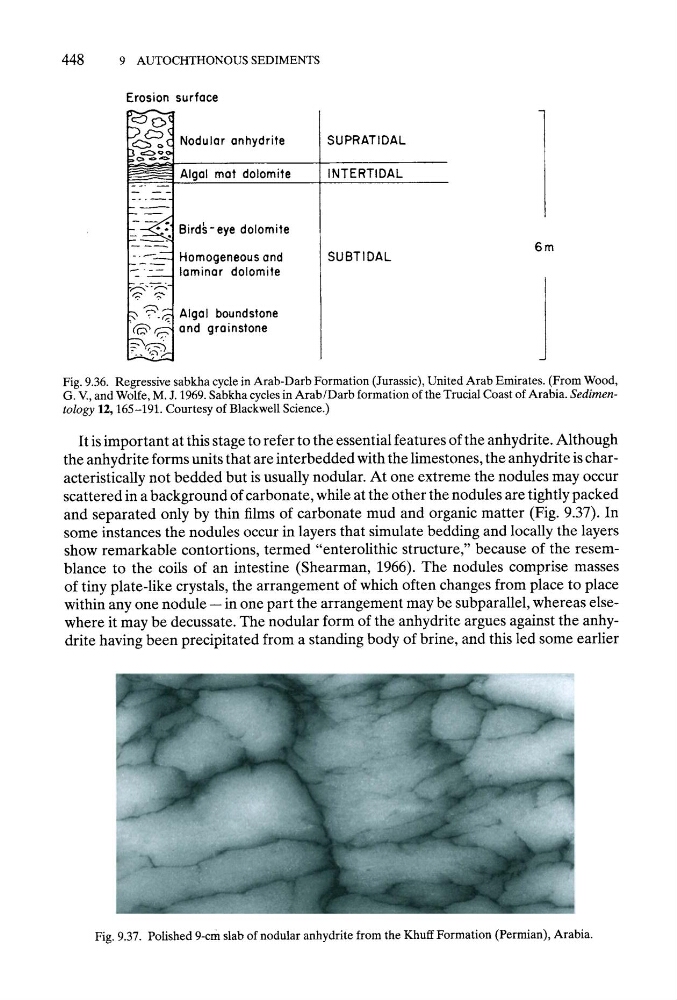
and separated only by thin films of carbonate mud and organic matter (Fig. 9.37). In
some instances the nodules occur in layers that simulate bedding and locally the layers
show remarkable contortions, termed "enterolithic structure," because of the resemblance to the coils of an intestine (Shearman, 1966). The nodules comprise masses
of tiny plate-like crystals, the arrangement of which often changes from place to place
within any one nodule -- in one part the arrangement may be subparallel, whereas elsewhere it may be decussate. The nodular form of the anhydrite argues against the anhydrite having been precipitated from a standing body of brine, and this led some earlier
Fig. 9.37. Polished 9-cm slab of nodular anhydrite from the Khuff Formation (Permian), Arabia.
9 AUTOCHTHONOUS SEDIMENTS
Erosion surface
~
Nodular anhydrite
~ A l g a l
mat dolomite
_
Bird~- eye dolomite
Homogeneous and
laminar dolomite
---, ~'~-~'. Algal boundstone
">(~ ~ and grainstone
SUPRATIDAL
INTERTIDAL
SUBTIDAL
6m
Fig. 9.36. Regressive sabkha cycle in Arab-Darb Formation (Jurassic), United Arab Emirates. (From Wood,
G. V., and Wolfe, M. J. 1969. Sabkha cycles in Arab/Darb formation of the Trucial Coast of Arabia. Sedimentology 12,165-191. Courtesy of Blackwell Science.)
It is important at this stage to refer to the essential features of the anhydrite. Although
the anhydrite forms units that are interbedded with the limestones, the anhydrite is characteristically not bedded but is usually nodular. At one extreme the nodules may occur
scattered in a background of carbonate, while at the other the nodules are tightly packed
and separated only by thin films of carbonate mud and organic matter (Fig. 9.37). In
some instances the nodules occur in layers that simulate bedding and locally the layers
show remarkable contortions, termed "enterolithic structure," because of the resemblance to the coils of an intestine (Shearman, 1966). The nodules comprise masses
of tiny plate-like crystals, the arrangement of which often changes from place to place
within any one nodule -- in one part the arrangement may be subparallel, whereas elsewhere it may be decussate. The nodular form of the anhydrite argues against the anhydrite having been precipitated from a standing body of brine, and this led some earlier
Fig. 9.37. Polished 9-cm slab of nodular anhydrite from the Khuff Formation (Permian), Arabia.