

9.6 EVAPORITES
449
SUBTIDAL
INTERTIDAL
SUPRATIDAL
A .Sea level
I _----~---"--- -
_ _ ~
B
, /
Lagoonal
Algal mats
Carbonates and J
and Pleistocene pellet muds
and gypsum
evaporites
limestone
islands
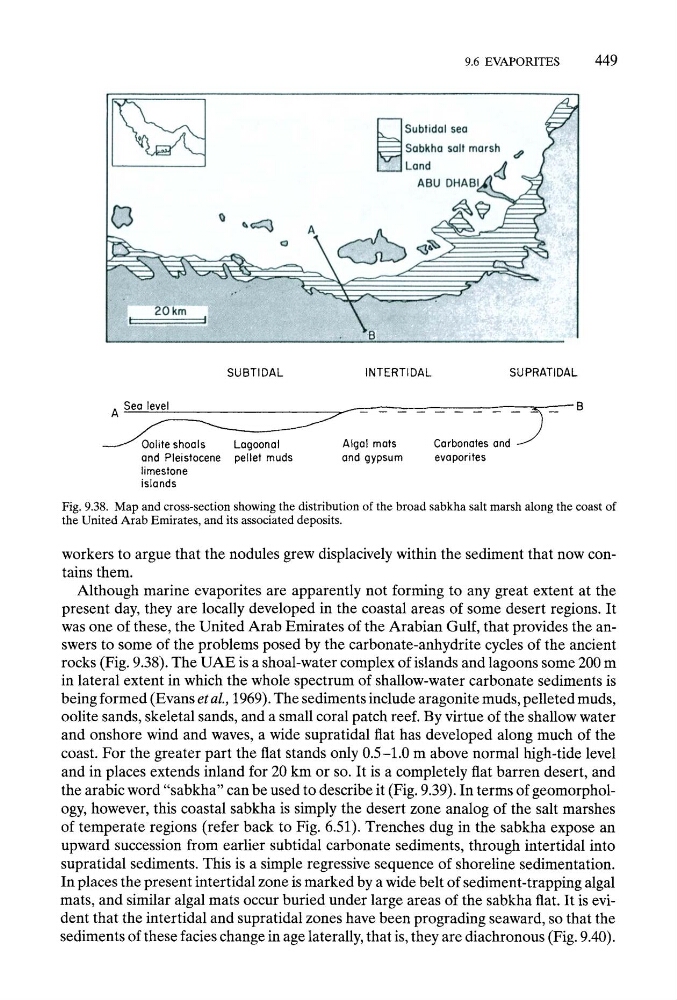
Fig. 9.38. Map and cross-section showing the distribution of the broad sabkha salt marsh along the coast of
the United Arab Emirates, and its associated deposits.
workers to argue that the nodules grew displacively within the sediment that now contains them.
Although marine evaporites are apparently not forming to any great extent at the
present day, they are locally developed in the coastal areas of some desert regions. It
was one of these, the United Arab Emirates of the Arabian Gulf, that provides the answers to some of the problems posed by the carbonate-anhydrite cycles of the ancient
rocks (Fig. 9.38). The UAE is a shoal-water complex of islands and lagoons some 200 m
in lateral extent in which the whole spectrum of shallow-water carbonate sediments is
being formed (Evans et al., 1969). The sediments include aragonite muds, pelleted muds,
oolite sands, skeletal sands, and a small coral patch reef. By virtue of the shallow water
and onshore wind and waves, a wide supratidal flat has developed along much of the
coast. For the greater part the flat stands only 0.5-1.0 m above normal high-tide level
and in places extends inland for 20 km or so. It is a completely flat barren desert, and
the arabic word "sabkha" can be used to describe it (Fig. 9.39). In terms of geomorphology, however, this coastal sabkha is simply the desert zone analog of the salt marshes
of temperate regions (refer back to Fig. 6.51). Trenches dug in the sabkha expose an
upward succession from earlier subtidal carbonate sediments, through intertidal into
supratidal sediments. This is a simple regressive sequence of shoreline sedimentation.
In places the present intertidal zone is marked by a wide belt of sediment-trapping algal
mats, and similar algal mats occur buried under large areas of the sabkha flat. It is evident that the intertidal and supratidal zones have been prograding seaward, so that the
sediments of these facies change in age laterally, that is, they are diachronous (Fig. 9.40).
449
SUBTIDAL
INTERTIDAL
SUPRATIDAL
A .Sea level
I _----~---"--- -
_ _ ~
B
, /
Lagoonal
Algal mats
Carbonates and J
and Pleistocene pellet muds
and gypsum
evaporites
limestone
islands
Fig. 9.38. Map and cross-section showing the distribution of the broad sabkha salt marsh along the coast of
the United Arab Emirates, and its associated deposits.
workers to argue that the nodules grew displacively within the sediment that now contains them.
Although marine evaporites are apparently not forming to any great extent at the
present day, they are locally developed in the coastal areas of some desert regions. It
was one of these, the United Arab Emirates of the Arabian Gulf, that provides the answers to some of the problems posed by the carbonate-anhydrite cycles of the ancient
rocks (Fig. 9.38). The UAE is a shoal-water complex of islands and lagoons some 200 m
in lateral extent in which the whole spectrum of shallow-water carbonate sediments is
being formed (Evans et al., 1969). The sediments include aragonite muds, pelleted muds,
oolite sands, skeletal sands, and a small coral patch reef. By virtue of the shallow water
and onshore wind and waves, a wide supratidal flat has developed along much of the
coast. For the greater part the flat stands only 0.5-1.0 m above normal high-tide level
and in places extends inland for 20 km or so. It is a completely flat barren desert, and
the arabic word "sabkha" can be used to describe it (Fig. 9.39). In terms of geomorphology, however, this coastal sabkha is simply the desert zone analog of the salt marshes
of temperate regions (refer back to Fig. 6.51). Trenches dug in the sabkha expose an
upward succession from earlier subtidal carbonate sediments, through intertidal into
supratidal sediments. This is a simple regressive sequence of shoreline sedimentation.
In places the present intertidal zone is marked by a wide belt of sediment-trapping algal
mats, and similar algal mats occur buried under large areas of the sabkha flat. It is evident that the intertidal and supratidal zones have been prograding seaward, so that the
sediments of these facies change in age laterally, that is, they are diachronous (Fig. 9.40).