

9.6 EVAPORITES
447
evaporites, and this limestone, the Crossfield member, is the reservoir rock of the Olds
gas field of Alberta. Anhydrite rocks are for the most part "tight" with respect to oil
and gas, and in consequence make excellent seals to hydrocarbon reservoirs.
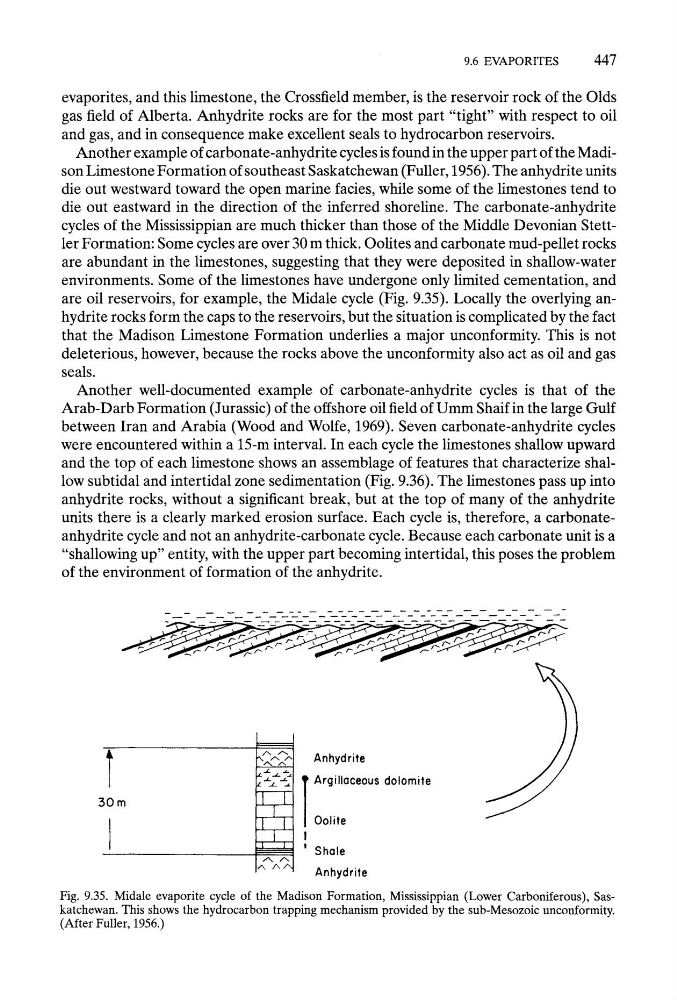
Another example of carbonate-anhydrite cycles is found in the upper part of the Madison Limestone Formation of southeast Saskatchewan (Fuller, 1956). The anhydrite units
die out westward toward the open marine facies, while some of the limestones tend to
die out eastward in the direction of the inferred shoreline. The carbonate-anhydrite
cycles of the Mississippian are much thicker than those of the Middle Devonian Stettler Formation: Some cycles are over 30 m thick. Oolites and carbonate mud-pellet rocks
are abundant in the limestones, suggesting that they were deposited in shallow-water
environments. Some of the limestones have undergone only limited cementation, and
are oil reservoirs, for example, the Midale cycle (Fig. 9.35). Locally the overlying anhydrite rocks form the caps to the reservoirs, but the situation is complicated by the fact
that the Madison Limestone Formation underlies a major unconformity. This is not
deleterious, however, because the rocks above the unconformity also act as oil and gas
seals.
Another well-documented example of carbonate-anhydrite cycles is that of the
Arab-Darb Formation (Jurassic) of the offshore oil field of Umm Shaif in the large Gulf
between Iran and Arabia (Wood and Wolfe, 1969). Seven carbonate-anhydrite cycles
were encountered within a 15-m interval. In each cycle the limestones shallow upward
and the top of each limestone shows an assemblage of features that characterize shallow subtidal and intertidal zone sedimentation (Fig. 9.36). The limestones pass up into
anhydrite rocks, without a significant break, but at the top of many of the anhydrite
units there is a clearly marked erosion surface. Each cycle is, therefore, a carbonateanhydrite cycle and not an anhydrite-carbonate cycle. Because each carbonate unit is a
"shallowing up" entity, with the upper part becoming intertidal, this poses the problem
of the environment of formation of the anhydrite.
T
30m
1
I
~~'~'I Anhydri te
% ~
Argillaceous dolomite
Oolite
! I
I
kl
J-- ~ Shale
Anhydrite
Fig. 9.35. Midale evaporite cycle of the Madison Formation, Mississippian (Lower Carboniferous), Saskatchewan. This shows the hydrocarbon trapping mechanism provided by the sub-Mesozoic unconformity.
(After Fuller, 1956.)
447
evaporites, and this limestone, the Crossfield member, is the reservoir rock of the Olds
gas field of Alberta. Anhydrite rocks are for the most part "tight" with respect to oil
and gas, and in consequence make excellent seals to hydrocarbon reservoirs.
Another example of carbonate-anhydrite cycles is found in the upper part of the Madison Limestone Formation of southeast Saskatchewan (Fuller, 1956). The anhydrite units
die out westward toward the open marine facies, while some of the limestones tend to
die out eastward in the direction of the inferred shoreline. The carbonate-anhydrite
cycles of the Mississippian are much thicker than those of the Middle Devonian Stettler Formation: Some cycles are over 30 m thick. Oolites and carbonate mud-pellet rocks
are abundant in the limestones, suggesting that they were deposited in shallow-water
environments. Some of the limestones have undergone only limited cementation, and
are oil reservoirs, for example, the Midale cycle (Fig. 9.35). Locally the overlying anhydrite rocks form the caps to the reservoirs, but the situation is complicated by the fact
that the Madison Limestone Formation underlies a major unconformity. This is not
deleterious, however, because the rocks above the unconformity also act as oil and gas
seals.
Another well-documented example of carbonate-anhydrite cycles is that of the
Arab-Darb Formation (Jurassic) of the offshore oil field of Umm Shaif in the large Gulf
between Iran and Arabia (Wood and Wolfe, 1969). Seven carbonate-anhydrite cycles
were encountered within a 15-m interval. In each cycle the limestones shallow upward
and the top of each limestone shows an assemblage of features that characterize shallow subtidal and intertidal zone sedimentation (Fig. 9.36). The limestones pass up into
anhydrite rocks, without a significant break, but at the top of many of the anhydrite
units there is a clearly marked erosion surface. Each cycle is, therefore, a carbonateanhydrite cycle and not an anhydrite-carbonate cycle. Because each carbonate unit is a
"shallowing up" entity, with the upper part becoming intertidal, this poses the problem
of the environment of formation of the anhydrite.
T
30m
1
I
~~'~'I Anhydri te
% ~
Argillaceous dolomite
Oolite
! I
I
kl
J-- ~ Shale
Anhydrite
Fig. 9.35. Midale evaporite cycle of the Madison Formation, Mississippian (Lower Carboniferous), Saskatchewan. This shows the hydrocarbon trapping mechanism provided by the sub-Mesozoic unconformity.
(After Fuller, 1956.)