

446
9 AUTOCHTHONOUS SEDIMENTS
9.6.3 Carbonate-Anhydrite Cycles
The general relationships of carbonate-anhydrite cycles are well exemplified in the
Stettler Formation (Upper Devonian) of western Canada (Fuller and Porter, 1969).
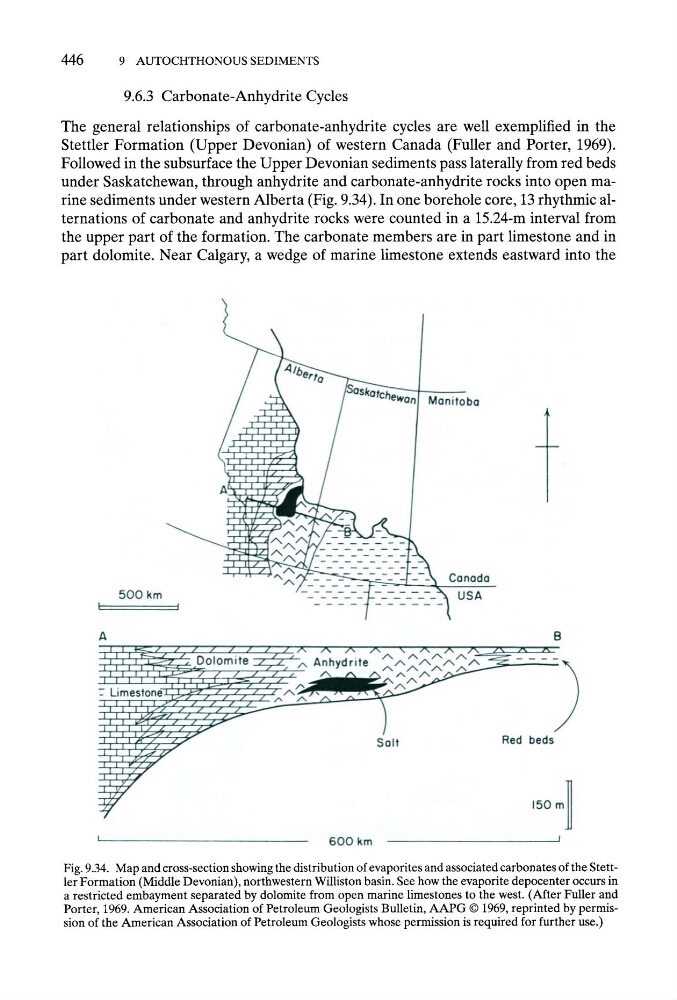
Followed in the subsurface the Upper Devonian sediments pass laterally from red beds
under Saskatchewan, through anhydrite and carbonate-anhydrite rocks into open marine sediments under western Alberta (Fig. 9.34). In one borehole core, 13 rhythmic alternations of carbonate and anhydrite rocks were counted in a 15.24-m interval from
the upper part of the formation. The carbonate members are in part limestone and in
part dolomite. Near Calgary, a wedge of marine limestone extends eastward into the
Fig. 9.34. Map and cross-section showing the distribution of evaporites and associated carbonates of the Stettler Formation (Middle Devonian), northwestern Williston basin. See how the evaporite depocenter occurs in
a restricted embayment separated by dolomite from open marine limestones to the west. (After Fuller and
Porter, 1969. American Association of Petroleum Geologists Bulletin, AAPG 9 1969, reprinted by permission of the American Association of Petroleum Geologists whose permission is required for further use.)
9 AUTOCHTHONOUS SEDIMENTS
9.6.3 Carbonate-Anhydrite Cycles
The general relationships of carbonate-anhydrite cycles are well exemplified in the
Stettler Formation (Upper Devonian) of western Canada (Fuller and Porter, 1969).
Followed in the subsurface the Upper Devonian sediments pass laterally from red beds
under Saskatchewan, through anhydrite and carbonate-anhydrite rocks into open marine sediments under western Alberta (Fig. 9.34). In one borehole core, 13 rhythmic alternations of carbonate and anhydrite rocks were counted in a 15.24-m interval from
the upper part of the formation. The carbonate members are in part limestone and in
part dolomite. Near Calgary, a wedge of marine limestone extends eastward into the
Fig. 9.34. Map and cross-section showing the distribution of evaporites and associated carbonates of the Stettler Formation (Middle Devonian), northwestern Williston basin. See how the evaporite depocenter occurs in
a restricted embayment separated by dolomite from open marine limestones to the west. (After Fuller and
Porter, 1969. American Association of Petroleum Geologists Bulletin, AAPG 9 1969, reprinted by permission of the American Association of Petroleum Geologists whose permission is required for further use.)