

9.6 EVAPORITES
445
Atlantic from the Grand Banks of Newfoundland, the Gulf of Mexico (the Louann
salt), to Brazil on the west and also along the coast of west and southwest Africa (see
Section 10.2.4.2).
A further particular feature of the evaporites is their high degree of plasticity. When
buried beneath an overburden of younger sediment, salt can act as a lubricant to permit
the cover to deform into eccentric structural styles. The salt acts as a zone of "decollement" along which the mobile cover becomes detached from the rigid basement. Notable examples of this phenomenon occur in Iran and in the Jura Mountains of southern France.
As discussed earlier, evaporites are less dense than other buried sediments, and thus
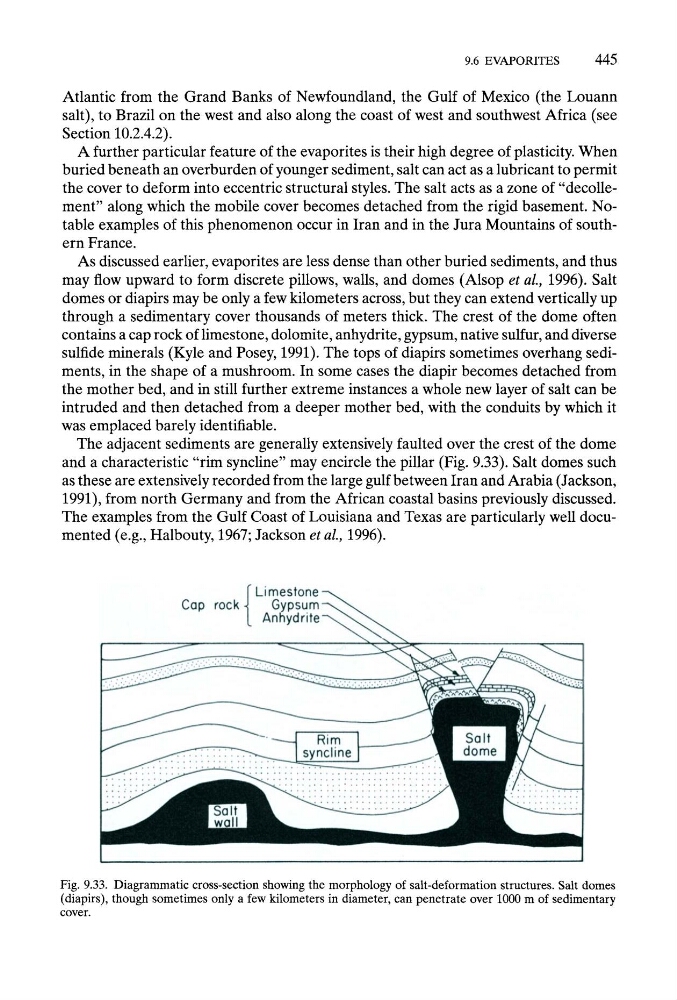
may flow upward to form discrete pillows, walls, and domes (Alsop et al., 1996). Salt
domes or diapirs may be only a few kilometers across, but they can extend vertically up
through a sedimentary cover thousands of meters thick. The crest of the dome often
contains a cap rock of limestone, dolomite, anhydrite, gypsum, native sulfur, and diverse
sulfide minerals (Kyle and Posey, 1991). The tops of diapirs sometimes overhang sediments, in the shape of a mushroom. In some cases the diapir becomes detached from
the mother bed, and in still further extreme instances a whole new layer of salt can be
intruded and then detached from a deeper mother bed, with the conduits by which it
was emplaced barely identifiable.
The adjacent sediments are generally extensively faulted over the crest of the dome
and a characteristic "rim syncline" may encircle the pillar (Fig. 9.33). Salt domes such
as these are extensively recorded from the large gulf between Iran and Arabia (Jackson,
1991), from north Germany and from the African coastal basins previously discussed.
The examples from the Gulf Coast of Louisiana and Texas are particularly well documented (e.g., Halbouty, 1967; Jackson et al., 1996).
Fig. 9.33. Diagrammatic cross-section showing the morphology of salt-deformation structures. Salt domes
(diapirs), though sometimes only a few kilometers in diameter, can penetrate over 1000 m of sedimentary
cover.
445
Atlantic from the Grand Banks of Newfoundland, the Gulf of Mexico (the Louann
salt), to Brazil on the west and also along the coast of west and southwest Africa (see
Section 10.2.4.2).
A further particular feature of the evaporites is their high degree of plasticity. When
buried beneath an overburden of younger sediment, salt can act as a lubricant to permit
the cover to deform into eccentric structural styles. The salt acts as a zone of "decollement" along which the mobile cover becomes detached from the rigid basement. Notable examples of this phenomenon occur in Iran and in the Jura Mountains of southern France.
As discussed earlier, evaporites are less dense than other buried sediments, and thus
may flow upward to form discrete pillows, walls, and domes (Alsop et al., 1996). Salt
domes or diapirs may be only a few kilometers across, but they can extend vertically up
through a sedimentary cover thousands of meters thick. The crest of the dome often
contains a cap rock of limestone, dolomite, anhydrite, gypsum, native sulfur, and diverse
sulfide minerals (Kyle and Posey, 1991). The tops of diapirs sometimes overhang sediments, in the shape of a mushroom. In some cases the diapir becomes detached from
the mother bed, and in still further extreme instances a whole new layer of salt can be
intruded and then detached from a deeper mother bed, with the conduits by which it
was emplaced barely identifiable.
The adjacent sediments are generally extensively faulted over the crest of the dome
and a characteristic "rim syncline" may encircle the pillar (Fig. 9.33). Salt domes such
as these are extensively recorded from the large gulf between Iran and Arabia (Jackson,
1991), from north Germany and from the African coastal basins previously discussed.
The examples from the Gulf Coast of Louisiana and Texas are particularly well documented (e.g., Halbouty, 1967; Jackson et al., 1996).
Fig. 9.33. Diagrammatic cross-section showing the morphology of salt-deformation structures. Salt domes
(diapirs), though sometimes only a few kilometers in diameter, can penetrate over 1000 m of sedimentary
cover.