

9.6 EVAPORITES
441
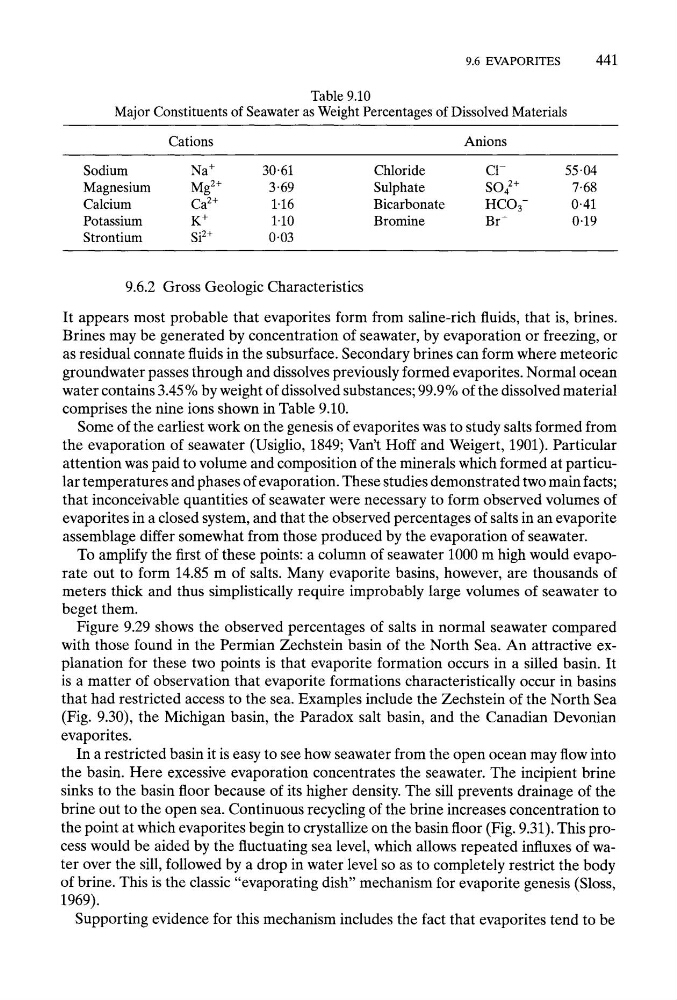
Table 9.10
Major Constituents of Seawater as Weight Percentages of Dissolved Materials
Cations
Anions
Sodium
Na §
30.61
Chloride
C155.04
Magnesium
Mg 2§
3.69
Sulphate
SO 2+
7.68
Calcium
Ca 2§
1.16
Bicarbonate
HCO 30.41
Potassium
K §
1.10
B r omine
B r0.19
Strontium
Si 2§
0.03
9.6.2 Gross Geologic Characteristics
It appears most probable that evaporites form from saline-rich fluids, that is, brines.
Brines may be generated by concentration of seawater, by evaporation or freezing, or
as residual connate fluids in the subsurface. Secondary brines can form where meteoric
groundwater passes through and dissolves previously formed evaporites. Normal ocean
water contains 3.45 % by weight of dissolved substances; 99.9% of the dissolved material
comprises the nine ions shown in Table 9.10.
Some of the earliest work on the genesis of evaporites was to study salts formed from
the evaporation of seawater (Usiglio, 1849; Van't Hoff and Weigert, 1901). Particular
attention was paid to volume and composition of the minerals which formed at particular temperatures and phases of evaporation. These studies demonstrated two main facts;
that inconceivable quantities of seawater were necessary to form observed volumes of
evaporites in a closed system, and that the observed percentages of salts in an evaporite
assemblage differ somewhat from those produced by the evaporation of seawater.
To amplify the first of these points: a column of seawater 1000 m high would evaporate out to form 14.85 m of salts. Many evaporite basins, however, are thousands of
meters thick and thus simplistically require improbably large volumes of seawater to
beget them.
Figure 9.29 shows the observed percentages of salts in normal seawater compared
with those found in the Permian Zechstein basin of the North Sea. An attractive explanation for these two points is that evaporite formation occurs in a silled basin. It
is a matter of observation that evaporite formations characteristically occur in basins
that had restricted access to the sea. Examples include the Zechstein of the North Sea
(Fig. 9.30), the Michigan basin, the Paradox salt basin, and the Canadian Devonian
evaporites.
In a restricted basin it is easy to see how seawater from the open ocean may flow into
the basin. Here excessive evaporation concentrates the seawater. The incipient brine
sinks to the basin floor because of its higher density. The sill prevents drainage of the
brine out to the open sea. Continuous recycling of the brine increases concentration to
the point at which evaporites begin to crystallize on the basin floor (Fig. 9.31). This process would be aided by the fluctuating sea level, which allows repeated influxes of water over the sill, followed by a drop in water level so as to completely restrict the body
of brine. This is the classic "evaporating dish" mechanism for evaporite genesis (Sloss,
1969).
Supporting evidence for this mechanism includes the fact that evaporites tend to be
441
Table 9.10
Major Constituents of Seawater as Weight Percentages of Dissolved Materials
Cations
Anions
Sodium
Na §
30.61
Chloride
C155.04
Magnesium
Mg 2§
3.69
Sulphate
SO 2+
7.68
Calcium
Ca 2§
1.16
Bicarbonate
HCO 30.41
Potassium
K §
1.10
B r omine
B r0.19
Strontium
Si 2§
0.03
9.6.2 Gross Geologic Characteristics
It appears most probable that evaporites form from saline-rich fluids, that is, brines.
Brines may be generated by concentration of seawater, by evaporation or freezing, or
as residual connate fluids in the subsurface. Secondary brines can form where meteoric
groundwater passes through and dissolves previously formed evaporites. Normal ocean
water contains 3.45 % by weight of dissolved substances; 99.9% of the dissolved material
comprises the nine ions shown in Table 9.10.
Some of the earliest work on the genesis of evaporites was to study salts formed from
the evaporation of seawater (Usiglio, 1849; Van't Hoff and Weigert, 1901). Particular
attention was paid to volume and composition of the minerals which formed at particular temperatures and phases of evaporation. These studies demonstrated two main facts;
that inconceivable quantities of seawater were necessary to form observed volumes of
evaporites in a closed system, and that the observed percentages of salts in an evaporite
assemblage differ somewhat from those produced by the evaporation of seawater.
To amplify the first of these points: a column of seawater 1000 m high would evaporate out to form 14.85 m of salts. Many evaporite basins, however, are thousands of
meters thick and thus simplistically require improbably large volumes of seawater to
beget them.
Figure 9.29 shows the observed percentages of salts in normal seawater compared
with those found in the Permian Zechstein basin of the North Sea. An attractive explanation for these two points is that evaporite formation occurs in a silled basin. It
is a matter of observation that evaporite formations characteristically occur in basins
that had restricted access to the sea. Examples include the Zechstein of the North Sea
(Fig. 9.30), the Michigan basin, the Paradox salt basin, and the Canadian Devonian
evaporites.
In a restricted basin it is easy to see how seawater from the open ocean may flow into
the basin. Here excessive evaporation concentrates the seawater. The incipient brine
sinks to the basin floor because of its higher density. The sill prevents drainage of the
brine out to the open sea. Continuous recycling of the brine increases concentration to
the point at which evaporites begin to crystallize on the basin floor (Fig. 9.31). This process would be aided by the fluctuating sea level, which allows repeated influxes of water over the sill, followed by a drop in water level so as to completely restrict the body
of brine. This is the classic "evaporating dish" mechanism for evaporite genesis (Sloss,
1969).
Supporting evidence for this mechanism includes the fact that evaporites tend to be