

442
9 AUTOCHTHONOUS SEDIMENTS
Sea- water
28 Potash~
i
68
Rock salt (halite)
Zechstein
5
Loss by
solution
79
~
16
00%
I00%
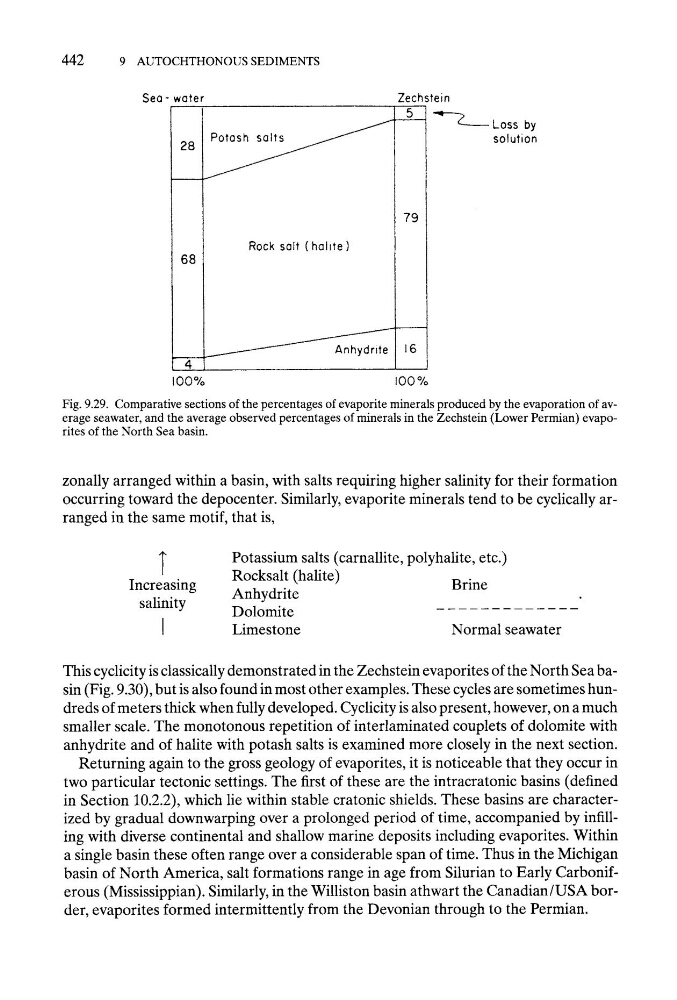
Fig. 9.29. Comparative sections of the percentages of evaporite minerals produced by the evaporation of average seawater, and the average observed percentages of minerals in the Zechstein (Lower Permian) evaporites of the North Sea basin.
zonally arranged within a basin, with salts requiring higher salinity for their formation
occurring toward the depocenter. Similarly, evaporite minerals tend to be cyclically arranged in the same motif, that is,
Y
Increasing
salinity
I
Potassium salts (carnallite, polyhalite, etc.)
Rocksalt (halite)
Brine
Anhydrite
Dolomite
Limestone
Normal seawater
This cyclicity is classically demonstrated in the Zechstein evaporites of the North Sea basin (Fig. 9.30), but is also found in most other examples. These cycles are sometimes hundreds of meters thick when fully developed. Cyclicity is also present, however, on a much
smaller scale. The monotonous repetition of interlaminated couplets of dolomite with
anhydrite and of halite with potash salts is examined more closely in the next section.
Returning again to the gross geology of evaporites, it is noticeable that they occur in
two particular tectonic settings. The first of these are the intracratonic basins (defined
in Section 10.2.2), which lie within stable cratonic shields. These basins are characterized by gradual downwarping over a prolonged period of time, accompanied by infilling with diverse continental and shallow marine deposits including evaporites. Within
a single basin these often range over a considerable span of time. Thus in the Michigan
basin of North America, salt formations range in age from Silurian to Early Carboniferous (Mississippian). Similarly, in the Williston basin athwart the Canadian/USA border, evaporites formed intermittently from the Devonian through to the Permian.
9 AUTOCHTHONOUS SEDIMENTS
Sea- water
28 Potash~
i
68
Rock salt (halite)
Zechstein
5
Loss by
solution
79
~
16
00%
I00%
Fig. 9.29. Comparative sections of the percentages of evaporite minerals produced by the evaporation of average seawater, and the average observed percentages of minerals in the Zechstein (Lower Permian) evaporites of the North Sea basin.
zonally arranged within a basin, with salts requiring higher salinity for their formation
occurring toward the depocenter. Similarly, evaporite minerals tend to be cyclically arranged in the same motif, that is,
Y
Increasing
salinity
I
Potassium salts (carnallite, polyhalite, etc.)
Rocksalt (halite)
Brine
Anhydrite
Dolomite
Limestone
Normal seawater
This cyclicity is classically demonstrated in the Zechstein evaporites of the North Sea basin (Fig. 9.30), but is also found in most other examples. These cycles are sometimes hundreds of meters thick when fully developed. Cyclicity is also present, however, on a much
smaller scale. The monotonous repetition of interlaminated couplets of dolomite with
anhydrite and of halite with potash salts is examined more closely in the next section.
Returning again to the gross geology of evaporites, it is noticeable that they occur in
two particular tectonic settings. The first of these are the intracratonic basins (defined
in Section 10.2.2), which lie within stable cratonic shields. These basins are characterized by gradual downwarping over a prolonged period of time, accompanied by infilling with diverse continental and shallow marine deposits including evaporites. Within
a single basin these often range over a considerable span of time. Thus in the Michigan
basin of North America, salt formations range in age from Silurian to Early Carboniferous (Mississippian). Similarly, in the Williston basin athwart the Canadian/USA border, evaporites formed intermittently from the Devonian through to the Permian.