

440
9 AUTOCHTHONOUS SEDIMENTS
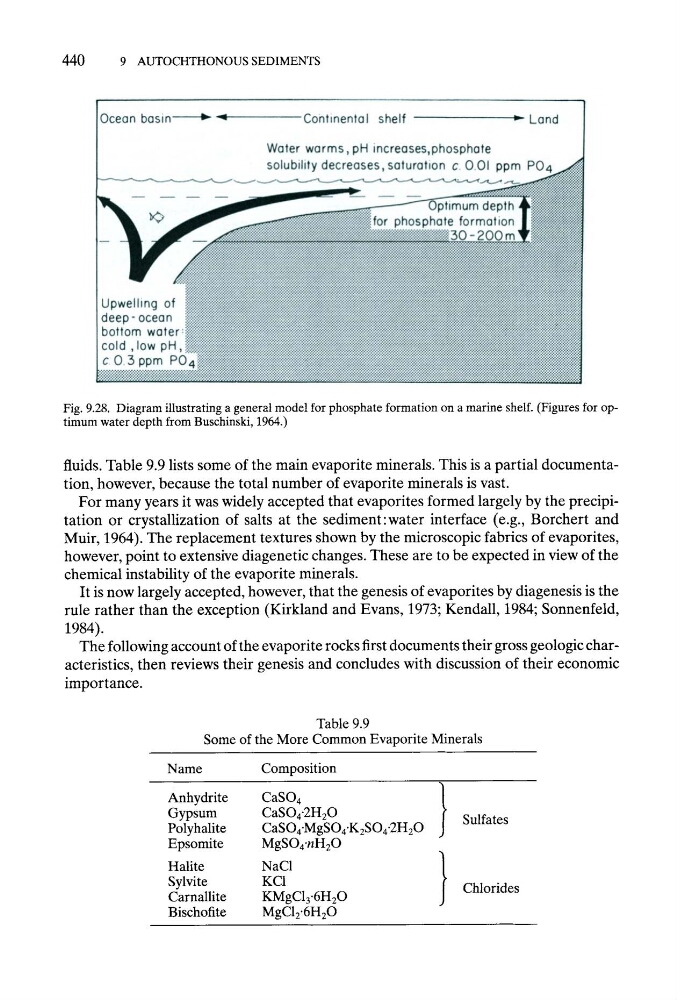
Fig. 9.28. Diagram illustrating a general model for phosphate formation on a marine shelf. (Figures for optimum water depth from Buschinski, 1964.)
fluids. Table 9.9 lists some of the main evaporite minerals. This is a partial documentation, however, because the total number of evaporite minerals is vast.
For many years it was widely accepted that evaporites formed largely by the precipitation or crystallization of salts at the sediment:water interface (e.g., Borchert and
Muir, 1964). The replacement textures shown by the microscopic fabrics of evaporites,
however, point to extensive diagenetic changes. These are to be expected in view of the
chemical instability of the evaporite minerals.
It is now largely accepted, however, that the genesis of evaporites by diagenesis is the
rule rather than the exception (Kirkland and Evans, 1973; Kendall, 1984; Sonnenfeld,
1984).
The following account of the evaporite rocks first documents their gross geologic characteristics, then reviews their genesis and concludes with discussion of their economic
importance.
Table 9.9
Some of the More Common Evaporite Minerals
Name
Anhydrite
Gypsum
Polyhalite
Epsomite
Halite
Sylvite
Carnallite
Bischofite
Composition
CaSO4
}
CaSO4"2H20
CaSO4.MgSO4.KESO4.2H20
MgSO4"nH20
NaC1
}
KC1
KMgC13"6H20
MgC12"6H20
Sulfates
Chlorides
9 AUTOCHTHONOUS SEDIMENTS
Fig. 9.28. Diagram illustrating a general model for phosphate formation on a marine shelf. (Figures for optimum water depth from Buschinski, 1964.)
fluids. Table 9.9 lists some of the main evaporite minerals. This is a partial documentation, however, because the total number of evaporite minerals is vast.
For many years it was widely accepted that evaporites formed largely by the precipitation or crystallization of salts at the sediment:water interface (e.g., Borchert and
Muir, 1964). The replacement textures shown by the microscopic fabrics of evaporites,
however, point to extensive diagenetic changes. These are to be expected in view of the
chemical instability of the evaporite minerals.
It is now largely accepted, however, that the genesis of evaporites by diagenesis is the
rule rather than the exception (Kirkland and Evans, 1973; Kendall, 1984; Sonnenfeld,
1984).
The following account of the evaporite rocks first documents their gross geologic characteristics, then reviews their genesis and concludes with discussion of their economic
importance.
Table 9.9
Some of the More Common Evaporite Minerals
Name
Anhydrite
Gypsum
Polyhalite
Epsomite
Halite
Sylvite
Carnallite
Bischofite
Composition
CaSO4
}
CaSO4"2H20
CaSO4.MgSO4.KESO4.2H20
MgSO4"nH20
NaC1
}
KC1
KMgC13"6H20
MgC12"6H20
Sulfates
Chlorides