

9.4 SEDIMENTARY IRON ORES
435
and richest iron deposits in the world. Notable examples include the Animikie Series
of the Lake Superior region, North America, the Hammersley basin of Western Australia, and the Transvaal basin of South Africa. There is naturally a huge literature on
these deposits. The following account draws on publications by Trendall (1968), Gross
(1972), Goodwin (1973), U N E S C O (1973), and Mel'nik (1982).
The Pre-Cambrian banded ironstones are remarkably similar wherever they occur in
the world. They all formed between 1900 and 2500 million years ago. The deposits are
found in laterally extensive sequences with the following succession from base to top:
dolomite, quartzite, red shale, black ferruginous shale, banded iron formation, and black
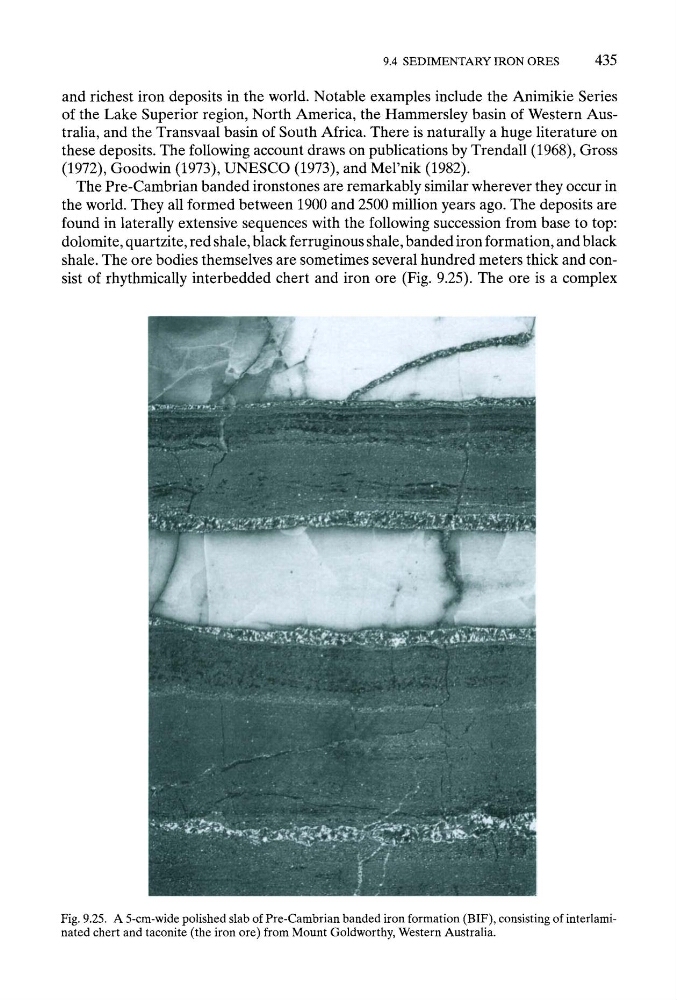
shale. The ore bodies themselves are sometimes several hundred meters thick and consist of rhythmically interbedded chert and iron ore (Fig. 9.25). The ore is a complex
Fig. 9.25. A 5-cm-wide polished slab of Pre-Cambrian banded iron formation (BIF), consisting of interlaminated chert and taconite (the iron ore) from Mount Goldworthy, Western Australia.
435
and richest iron deposits in the world. Notable examples include the Animikie Series
of the Lake Superior region, North America, the Hammersley basin of Western Australia, and the Transvaal basin of South Africa. There is naturally a huge literature on
these deposits. The following account draws on publications by Trendall (1968), Gross
(1972), Goodwin (1973), U N E S C O (1973), and Mel'nik (1982).
The Pre-Cambrian banded ironstones are remarkably similar wherever they occur in
the world. They all formed between 1900 and 2500 million years ago. The deposits are
found in laterally extensive sequences with the following succession from base to top:
dolomite, quartzite, red shale, black ferruginous shale, banded iron formation, and black
shale. The ore bodies themselves are sometimes several hundred meters thick and consist of rhythmically interbedded chert and iron ore (Fig. 9.25). The ore is a complex
Fig. 9.25. A 5-cm-wide polished slab of Pre-Cambrian banded iron formation (BIF), consisting of interlaminated chert and taconite (the iron ore) from Mount Goldworthy, Western Australia.