

434
9 AUTOCHTHONOUS SEDIMENTS
the two main periods of oolitic iron formation are episodes when the world's oceans
were largely anoxic (Van Houten and Arthur, 1989). There is general agreement that
the iron was brought into the marine realm by rivers that drained a lateritized hinterland. There is, however, considerable debate as to the exact mode of ore formation.
The transformist/metasomatic school argues that primary aragonitic ooids were later
replaced by the iron minerals (Sorby, 1856; Kimberley, 1979). The syngenetic school argues for primary deposition of iron minerals (Taylor, 1949; Hallam, 1963; Bubinicek,
1971).
In support of the metasomatic school it should be noted that many hematic ores occur
beneath unconformities, such as the Forest of Dean deposits (England), and the Shatti
Valley ores of Libya (Goudarzi, 1971; Turk et al., 1980). This could reflect epidiagenetic
replacement of limestones by ferruginous groundwaters. Furthermore, in both the Lorraine and Gara Djebilet deposits there are Nubecularid foraminifera, whose tests are
normally cryptocrystalline calcite, but now are replaced by iron, and whose chambers
are infilled with hematite and apatite (Champetier et al., 1985).
In support of the primary precipitate theory it should be noted that there are considerable differences between the ooids of iron ores and those of limestones (Section 9.2.3.1). Ferruginous ooids are often not spherical, but flattened ("flax seed" ore of
the Clinton deposit). Many ore bodies are not high-energy, cross-bedded grainstone
shoal deposits, like most oolitic limestones. They tend to be poorly sorted wackestones
in which both grains and matrix are mineralized. Evidence of primary deposition includes the occurrence of iron ore intraclasts and ooids in adjacent and overlying normal sediments, the occurrence of unreplaced calcite shells within ferruginous material,
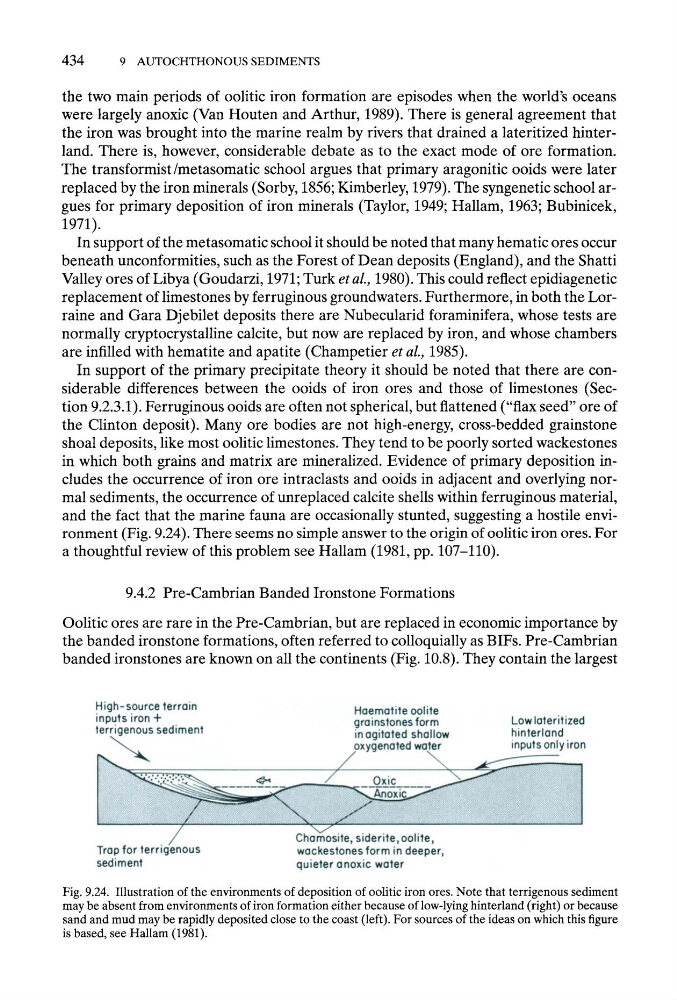
and the fact that the marine fauna are occasionally stunted, suggesting a hostile environment (Fig. 9.24). There seems no simple answer to the origin of oolitic iron ores. For
a thoughtful review of this problem see Hallam (1981, pp. 107-110).
9.4.2 Pre-Cambrian Banded Ironstone Formations
Oolitic ores are rare in the Pre-Cambrian, but are replaced in economic importance by
the banded ironstone formations, often referred to colloquially as B IFs. Pre-Cambrian
banded ironstones are known on all the continents (Fig. 10.8). They contain the largest
Fig. 9.24. Illustration of the environments of deposition of oolitic iron ores. Note that terrigenous sediment
may be absent from environments of iron formation either because of low-lying hinterland (right) or because
sand and mud may be rapidly deposited close to the coast (left). For sources of the ideas on which this figure
is based, see Hallam (1981).
9 AUTOCHTHONOUS SEDIMENTS
the two main periods of oolitic iron formation are episodes when the world's oceans
were largely anoxic (Van Houten and Arthur, 1989). There is general agreement that
the iron was brought into the marine realm by rivers that drained a lateritized hinterland. There is, however, considerable debate as to the exact mode of ore formation.
The transformist/metasomatic school argues that primary aragonitic ooids were later
replaced by the iron minerals (Sorby, 1856; Kimberley, 1979). The syngenetic school argues for primary deposition of iron minerals (Taylor, 1949; Hallam, 1963; Bubinicek,
1971).
In support of the metasomatic school it should be noted that many hematic ores occur
beneath unconformities, such as the Forest of Dean deposits (England), and the Shatti
Valley ores of Libya (Goudarzi, 1971; Turk et al., 1980). This could reflect epidiagenetic
replacement of limestones by ferruginous groundwaters. Furthermore, in both the Lorraine and Gara Djebilet deposits there are Nubecularid foraminifera, whose tests are
normally cryptocrystalline calcite, but now are replaced by iron, and whose chambers
are infilled with hematite and apatite (Champetier et al., 1985).
In support of the primary precipitate theory it should be noted that there are considerable differences between the ooids of iron ores and those of limestones (Section 9.2.3.1). Ferruginous ooids are often not spherical, but flattened ("flax seed" ore of
the Clinton deposit). Many ore bodies are not high-energy, cross-bedded grainstone
shoal deposits, like most oolitic limestones. They tend to be poorly sorted wackestones
in which both grains and matrix are mineralized. Evidence of primary deposition includes the occurrence of iron ore intraclasts and ooids in adjacent and overlying normal sediments, the occurrence of unreplaced calcite shells within ferruginous material,
and the fact that the marine fauna are occasionally stunted, suggesting a hostile environment (Fig. 9.24). There seems no simple answer to the origin of oolitic iron ores. For
a thoughtful review of this problem see Hallam (1981, pp. 107-110).
9.4.2 Pre-Cambrian Banded Ironstone Formations
Oolitic ores are rare in the Pre-Cambrian, but are replaced in economic importance by
the banded ironstone formations, often referred to colloquially as B IFs. Pre-Cambrian
banded ironstones are known on all the continents (Fig. 10.8). They contain the largest
Fig. 9.24. Illustration of the environments of deposition of oolitic iron ores. Note that terrigenous sediment
may be absent from environments of iron formation either because of low-lying hinterland (right) or because
sand and mud may be rapidly deposited close to the coast (left). For sources of the ideas on which this figure
is based, see Hallam (1981).