

9.4 SEDIMENTARY IRON ORES
433
Age
Recent to"~,.
Tertiary J
Jurassic
Mississippian
to Silurian
~Pre-Cambrian
Type
Laterites
Bog iron ores
Minette
Clinton
~- Oolitic
Banded-iron
formations
Minerals
Magnetite Haematite Siderite Chamosite[ Goethite/Lirnonite
FE304
Fe203
'"
I
I
When
I
metamorphosed !~
FeC03 FesAi2Si-dO10.3H20]2 Fe 303.3 H20
II
When
weathered
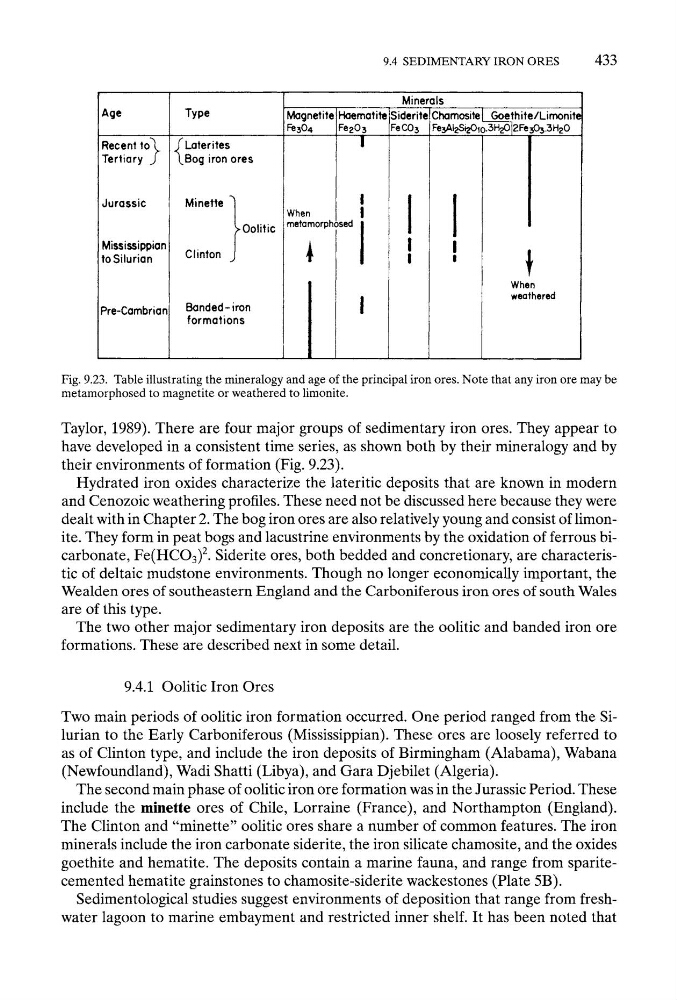
Fig. 9.23. Table illustrating the mineralogy and age of the principal iron ores. Note that any iron ore may be
metamorphosed to magnetite or weathered to limonite.
Taylor, 1989). There are four major groups of sedimentary iron ores. They appear to
have developed in a consistent time series, as shown both by their mineralogy and by
their environments of formation (Fig. 9.23).
Hydrated iron oxides characterize the lateritic deposits that are known in modern
and Cenozoic weathering profiles. These need not be discussed here because they were
dealt with in Chapter 2. The bog iron ores are also relatively young and consist of limonite. They form in peat bogs and lacustrine environments by the oxidation of ferrous bicarbonate, Fe(HCO3) 2. Siderite ores, both bedded and concretionary, are characteristic of deltaic mudstone environments. Though no longer economically important, the
Wealden ores of southeastern England and the Carboniferous iron ores of south Wales
are of this type.
The two other major sedimentary iron deposits are the oolitic and banded iron ore
formations. These are described next in some detail.
9.4.1 Oolitic Iron Ores
Two main periods of oolitic iron formation occurred. One period ranged from the Silurian to the Early Carboniferous (Mississippian). These ores are loosely referred to
as of Clinton type, and include the iron deposits of Birmingham (Alabama), Wabana
(Newfoundland), Wadi Shatti (Libya), and Gara Djebilet (Algeria).
The second main phase of oolitic iron ore formation was in the Jurassic Period. These
include the minette ores of Chile, Lorraine (France), and Northampton (England).
The Clinton and "minette" oolitic ores share a number of common features. The iron
minerals include the iron carbonate siderite, the iron silicate chamosite, and the oxides
goethite and hematite. The deposits contain a marine fauna, and range from sparitecemented hematite grainstones to chamosite-siderite wackestones (Plate 5B).
Sedimentological studies suggest environments of deposition that range from fleshwater lagoon to marine embayment and restricted inner shelf. It has been noted that
433
Age
Recent to"~,.
Tertiary J
Jurassic
Mississippian
to Silurian
~Pre-Cambrian
Type
Laterites
Bog iron ores
Minette
Clinton
~- Oolitic
Banded-iron
formations
Minerals
Magnetite Haematite Siderite Chamosite[ Goethite/Lirnonite
FE304
Fe203
'"
I
I
When
I
metamorphosed !~
FeC03 FesAi2Si-dO10.3H20]2 Fe 303.3 H20
II
When
weathered
Fig. 9.23. Table illustrating the mineralogy and age of the principal iron ores. Note that any iron ore may be
metamorphosed to magnetite or weathered to limonite.
Taylor, 1989). There are four major groups of sedimentary iron ores. They appear to
have developed in a consistent time series, as shown both by their mineralogy and by
their environments of formation (Fig. 9.23).
Hydrated iron oxides characterize the lateritic deposits that are known in modern
and Cenozoic weathering profiles. These need not be discussed here because they were
dealt with in Chapter 2. The bog iron ores are also relatively young and consist of limonite. They form in peat bogs and lacustrine environments by the oxidation of ferrous bicarbonate, Fe(HCO3) 2. Siderite ores, both bedded and concretionary, are characteristic of deltaic mudstone environments. Though no longer economically important, the
Wealden ores of southeastern England and the Carboniferous iron ores of south Wales
are of this type.
The two other major sedimentary iron deposits are the oolitic and banded iron ore
formations. These are described next in some detail.
9.4.1 Oolitic Iron Ores
Two main periods of oolitic iron formation occurred. One period ranged from the Silurian to the Early Carboniferous (Mississippian). These ores are loosely referred to
as of Clinton type, and include the iron deposits of Birmingham (Alabama), Wabana
(Newfoundland), Wadi Shatti (Libya), and Gara Djebilet (Algeria).
The second main phase of oolitic iron ore formation was in the Jurassic Period. These
include the minette ores of Chile, Lorraine (France), and Northampton (England).
The Clinton and "minette" oolitic ores share a number of common features. The iron
minerals include the iron carbonate siderite, the iron silicate chamosite, and the oxides
goethite and hematite. The deposits contain a marine fauna, and range from sparitecemented hematite grainstones to chamosite-siderite wackestones (Plate 5B).
Sedimentological studies suggest environments of deposition that range from fleshwater lagoon to marine embayment and restricted inner shelf. It has been noted that