

432
9 AUTOCHTHONOUS SEDIMENTS
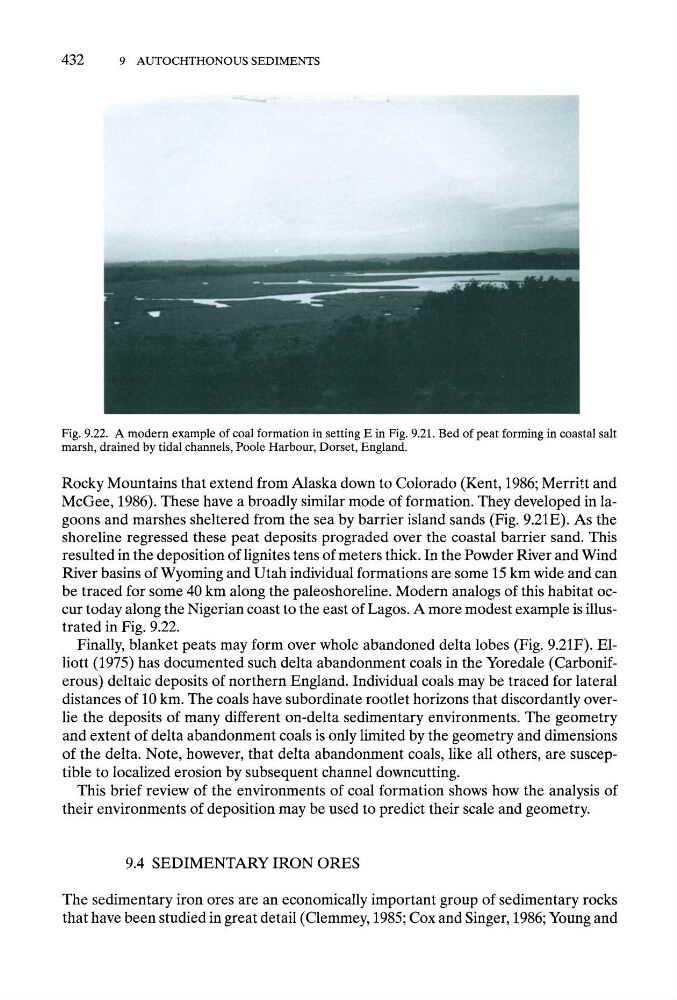
Fig. 9.22. A modern example of coal formation in setting E in Fig. 9.21. Bed of peat forming in coastal salt
marsh, drained by tidal channels, Poole Harbour, Dorset, England.
Rocky Mountains that extend from Alaska down to Colorado (Kent, 1986; Merritt and
McGee, 1986). These have a broadly similar mode of formation. They developed in lagoons and marshes sheltered from the sea by barrier island sands (Fig. 9.21E). As the
shoreline regressed these peat deposits prograded over the coastal barrier sand. This
resulted in the deposition of lignites tens of meters thick. Inthe Powder River and Wind
River basins of Wyoming and Utah individual formations are some 15 km wide and can
be traced for some 40 km along the paleoshoreline. Modern analogs of this habitat occur today along the Nigerian coast to the east of Lagos. A more modest example is illustrated in Fig. 9.22.
Finally, blanket peats may form over whole abandoned delta lobes (Fig. 9.21F). E1liott (1975) has documented such delta abandonment coals in the Yoredale (Carboniferous) deltaic deposits of northern England. Individual coals may be traced for lateral
distances of 10 km. The coals have subordinate rootlet horizons that discordantly overlie the deposits of many different on-delta sedimentary environments. The geometry
and extent of delta abandonment coals is only limited by the geometry and dimensions
of the delta. Note, however, that delta abandonment coals, like all others, are susceptible to localized erosion by subsequent channel downcutting.
This brief review of the environments of coal formation shows how the analysis of
their environments of deposition may be used to predict their scale and geometry.
9.4 SEDIMENTARY IRON ORES
The sedimentary iron ores are an economically important group of sedimentary rocks
that have been studied in great detail (Clemmey, 1985; Cox and Singer, 1986; Young and
9 AUTOCHTHONOUS SEDIMENTS
Fig. 9.22. A modern example of coal formation in setting E in Fig. 9.21. Bed of peat forming in coastal salt
marsh, drained by tidal channels, Poole Harbour, Dorset, England.
Rocky Mountains that extend from Alaska down to Colorado (Kent, 1986; Merritt and
McGee, 1986). These have a broadly similar mode of formation. They developed in lagoons and marshes sheltered from the sea by barrier island sands (Fig. 9.21E). As the
shoreline regressed these peat deposits prograded over the coastal barrier sand. This
resulted in the deposition of lignites tens of meters thick. Inthe Powder River and Wind
River basins of Wyoming and Utah individual formations are some 15 km wide and can
be traced for some 40 km along the paleoshoreline. Modern analogs of this habitat occur today along the Nigerian coast to the east of Lagos. A more modest example is illustrated in Fig. 9.22.
Finally, blanket peats may form over whole abandoned delta lobes (Fig. 9.21F). E1liott (1975) has documented such delta abandonment coals in the Yoredale (Carboniferous) deltaic deposits of northern England. Individual coals may be traced for lateral
distances of 10 km. The coals have subordinate rootlet horizons that discordantly overlie the deposits of many different on-delta sedimentary environments. The geometry
and extent of delta abandonment coals is only limited by the geometry and dimensions
of the delta. Note, however, that delta abandonment coals, like all others, are susceptible to localized erosion by subsequent channel downcutting.
This brief review of the environments of coal formation shows how the analysis of
their environments of deposition may be used to predict their scale and geometry.
9.4 SEDIMENTARY IRON ORES
The sedimentary iron ores are an economically important group of sedimentary rocks
that have been studied in great detail (Clemmey, 1985; Cox and Singer, 1986; Young and