

436
9 AUTOCHTHONOUS SEDIMENTS
mineral, termed "taconite," in which the iron occurs in the reduced ferrous state, though
recent weathering may have oxidized it to ferric iron (Guilbert and Park, 1986).Two
types of B IF are recognized. The Algoma type is of Archean age and is always related
to submarine volcanism. The Superior type is of early Proterozoic age and is sometimes,
but not invariably, associated with volcanism.
The origin of these deposits has aroused much speculation. The age and reduced state
of the iron minerals is consistent with formation when the earth's atmosphere lacked
oxygen (Nunn, 1998), and is shortly before the evolution of algae changed the atmosphere of the earth from reducing to oxic conditions (Holland, 1972).
There are two main theories to explain the formation of banded ironstones: the clastic sedimentary and the volcanogenic sedimentary. The clastic sedimentary theory advocates that the iron was transported into the basins from a deeply weathered lateritic
hinterland. Deposition was then by normal sedimentation in a shallow aqueous environment. The rhythmic nature of the deposits may be seasonal or in response to longer
alternations of oxidizing and reducing conditions. The volcanogenic sedimentary theory believes that the source for the iron and the silica was the volcanic rocks that are
commonly associated with the deposits.
The first theory seems able to explain the Lake Superior type of banded iron ore,
which is developed across extensive continental shelves. The volcanogenic theory seems
more appropriate for the Algoma type of banded iron ore, which occurs in subductive
zones with extensive igneous activity and has generally undergone subsequent metamorphism.
9.5 PHOSPHATES
9.5.1 Mode of Occurrence of Phosphates
The element phosphorus is an essential constituent of all living matter, both plant and
animal. Phosphate minerals are, therefore, extensively used as agricultural fertilizers.
They are a valuable natural resource that must be located by geologists (Nriagu and
Moore, 1985; Cook, 1986; Cook and Shergold, 1986; Slansky, 1986; Notholt et al., 1989;
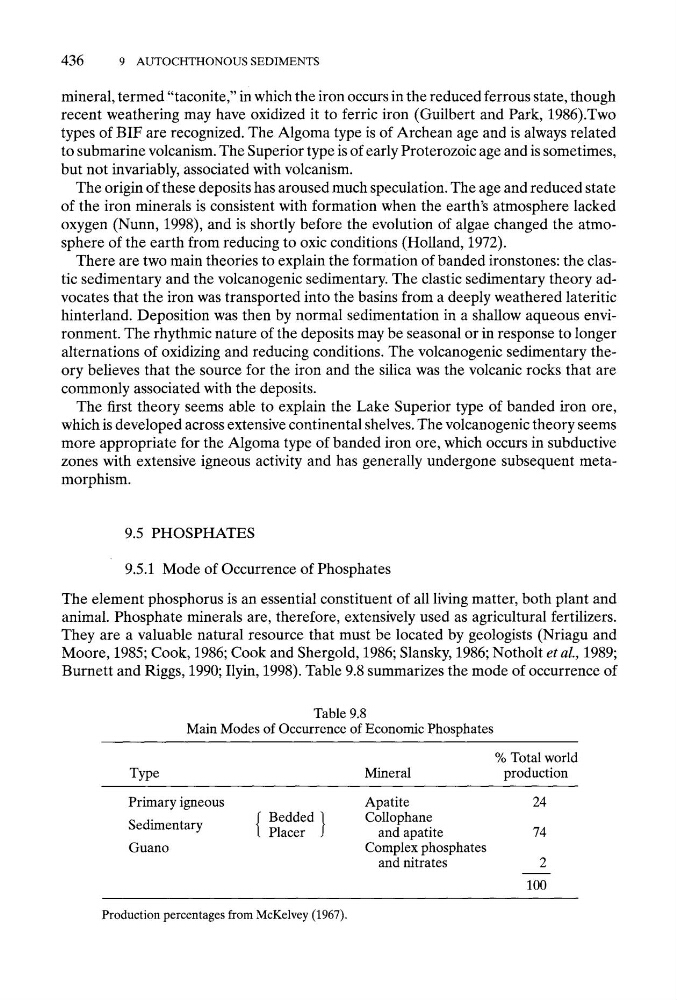
Burnett and Riggs, 1990; Ilyin, 1998). Table 9.8 summarizes the mode of occurrence of
Table 9.8
Main Modes of Occurrence of Economic Phosphates
% Total world
Type
Mineral
production
Primary igneous
Apatite
24
Sedimentary
{ Bedded }
Collophane
Placer
and apatite
74
Guano
Complex phosphates
and nitrates
2
100
Production percentages from McKelvey (1967).
9 AUTOCHTHONOUS SEDIMENTS
mineral, termed "taconite," in which the iron occurs in the reduced ferrous state, though
recent weathering may have oxidized it to ferric iron (Guilbert and Park, 1986).Two
types of B IF are recognized. The Algoma type is of Archean age and is always related
to submarine volcanism. The Superior type is of early Proterozoic age and is sometimes,
but not invariably, associated with volcanism.
The origin of these deposits has aroused much speculation. The age and reduced state
of the iron minerals is consistent with formation when the earth's atmosphere lacked
oxygen (Nunn, 1998), and is shortly before the evolution of algae changed the atmosphere of the earth from reducing to oxic conditions (Holland, 1972).
There are two main theories to explain the formation of banded ironstones: the clastic sedimentary and the volcanogenic sedimentary. The clastic sedimentary theory advocates that the iron was transported into the basins from a deeply weathered lateritic
hinterland. Deposition was then by normal sedimentation in a shallow aqueous environment. The rhythmic nature of the deposits may be seasonal or in response to longer
alternations of oxidizing and reducing conditions. The volcanogenic sedimentary theory believes that the source for the iron and the silica was the volcanic rocks that are
commonly associated with the deposits.
The first theory seems able to explain the Lake Superior type of banded iron ore,
which is developed across extensive continental shelves. The volcanogenic theory seems
more appropriate for the Algoma type of banded iron ore, which occurs in subductive
zones with extensive igneous activity and has generally undergone subsequent metamorphism.
9.5 PHOSPHATES
9.5.1 Mode of Occurrence of Phosphates
The element phosphorus is an essential constituent of all living matter, both plant and
animal. Phosphate minerals are, therefore, extensively used as agricultural fertilizers.
They are a valuable natural resource that must be located by geologists (Nriagu and
Moore, 1985; Cook, 1986; Cook and Shergold, 1986; Slansky, 1986; Notholt et al., 1989;
Burnett and Riggs, 1990; Ilyin, 1998). Table 9.8 summarizes the mode of occurrence of
Table 9.8
Main Modes of Occurrence of Economic Phosphates
% Total world
Type
Mineral
production
Primary igneous
Apatite
24
Sedimentary
{ Bedded }
Collophane
Placer
and apatite
74
Guano
Complex phosphates
and nitrates
2
100
Production percentages from McKelvey (1967).