

9.2 CARBONATES
409
which one mineral replaces another, can have large effects on rock porosity. As already
mentioned, one of the earliest diagenetic changes is the transformation of aragonite to
calcite. This results in an increase in total rock volume of 8%.
Another important diagenetic process is the replacement of one mineral by another,
as for example calcite by dolomite. Dolomitization can cause an overall contraction of
the rock by as much as 13% (Chilingar and Terry, 1964). It is the intercrystalline porosity caused by this replacement that makes secondary dolomites such attractive reservoir rocks. Conversely, a decrease in porosity is caused by the transformation of dolomite to calcite; dedolomitization or calcitization as it is called (Shearman et al., 1961).
Leaching is one of the most important processes giving rise to secondary porosity. Solution porosity may be due to the selective solution of matrix, cement, or specific grain
types. Vuggy porosity results from the solution of pores whose boundaries cross-cut the
fabric. Moldic porosity describes the selective solution of one particular grain type, for
example, oomoldic porosity or biomoldic porosity. Lastly, silicification is another characteristic diagenetic process in carbonate rocks. The silicification of lime muds is described elsewhere (see Section 9.7) and is not of petrophysical significance. In calcarenites and reef rocks, however, silicification can be an important destroyer of primary
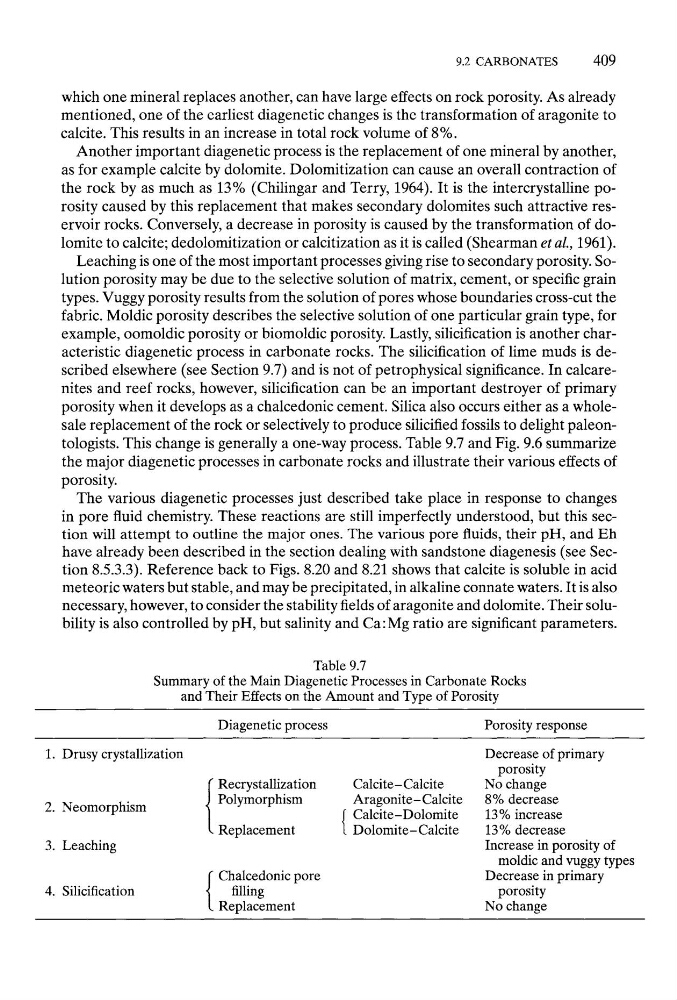
porosity when it develops as a chalcedonic cement. Silica also occurs either as a wholesale replacement of the rock or selectively to produce silicified fossils to delight paleontologists. This change is generally a one-way process. Table 9.7 and Fig. 9.6 summarize
the major diagenetic processes in carbonate rocks and illustrate their various effects of
porosity.
The various diagenetic processes just described take place in response to changes
in pore fluid chemistry. These reactions are still imperfectly understood, but this section will attempt to outline the major ones. The various pore fluids, their pH, and Eh
have already been described in the section dealing with sandstone diagenesis (see Section 8.5.3.3). Reference back to Figs. 8.20 and 8.21 shows that calcite is soluble in acid
meteoric waters but stable, and may be precipitated, in alkaline connate waters. It is also
necessary, however, to consider the stability fields of aragonite and dolomite. Their solubility is also controlled by pH, but salinity and Ca:Mg ratio are significant parameters.
Table 9.7
Summary of the Main Diagenetic Processes in Carbonate Rocks
and Their Effects on the Amount and Type of Porosity
Diagenetic process
Porosity response
1. Drusy crystallization
2. Neomorphism
3. Leaching
4. Silicification
t
" Recrystallization
Polymorphism
9 Replacement
" Chalcedonic pore
filling
. Replacement
Calcite-Calcite
Aragonite-Calcite
Calcite-Dolomite
Dolomite-Calcite
Decrease of primary
porosity
No change
8% decrease
13 % increase
13 % decrease
Increase in porosity of
moldic and vuggy types
Decrease in primary
porosity
No change
409
which one mineral replaces another, can have large effects on rock porosity. As already
mentioned, one of the earliest diagenetic changes is the transformation of aragonite to
calcite. This results in an increase in total rock volume of 8%.
Another important diagenetic process is the replacement of one mineral by another,
as for example calcite by dolomite. Dolomitization can cause an overall contraction of
the rock by as much as 13% (Chilingar and Terry, 1964). It is the intercrystalline porosity caused by this replacement that makes secondary dolomites such attractive reservoir rocks. Conversely, a decrease in porosity is caused by the transformation of dolomite to calcite; dedolomitization or calcitization as it is called (Shearman et al., 1961).
Leaching is one of the most important processes giving rise to secondary porosity. Solution porosity may be due to the selective solution of matrix, cement, or specific grain
types. Vuggy porosity results from the solution of pores whose boundaries cross-cut the
fabric. Moldic porosity describes the selective solution of one particular grain type, for
example, oomoldic porosity or biomoldic porosity. Lastly, silicification is another characteristic diagenetic process in carbonate rocks. The silicification of lime muds is described elsewhere (see Section 9.7) and is not of petrophysical significance. In calcarenites and reef rocks, however, silicification can be an important destroyer of primary
porosity when it develops as a chalcedonic cement. Silica also occurs either as a wholesale replacement of the rock or selectively to produce silicified fossils to delight paleontologists. This change is generally a one-way process. Table 9.7 and Fig. 9.6 summarize
the major diagenetic processes in carbonate rocks and illustrate their various effects of
porosity.
The various diagenetic processes just described take place in response to changes
in pore fluid chemistry. These reactions are still imperfectly understood, but this section will attempt to outline the major ones. The various pore fluids, their pH, and Eh
have already been described in the section dealing with sandstone diagenesis (see Section 8.5.3.3). Reference back to Figs. 8.20 and 8.21 shows that calcite is soluble in acid
meteoric waters but stable, and may be precipitated, in alkaline connate waters. It is also
necessary, however, to consider the stability fields of aragonite and dolomite. Their solubility is also controlled by pH, but salinity and Ca:Mg ratio are significant parameters.
Table 9.7
Summary of the Main Diagenetic Processes in Carbonate Rocks
and Their Effects on the Amount and Type of Porosity
Diagenetic process
Porosity response
1. Drusy crystallization
2. Neomorphism
3. Leaching
4. Silicification
t
" Recrystallization
Polymorphism
9 Replacement
" Chalcedonic pore
filling
. Replacement
Calcite-Calcite
Aragonite-Calcite
Calcite-Dolomite
Dolomite-Calcite
Decrease of primary
porosity
No change
8% decrease
13 % increase
13 % decrease
Increase in porosity of
moldic and vuggy types
Decrease in primary
porosity
No change