

408
9 AUTOCHTHONOUS SEDIMENTS
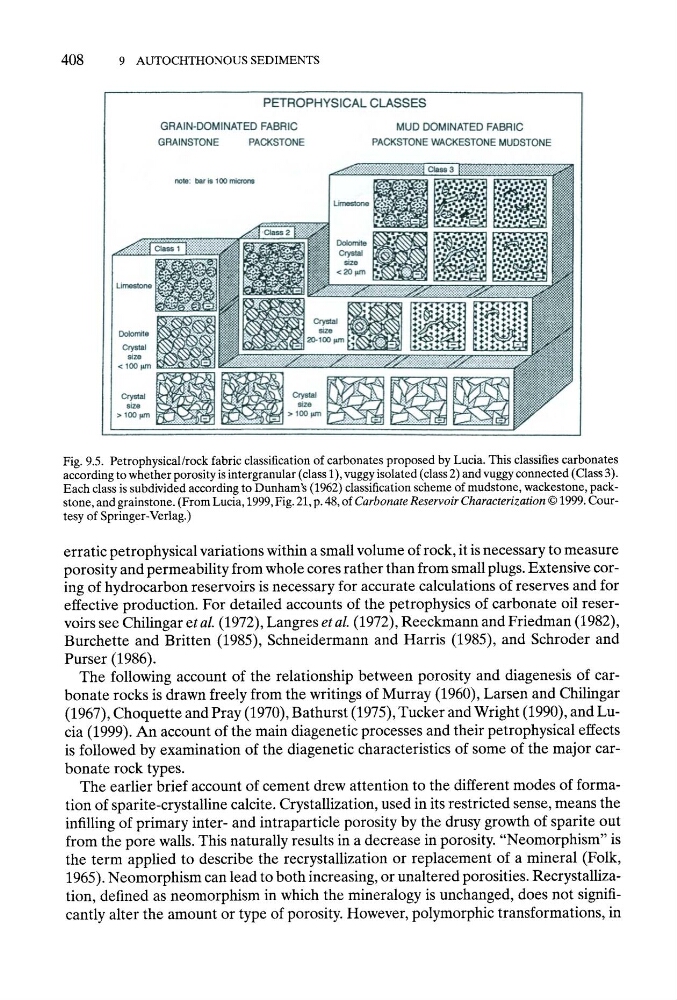
Fig. 9.5. Petrophysical/rock fabric classification of carbonates proposed by Lucia. This classifies carbonates
according to whether porosity is intergranular (class 1), vuggy isolated (class 2) and vuggy connected (Class 3).
Each class is subdivided according to Dunham's (1962) classification scheme of mudstone, wackestone, packstone, and grainstone. (From Lucia, 1999, Fig. 21, p. 48, of Carbonate Reservoir Characterization 9 1999. Courtesy of Springer-Verlag.)
erratic petrophysical variations within a small volume of rock, it is necessary to measure
porosity and permeability from whole cores rather than from small plugs. Extensive coring of hydrocarbon reservoirs is necessary for accurate calculations of reserves and for
effective production. For detailed accounts of the petrophysics of carbonate oil reservoirs see Chilingar et al. (1972), Langres et al. (1972), Reeckmann and Friedman (1982),
Burchette and Britten (1985), Schneidermann and Harris (1985), and Schroder and
Purser (1986).
The following account of the relationship between porosity and diagenesis of carbonate rocks is drawn freely from the writings of Murray (1960), Larsen and Chilingar
(1967), Choquette and Pray (1970), Bathurst (1975), Tucker and Wright (1990), and Lucia (1999). An account of the main diagenetic processes and their petrophysical effects
is followed by examination of the diagenetic characteristics of some of the major carbonate rock types.
The earlier brief account of cement drew attention to the different modes of formation of sparite-crystalline calcite. Crystallization, used in its restricted sense, means the
infilling of primary inter- and intraparticle porosity by the drusy growth of sparite out
from the pore walls. This naturally results in a decrease in porosity. "Neomorphism" is
the term applied to describe the recrystallization or replacement of a mineral (Folk,
1965). Neomorphism can lead to both increasing, or unaltered porosities. Recrystallization, defined as neomorphism in which the mineralogy is unchanged, does not significantly alter the amount or type of porosity. However, polymorphic transformations, in
9 AUTOCHTHONOUS SEDIMENTS
Fig. 9.5. Petrophysical/rock fabric classification of carbonates proposed by Lucia. This classifies carbonates
according to whether porosity is intergranular (class 1), vuggy isolated (class 2) and vuggy connected (Class 3).
Each class is subdivided according to Dunham's (1962) classification scheme of mudstone, wackestone, packstone, and grainstone. (From Lucia, 1999, Fig. 21, p. 48, of Carbonate Reservoir Characterization 9 1999. Courtesy of Springer-Verlag.)
erratic petrophysical variations within a small volume of rock, it is necessary to measure
porosity and permeability from whole cores rather than from small plugs. Extensive coring of hydrocarbon reservoirs is necessary for accurate calculations of reserves and for
effective production. For detailed accounts of the petrophysics of carbonate oil reservoirs see Chilingar et al. (1972), Langres et al. (1972), Reeckmann and Friedman (1982),
Burchette and Britten (1985), Schneidermann and Harris (1985), and Schroder and
Purser (1986).
The following account of the relationship between porosity and diagenesis of carbonate rocks is drawn freely from the writings of Murray (1960), Larsen and Chilingar
(1967), Choquette and Pray (1970), Bathurst (1975), Tucker and Wright (1990), and Lucia (1999). An account of the main diagenetic processes and their petrophysical effects
is followed by examination of the diagenetic characteristics of some of the major carbonate rock types.
The earlier brief account of cement drew attention to the different modes of formation of sparite-crystalline calcite. Crystallization, used in its restricted sense, means the
infilling of primary inter- and intraparticle porosity by the drusy growth of sparite out
from the pore walls. This naturally results in a decrease in porosity. "Neomorphism" is
the term applied to describe the recrystallization or replacement of a mineral (Folk,
1965). Neomorphism can lead to both increasing, or unaltered porosities. Recrystallization, defined as neomorphism in which the mineralogy is unchanged, does not significantly alter the amount or type of porosity. However, polymorphic transformations, in