

9.2 CARBONATES
407
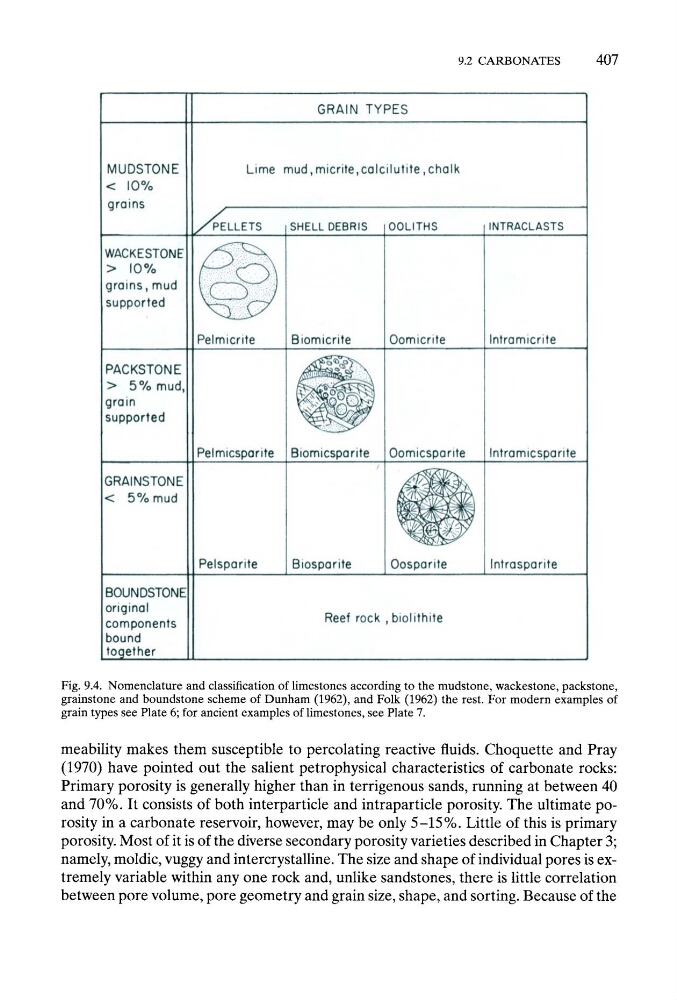
Fig. 9.4. Nomenclature and classification of limestones according to the mudstone, wackestone, packstone,
grainstone and boundstone scheme of Dunham (1962), and Folk (1962) the rest. For modern examples of
grain types see Plate 6; for ancient examples of limestones, see Plate 7.
meability makes them susceptible to percolating reactive fluids. Choquette and Pray
(1970) have pointed out the salient petrophysical characteristics of carbonate rocks:
Primary porosity is generally higher than in terrigenous sands, running at between 40
and 70%. It consists of both interparticle and intraparticle porosity. The ultimate porosity in a carbonate reservoir, however, may be only 5-15 %. Little of this is primary
porosity. Most of it is of the diverse secondary porosity varieties described in Chapter 3;
namely, moldic, vuggy and intercrystalline. The size and shape of individual pores is extremely variable within any one rock and, unlike sandstones, there is little correlation
between pore volume, pore geometry and grain size, shape, and sorting. Because of the
407
Fig. 9.4. Nomenclature and classification of limestones according to the mudstone, wackestone, packstone,
grainstone and boundstone scheme of Dunham (1962), and Folk (1962) the rest. For modern examples of
grain types see Plate 6; for ancient examples of limestones, see Plate 7.
meability makes them susceptible to percolating reactive fluids. Choquette and Pray
(1970) have pointed out the salient petrophysical characteristics of carbonate rocks:
Primary porosity is generally higher than in terrigenous sands, running at between 40
and 70%. It consists of both interparticle and intraparticle porosity. The ultimate porosity in a carbonate reservoir, however, may be only 5-15 %. Little of this is primary
porosity. Most of it is of the diverse secondary porosity varieties described in Chapter 3;
namely, moldic, vuggy and intercrystalline. The size and shape of individual pores is extremely variable within any one rock and, unlike sandstones, there is little correlation
between pore volume, pore geometry and grain size, shape, and sorting. Because of the