

406
9 AUTOCHTHONOUS SEDIMENTS
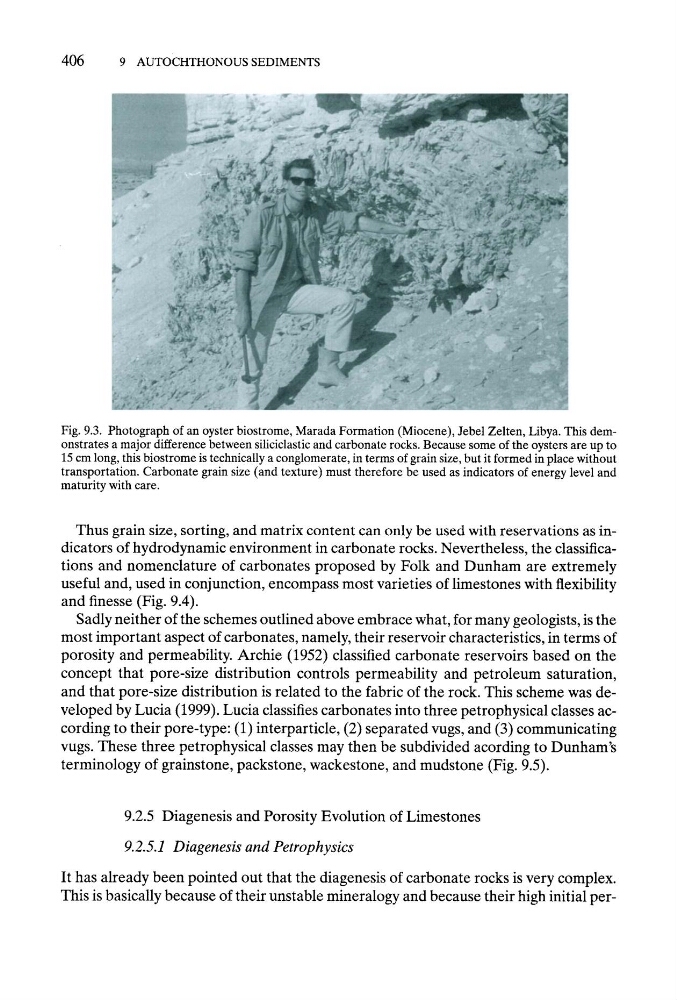
Fig. 9.3. Photograph of an oyster biostrome, Marada Formation (Miocene), Jebel Zelten, Libya. This demonstrates a major difference between siliciclastic and carbonate rocks. Because some of the oysters are up to
15 cm long, this biostrome is technically a conglomerate, in terms of grain size, but it formed in place without
transportation. Carbonate grain size (and texture) must therefore be used as indicators of energy level and
maturity with care.
Thus grain size, sorting, and matrix content can only be used with reservations as indicators of hydrodynamic environment in carbonate rocks. Nevertheless, the classifications and nomenclature of carbonates proposed by Folk and Dunham are extremely
useful and, used in conjunction, encompass most varieties of limestones with flexibility
and finesse (Fig. 9.4).
Sadly neither of the schemes outlined above embrace what, for many geologists, is the
most important aspect of carbonates, namely, their reservoir characteristics, in terms of
porosity and permeability. Archie (1952) classified carbonate reservoirs based on the
concept that pore-size distribution controls permeability and petroleum saturation,
and that pore-size distribution is related to the fabric of the rock. This scheme was developed by Lucia (1999). Lucia classifies carbonates into three petrophysical classes according to their pore-type: (1) interparticle, (2) separated vugs, and (3) communicating
vugs. These three petrophysical classes may then be subdivided acording to Dunham's
terminology of grainstone, packstone, wackestone, and mudstone (Fig. 9.5).
9.2.5 Diagenesis and Porosity Evolution of Limestones
9.2.5.1 Diagenesis and Petrophysics
It has already been pointed out that the diagenesis of carbonate rocks is very complex.
This is basically because of their unstable mineralogy and because their high initial per-
9 AUTOCHTHONOUS SEDIMENTS
Fig. 9.3. Photograph of an oyster biostrome, Marada Formation (Miocene), Jebel Zelten, Libya. This demonstrates a major difference between siliciclastic and carbonate rocks. Because some of the oysters are up to
15 cm long, this biostrome is technically a conglomerate, in terms of grain size, but it formed in place without
transportation. Carbonate grain size (and texture) must therefore be used as indicators of energy level and
maturity with care.
Thus grain size, sorting, and matrix content can only be used with reservations as indicators of hydrodynamic environment in carbonate rocks. Nevertheless, the classifications and nomenclature of carbonates proposed by Folk and Dunham are extremely
useful and, used in conjunction, encompass most varieties of limestones with flexibility
and finesse (Fig. 9.4).
Sadly neither of the schemes outlined above embrace what, for many geologists, is the
most important aspect of carbonates, namely, their reservoir characteristics, in terms of
porosity and permeability. Archie (1952) classified carbonate reservoirs based on the
concept that pore-size distribution controls permeability and petroleum saturation,
and that pore-size distribution is related to the fabric of the rock. This scheme was developed by Lucia (1999). Lucia classifies carbonates into three petrophysical classes according to their pore-type: (1) interparticle, (2) separated vugs, and (3) communicating
vugs. These three petrophysical classes may then be subdivided acording to Dunham's
terminology of grainstone, packstone, wackestone, and mudstone (Fig. 9.5).
9.2.5 Diagenesis and Porosity Evolution of Limestones
9.2.5.1 Diagenesis and Petrophysics
It has already been pointed out that the diagenesis of carbonate rocks is very complex.
This is basically because of their unstable mineralogy and because their high initial per-