

9.2 CARBONATES
405
Table 9.6
Classification of Carbonate Rocks
Boundstone- Original components bound together in life, i.e., biogenic reefs
Mudstone
< 10% grains
Mud-supported
Wackestone
Contain mud
> 10% grains
Packstone
>5 % micrite
Grainstone
<5 % micrite
Grain-supported
Original constituents
not bound together
during life
Crystalline carbonate- Primary depositional fabric destroyed by recrystallization
After Dunham (1962).
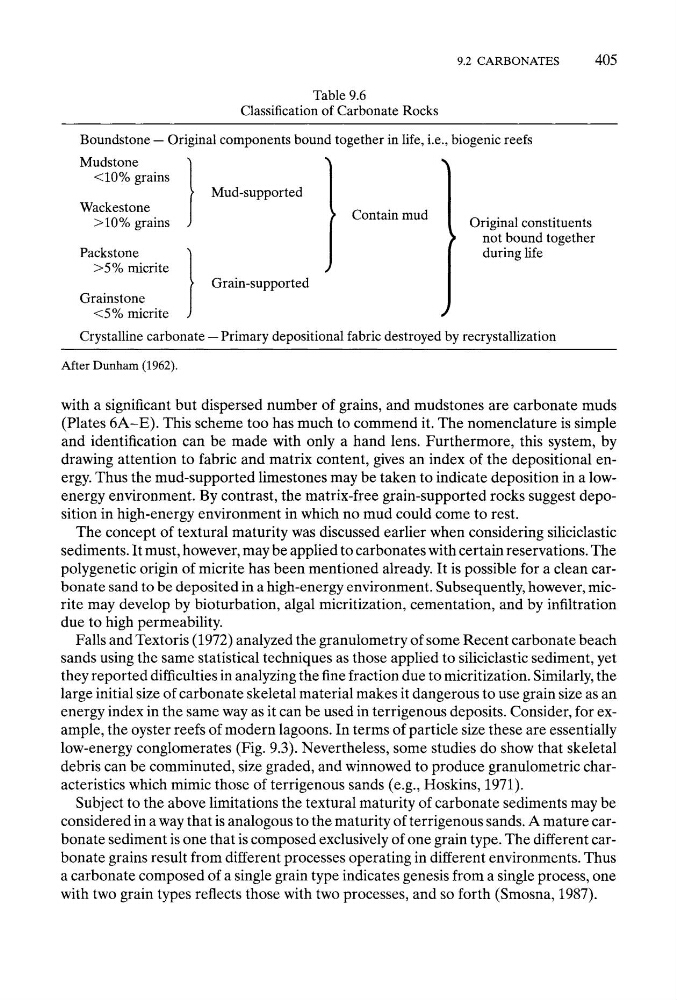
with a significant but dispersed number of grains, and mudstones are carbonate muds
(Plates 6A-E). This scheme too has much to commend it. The nomenclature is simple
and identification can be made with only a hand lens. Furthermore, this system, by
drawing attention to fabric and matrix content, gives an index of the depositional energy. Thus the mud-supported limestones may be taken to indicate deposition in a lowenergy environment. By contrast, the matrix-free grain-supported rocks suggest deposition in high-energy environment in which no mud could come to rest.
The concept of textural maturity was discussed earlier when considering siliciclastic
sediments. It must, however, may be applied to carbonates with certain reservations. The
polygenetic origin of micrite has been mentioned already. It is possible for a clean carbonate sand to be deposited in a high-energy environment. Subsequently, however, micrite may develop by bioturbation, algal micritization, cementation, and by infiltration
due to high permeability.
Falls and Textoris (1972) analyzed the granulometry of some Recent carbonate beach
sands using the same statistical techniques as those applied to siliciclastic sediment, yet
they reported difficulties in analyzing the fine fraction due to micritization. Similarly, the
large initial size of carbonate skeletal material makes it dangerous to use grain size as an
energy index in the same way as it can be used in terrigenous deposits. Consider, for example, the oyster reefs of modern lagoons. In terms of particle size these are essentially
low-energy conglomerates (Fig. 9.3). Nevertheless, some studies do show that skeletal
debris can be comminuted, size graded, and winnowed to produce granulometric characteristics which mimic those of terrigenous sands (e.g., Hoskins, 1971).
Subject to the above limitations the textural maturity of carbonate sediments may be
considered in a way that is analogous to the maturity of terrigenous sands. A mature carbonate sediment is one that is composed exclusively of one grain type. The different carbonate grains result from different processes operating in different environments. Thus
a carbonate composed of a single grain type indicates genesis from a single process, one
with two grain types reflects those with two processes, and so forth (Smosna, 1987).
405
Table 9.6
Classification of Carbonate Rocks
Boundstone- Original components bound together in life, i.e., biogenic reefs
Mudstone
< 10% grains
Mud-supported
Wackestone
Contain mud
> 10% grains
Packstone
>5 % micrite
Grainstone
<5 % micrite
Grain-supported
Original constituents
not bound together
during life
Crystalline carbonate- Primary depositional fabric destroyed by recrystallization
After Dunham (1962).
with a significant but dispersed number of grains, and mudstones are carbonate muds
(Plates 6A-E). This scheme too has much to commend it. The nomenclature is simple
and identification can be made with only a hand lens. Furthermore, this system, by
drawing attention to fabric and matrix content, gives an index of the depositional energy. Thus the mud-supported limestones may be taken to indicate deposition in a lowenergy environment. By contrast, the matrix-free grain-supported rocks suggest deposition in high-energy environment in which no mud could come to rest.
The concept of textural maturity was discussed earlier when considering siliciclastic
sediments. It must, however, may be applied to carbonates with certain reservations. The
polygenetic origin of micrite has been mentioned already. It is possible for a clean carbonate sand to be deposited in a high-energy environment. Subsequently, however, micrite may develop by bioturbation, algal micritization, cementation, and by infiltration
due to high permeability.
Falls and Textoris (1972) analyzed the granulometry of some Recent carbonate beach
sands using the same statistical techniques as those applied to siliciclastic sediment, yet
they reported difficulties in analyzing the fine fraction due to micritization. Similarly, the
large initial size of carbonate skeletal material makes it dangerous to use grain size as an
energy index in the same way as it can be used in terrigenous deposits. Consider, for example, the oyster reefs of modern lagoons. In terms of particle size these are essentially
low-energy conglomerates (Fig. 9.3). Nevertheless, some studies do show that skeletal
debris can be comminuted, size graded, and winnowed to produce granulometric characteristics which mimic those of terrigenous sands (e.g., Hoskins, 1971).
Subject to the above limitations the textural maturity of carbonate sediments may be
considered in a way that is analogous to the maturity of terrigenous sands. A mature carbonate sediment is one that is composed exclusively of one grain type. The different carbonate grains result from different processes operating in different environments. Thus
a carbonate composed of a single grain type indicates genesis from a single process, one
with two grain types reflects those with two processes, and so forth (Smosna, 1987).