

404
9 AUTOCHTHONOUS SEDIMENTS
aragonite to calcite. Recrystallization is the development of calcite spar by the enlargement of preexisting calcite crystals. Additional discussion of cement is contained in Section 9.2.5 on diagenesis.
9.2.4 Nomenclature and Classification
The nomenclature and classification of carbonate rocks was once a topic of great confusion and debate. There were several good reasons for this, including the fact that so
many parameters can be used to define carbonate rock types. These include chemical
composition (e.g., limestone, dolomite), grain size, particle type, type and amount of porosity, degree of crystallinity, quantity of mud, and so on. The concepts on which presentday carbonate nomenclature are based are contained in a volume of papers edited by
Ham (1962). Two of these articles deserve special mention because they proposed a series of terms and groupings which are widely used today.
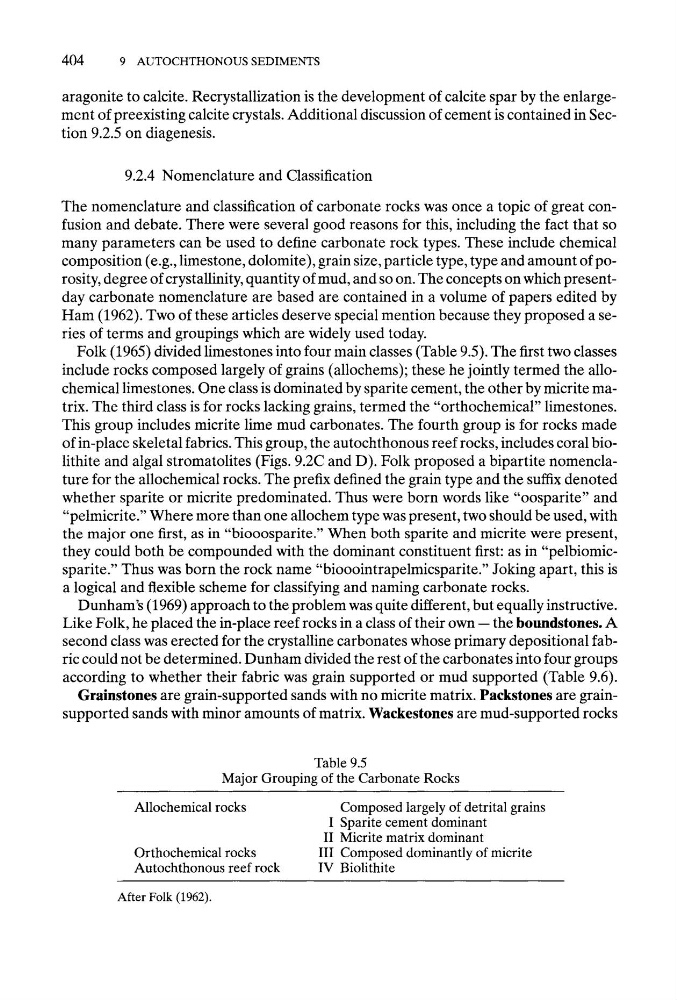
Folk (1965) divided limestones into four main classes (Table 9.5). The first two classes
include rocks composed largely of grains (allochems); these he jointly termed the allochemical limestones. One class is dominated by sparite cement, the other by micrite matrix. The third class is for rocks lacking grains, termed the "orthochemical" limestones.
This group includes micrite lime mud carbonates. The fourth group is for rocks made
of in-place skeletal fabrics. This group, the autochthonous reef rocks, includes coral biolithite and algal stromatolites (Figs. 9.2C and D). Folk proposed a bipartite nomenclature for the allochemical rocks. The prefix defined the grain type and the suffix denoted
whether sparite or micrite predominated. Thus were born words like "oosparite" and
"pelmicrite." Where more than one allochem type was present, two should be used, with
the major one first, as in "biooosparite." When both sparite and micrite were present,
they could both be compounded with the dominant constituent first: as in "pelbiomicsparite." Thus was born the rock name "biooointrapelmicsparite." Joking apart, this is
a logical and flexible scheme for classifying and naming carbonate rocks.
Dunham's (1969) approach to the problem was quite different, but equally instructive.
Like Folk, he placed the in-place reef rocks in a class of their own -- the boundstones. A
second class was erected for the crystalline carbonates whose primary depositional fabric could not be determined. Dunham divided the rest of the carbonates into four groups
according to whether their fabric was grain supported or mud supported (Table 9.6).
Grainstones are grain-supported sands with no micrite matrix. Packstones are grainsupported sands with minor amounts of matrix. Wackestones are mud-supported rocks
Table 9.5
Major Grouping of the Carbonate Rocks
Allochemical rocks
Orthochemical rocks
Autochthonous reef rock
Composed largely of detrital grains
I Sparite cement dominant
II Micrite matrix dominant
III Composed dominantly of micrite
IV Biolithite
After Folk (1962).
9 AUTOCHTHONOUS SEDIMENTS
aragonite to calcite. Recrystallization is the development of calcite spar by the enlargement of preexisting calcite crystals. Additional discussion of cement is contained in Section 9.2.5 on diagenesis.
9.2.4 Nomenclature and Classification
The nomenclature and classification of carbonate rocks was once a topic of great confusion and debate. There were several good reasons for this, including the fact that so
many parameters can be used to define carbonate rock types. These include chemical
composition (e.g., limestone, dolomite), grain size, particle type, type and amount of porosity, degree of crystallinity, quantity of mud, and so on. The concepts on which presentday carbonate nomenclature are based are contained in a volume of papers edited by
Ham (1962). Two of these articles deserve special mention because they proposed a series of terms and groupings which are widely used today.
Folk (1965) divided limestones into four main classes (Table 9.5). The first two classes
include rocks composed largely of grains (allochems); these he jointly termed the allochemical limestones. One class is dominated by sparite cement, the other by micrite matrix. The third class is for rocks lacking grains, termed the "orthochemical" limestones.
This group includes micrite lime mud carbonates. The fourth group is for rocks made
of in-place skeletal fabrics. This group, the autochthonous reef rocks, includes coral biolithite and algal stromatolites (Figs. 9.2C and D). Folk proposed a bipartite nomenclature for the allochemical rocks. The prefix defined the grain type and the suffix denoted
whether sparite or micrite predominated. Thus were born words like "oosparite" and
"pelmicrite." Where more than one allochem type was present, two should be used, with
the major one first, as in "biooosparite." When both sparite and micrite were present,
they could both be compounded with the dominant constituent first: as in "pelbiomicsparite." Thus was born the rock name "biooointrapelmicsparite." Joking apart, this is
a logical and flexible scheme for classifying and naming carbonate rocks.
Dunham's (1969) approach to the problem was quite different, but equally instructive.
Like Folk, he placed the in-place reef rocks in a class of their own -- the boundstones. A
second class was erected for the crystalline carbonates whose primary depositional fabric could not be determined. Dunham divided the rest of the carbonates into four groups
according to whether their fabric was grain supported or mud supported (Table 9.6).
Grainstones are grain-supported sands with no micrite matrix. Packstones are grainsupported sands with minor amounts of matrix. Wackestones are mud-supported rocks
Table 9.5
Major Grouping of the Carbonate Rocks
Allochemical rocks
Orthochemical rocks
Autochthonous reef rock
Composed largely of detrital grains
I Sparite cement dominant
II Micrite matrix dominant
III Composed dominantly of micrite
IV Biolithite
After Folk (1962).