

410
9 AUTOCHTHONOUS SEDIMENTS
Surface
[ Aragonite ]
Primary
dolomite
Polymorphism Recrystallization Replacement Recrystallization
Subsurface
~,~.~~.~ ,Cali, ite
cement l Se~~ ~
Replacement
j ','Quartz and
chalcedony
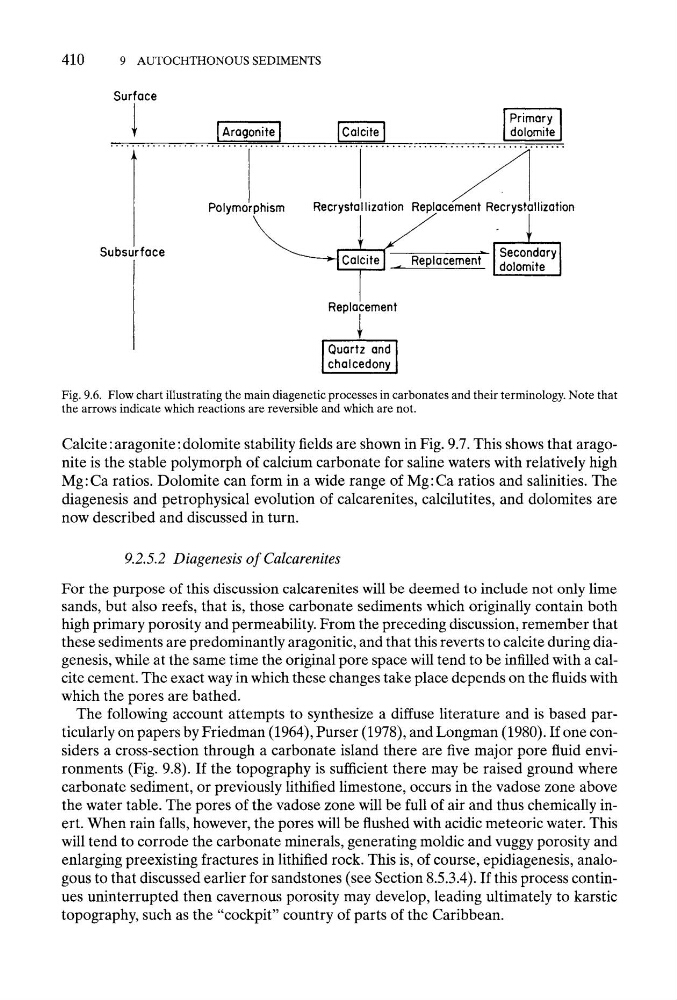
Fig. 9.6. Flow chart illustrating the main diagenetic processes in carbonates and their terminology. Note that
the arrows indicate which reactions are reversible and which are not.
Calcite: aragonite :dolomite stability fields are shown in Fig. 9.7. This shows that aragonite is the stable polymorph of calcium carbonate for saline waters with relatively high
Mg:Ca ratios. Dolomite can form in a wide range of Mg:Ca ratios and salinities. The
diagenesis and petrophysical evolution of calcarenites, calcilutites, and dolomites are
now described and discussed in turn.
9.2.5.2 Diagenesis of Calcarenites
For the purpose of this discussion calcarenites will be deemed to include not only lime
sands, but also reefs, that is, those carbonate sediments which originally contain both
high primary porosity and permeability. From the preceding discussion, remember that
these sediments are predominantly aragonitic, and that this reverts to calcite during diagenesis, while at the same time the original pore space will tend to be infilled with a calcite cement. The exact way in which these changes take place depends on the fluids with
which the pores are bathed.
The following account attempts to synthesize a diffuse literature and is based particularly on papers by Friedman (1964), Purser (1978), and Longman (1980). If one considers a cross-section through a carbonate island there are five major pore fluid environments (Fig. 9.8). If the topography is sufficient there may be raised ground where
carbonate sediment, or previously lithified limestone, occurs in the vadose zone above
the water table. The pores of the vadose zone will be full of air and thus chemically inert. When rain falls, however, the pores will be flushed with acidic meteoric water. This
will tend to corrode the carbonate minerals, generating moldic and vuggy porosity and
enlarging preexisting fractures in lithified rock. This is, of course, epidiagenesis, analogous to that discussed earlier for sandstones (see Section 8.5.3.4). If this process continues uninterrupted then cavernous porosity may develop, leading ultimately to karstic
topography, such as the "cockpit" country of parts of the Caribbean.
9 AUTOCHTHONOUS SEDIMENTS
Surface
[ Aragonite ]
Primary
dolomite
Polymorphism Recrystallization Replacement Recrystallization
Subsurface
~,~.~~.~ ,Cali, ite
cement l Se~~ ~
Replacement
j ','Quartz and
chalcedony
Fig. 9.6. Flow chart illustrating the main diagenetic processes in carbonates and their terminology. Note that
the arrows indicate which reactions are reversible and which are not.
Calcite: aragonite :dolomite stability fields are shown in Fig. 9.7. This shows that aragonite is the stable polymorph of calcium carbonate for saline waters with relatively high
Mg:Ca ratios. Dolomite can form in a wide range of Mg:Ca ratios and salinities. The
diagenesis and petrophysical evolution of calcarenites, calcilutites, and dolomites are
now described and discussed in turn.
9.2.5.2 Diagenesis of Calcarenites
For the purpose of this discussion calcarenites will be deemed to include not only lime
sands, but also reefs, that is, those carbonate sediments which originally contain both
high primary porosity and permeability. From the preceding discussion, remember that
these sediments are predominantly aragonitic, and that this reverts to calcite during diagenesis, while at the same time the original pore space will tend to be infilled with a calcite cement. The exact way in which these changes take place depends on the fluids with
which the pores are bathed.
The following account attempts to synthesize a diffuse literature and is based particularly on papers by Friedman (1964), Purser (1978), and Longman (1980). If one considers a cross-section through a carbonate island there are five major pore fluid environments (Fig. 9.8). If the topography is sufficient there may be raised ground where
carbonate sediment, or previously lithified limestone, occurs in the vadose zone above
the water table. The pores of the vadose zone will be full of air and thus chemically inert. When rain falls, however, the pores will be flushed with acidic meteoric water. This
will tend to corrode the carbonate minerals, generating moldic and vuggy porosity and
enlarging preexisting fractures in lithified rock. This is, of course, epidiagenesis, analogous to that discussed earlier for sandstones (see Section 8.5.3.4). If this process continues uninterrupted then cavernous porosity may develop, leading ultimately to karstic
topography, such as the "cockpit" country of parts of the Caribbean.