

8.5 SANDSTONES
373
exposure of the rocks, it is not possible to prove the time or climatic conditions that produced the weathering profile seen at the present time. On the intensely weathered bare
rock surfaces of the Saharan hamadas, sandstones typically show a dark brown ferruginous layer a few millimeters thick. Beneath this crust two zones can be distinguished.
The upper zone is one of increased porosity; the lower zone is one of decreased porosity. In the upper zone iron and carbonate are removed in solution; micas, feldspars, and
illitic clays are altered to kaolinite and the total clay content is reduced by leaching. Detrital silica grains can be corroded in the more porous sand, though silica cementation
may occur in the less permeable sands. This upper zone of leaching, and hence increased
secondary porosity, varies from decimeters to hundreds of meters in thickness. The second lower zone is one where porosity is decreased by precipitation of the minerals percolating down from the zone above. Silica is the dominant cement. This is often opaline
hydrous silica in modern weathering profiles, though this ages to chalcedony in ancient
examples. Iron may also be precipitated in this zone, particularly in the form of ferruginous crusts at the contacts between permeable sands and impermeable shales. The
overall effect of these reactions is to decrease the porosity and permeability of this zone.
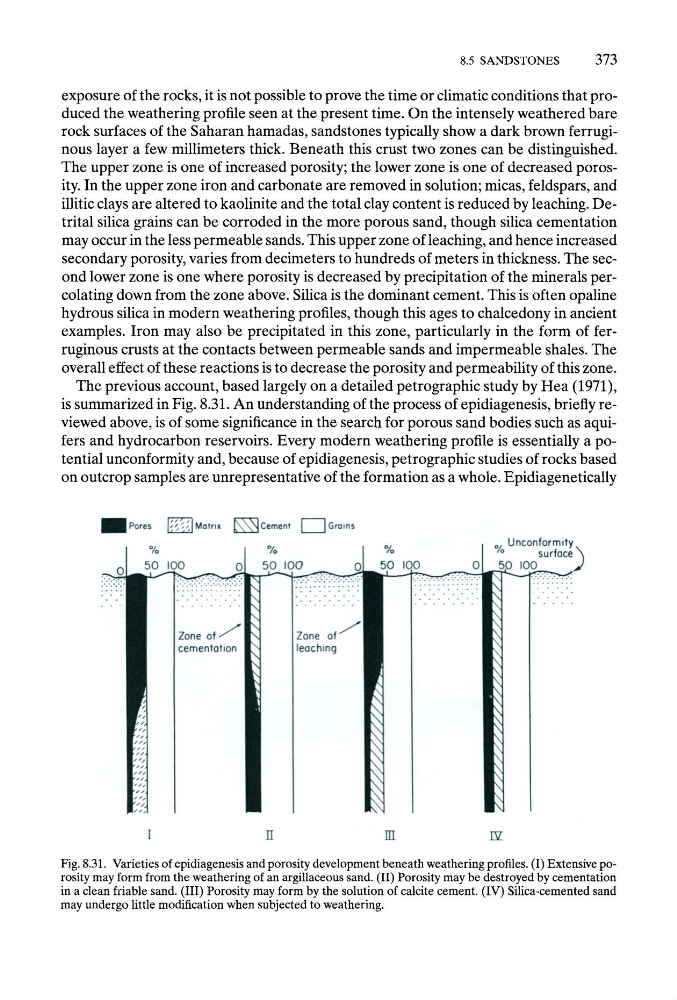
The previous account, based largely on a detailed petrographic study by Hea (1971),
is summarized in Fig. 8.31. An understanding of the process of epidiagenesis, briefly reviewed above, is of some significance in the search for porous sand bodies such as aquifers and hydrocarbon reservoirs. Every modern weathering profile is essentially a potential unconformity and, because of epidiagenesis, petrographic studies of rocks based
on outcrop samples are unrepresentative of the formation as a whole. Epidiagenetically
Fig. 8.31. Varieties of epidiagenesis and porosity development beneath weathering profiles. (I) Extensive porosity may form from the weathering of an argillaceous sand. (II) Porosity may be destroyed by cementation
in a clean friable sand. (III) Porosity may form by the solution of calcite cement. (IV) Silica-cemented sand
may undergo little modification when subjected to weathering.
373
exposure of the rocks, it is not possible to prove the time or climatic conditions that produced the weathering profile seen at the present time. On the intensely weathered bare
rock surfaces of the Saharan hamadas, sandstones typically show a dark brown ferruginous layer a few millimeters thick. Beneath this crust two zones can be distinguished.
The upper zone is one of increased porosity; the lower zone is one of decreased porosity. In the upper zone iron and carbonate are removed in solution; micas, feldspars, and
illitic clays are altered to kaolinite and the total clay content is reduced by leaching. Detrital silica grains can be corroded in the more porous sand, though silica cementation
may occur in the less permeable sands. This upper zone of leaching, and hence increased
secondary porosity, varies from decimeters to hundreds of meters in thickness. The second lower zone is one where porosity is decreased by precipitation of the minerals percolating down from the zone above. Silica is the dominant cement. This is often opaline
hydrous silica in modern weathering profiles, though this ages to chalcedony in ancient
examples. Iron may also be precipitated in this zone, particularly in the form of ferruginous crusts at the contacts between permeable sands and impermeable shales. The
overall effect of these reactions is to decrease the porosity and permeability of this zone.
The previous account, based largely on a detailed petrographic study by Hea (1971),
is summarized in Fig. 8.31. An understanding of the process of epidiagenesis, briefly reviewed above, is of some significance in the search for porous sand bodies such as aquifers and hydrocarbon reservoirs. Every modern weathering profile is essentially a potential unconformity and, because of epidiagenesis, petrographic studies of rocks based
on outcrop samples are unrepresentative of the formation as a whole. Epidiagenetically
Fig. 8.31. Varieties of epidiagenesis and porosity development beneath weathering profiles. (I) Extensive porosity may form from the weathering of an argillaceous sand. (II) Porosity may be destroyed by cementation
in a clean friable sand. (III) Porosity may form by the solution of calcite cement. (IV) Silica-cemented sand
may undergo little modification when subjected to weathering.