

374
8 ALLOCHTHONOUS SEDIMENTS
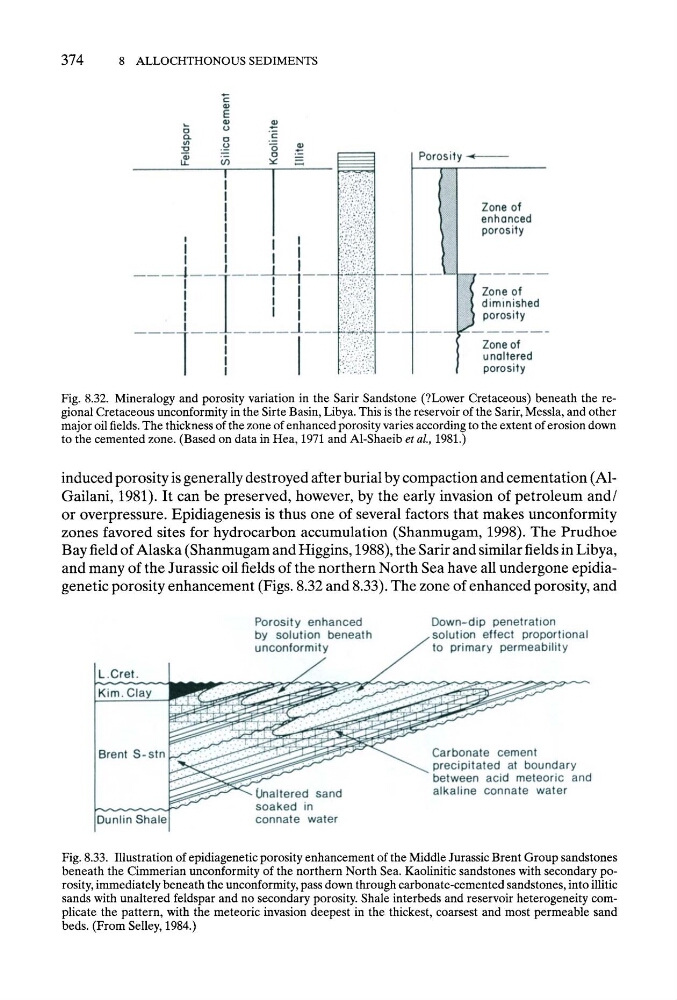
Fig. 8.32. Mineralogy and porosity variation in the Sarir Sandstone (?Lower Cretaceous) beneath the regional Cretaceous unconformity in the Sirte Basin, Libya. This is the reservoir of the Sarir, Messla, and other
major oil fields. The thickness of the zone of enhanced porosity varies according to the extent of erosion down
to the cemented zone. (Based on data in Hea, 1971 and A1-Shaeib et al., 1981.)
induced porosity is generally destroyed after burial by c o m p a c t i o n and c e m e n t a t i o n (A1Gailani, 1981). It can be preserved, however, by the early invasion of p e t r o l e u m and/
or overpressure. Epidiagenesis is thus one of several factors that m a k e s u n c o n f o r m i t y
zones favored sites for h y d r o c a r b o n accumulation ( S h a n m u g a m , 1998). T h e P r u d h o e
Bay field of A l a s k a ( S h a n m u g a m and Higgins, 1988), the Sarir and similar fields in Libya,
and m a n y of the Jurassic oil fields of the n o r t h e r n N o r t h Sea have all u n d e r g o n e epidiagenetic porosity e n h a n c e m e n t (Figs. 8.32 and 8.33). The zone of e n h a n c e d porosity, and
Fig. 8.33. Illustration of epidiagenetic porosity enhancement of the Middle Jurassic Brent Group sandstones
beneath the Cimmerian unconformity of the northern North Sea. Kaolinitic sandstones with secondary porosity, immediately beneath the unconformity, pass down through carbonate-cemented sandstones, into illitic
sands with unaltered feldspar and no secondary porosity. Shale interbeds and reservoir heterogeneity complicate the pattern, with the meteoric invasion deepest in the thickest, coarsest and most permeable sand
beds. (From Selley, 1984.)
8 ALLOCHTHONOUS SEDIMENTS
Fig. 8.32. Mineralogy and porosity variation in the Sarir Sandstone (?Lower Cretaceous) beneath the regional Cretaceous unconformity in the Sirte Basin, Libya. This is the reservoir of the Sarir, Messla, and other
major oil fields. The thickness of the zone of enhanced porosity varies according to the extent of erosion down
to the cemented zone. (Based on data in Hea, 1971 and A1-Shaeib et al., 1981.)
induced porosity is generally destroyed after burial by c o m p a c t i o n and c e m e n t a t i o n (A1Gailani, 1981). It can be preserved, however, by the early invasion of p e t r o l e u m and/
or overpressure. Epidiagenesis is thus one of several factors that m a k e s u n c o n f o r m i t y
zones favored sites for h y d r o c a r b o n accumulation ( S h a n m u g a m , 1998). T h e P r u d h o e
Bay field of A l a s k a ( S h a n m u g a m and Higgins, 1988), the Sarir and similar fields in Libya,
and m a n y of the Jurassic oil fields of the n o r t h e r n N o r t h Sea have all u n d e r g o n e epidiagenetic porosity e n h a n c e m e n t (Figs. 8.32 and 8.33). The zone of e n h a n c e d porosity, and
Fig. 8.33. Illustration of epidiagenetic porosity enhancement of the Middle Jurassic Brent Group sandstones
beneath the Cimmerian unconformity of the northern North Sea. Kaolinitic sandstones with secondary porosity, immediately beneath the unconformity, pass down through carbonate-cemented sandstones, into illitic
sands with unaltered feldspar and no secondary porosity. Shale interbeds and reservoir heterogeneity complicate the pattern, with the meteoric invasion deepest in the thickest, coarsest and most permeable sand
beds. (From Selley, 1984.)