

372
8 ALLOCHTHONOUS SEDIMENTS
8.5.3.4.1 Secondary porosity by epidiagenesis
The term epidiagenesis is applied to the reactions that take place in a previously lithifed
sediment (Fairbridge, 1967). Weathering was described in some detail in Chapter 2. This
process is well understood and it is known to affect sediments down to over a 100 m below the surface. Geologists are familiar with the development of solution porosity in carbonates, and its preservation in the subsurface beneath unconformities (Fig. 6.65, V).
Geophysicists are familiar with the static correction that has to be made in seismic processing to allow for low velocities in the superficial weathered zone.
The epidiagenetic processes are now considered. First, physical weathering, the release of overburden pressure and mass movement on sloping ground, can generate fracture porosity. At the same time diverse chemical changes can generate secondary porosity by leaching. In carbonate-cemented sandstones, groundwater rich in humic and
other acids will leach out the cement and carry the carbonate away in solution. This may
leave an unconsolidated sand with a porosity approaching that which it had when it was
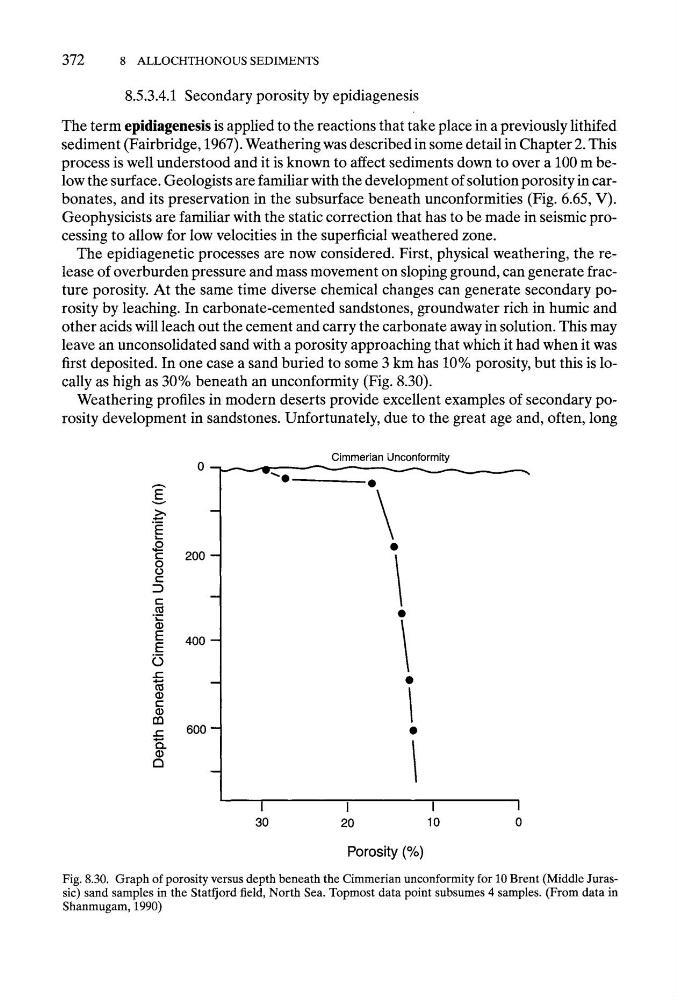
first deposited. In one case a sand buried to some 3 km has 10% porosity, but this is locally as high as 30% beneath an unconformity (Fig. 8.30).
Weathering profiles in modern deserts provide excellent examples of secondary porosity development in sandstones. Unfortunately, due to the great age and, often, long
._
E
v
>.,
.-.,..
E
,9.o
c
200 -o
o r
c
I..
E
400 -
E
.B
o
r
c
d~
rn
.c:
600 -
tl)
a
Cimmerian Unconformity
/
/
I
I
I
I
30
20
10
0
Porosity (%)
Fig. 8.30. Graph of porosity versus depth beneath the Cimmerian unconformity for 10 Brent (Middle Jurassic) sand samples in the Statfjord field, North Sea. Topmost data point subsumes 4 samples. (From data in
Shanmugam, 1990)
8 ALLOCHTHONOUS SEDIMENTS
8.5.3.4.1 Secondary porosity by epidiagenesis
The term epidiagenesis is applied to the reactions that take place in a previously lithifed
sediment (Fairbridge, 1967). Weathering was described in some detail in Chapter 2. This
process is well understood and it is known to affect sediments down to over a 100 m below the surface. Geologists are familiar with the development of solution porosity in carbonates, and its preservation in the subsurface beneath unconformities (Fig. 6.65, V).
Geophysicists are familiar with the static correction that has to be made in seismic processing to allow for low velocities in the superficial weathered zone.
The epidiagenetic processes are now considered. First, physical weathering, the release of overburden pressure and mass movement on sloping ground, can generate fracture porosity. At the same time diverse chemical changes can generate secondary porosity by leaching. In carbonate-cemented sandstones, groundwater rich in humic and
other acids will leach out the cement and carry the carbonate away in solution. This may
leave an unconsolidated sand with a porosity approaching that which it had when it was
first deposited. In one case a sand buried to some 3 km has 10% porosity, but this is locally as high as 30% beneath an unconformity (Fig. 8.30).
Weathering profiles in modern deserts provide excellent examples of secondary porosity development in sandstones. Unfortunately, due to the great age and, often, long
._
E
v
>.,
.-.,..
E
,9.o
c
200 -o
o r
c
I..
E
400 -
E
.B
o
r
c
d~
rn
.c:
600 -
tl)
a
Cimmerian Unconformity
/
/
I
I
I
I
30
20
10
0
Porosity (%)
Fig. 8.30. Graph of porosity versus depth beneath the Cimmerian unconformity for 10 Brent (Middle Jurassic) sand samples in the Statfjord field, North Sea. Topmost data point subsumes 4 samples. (From data in
Shanmugam, 1990)