

8.5 SANDSTONES
371
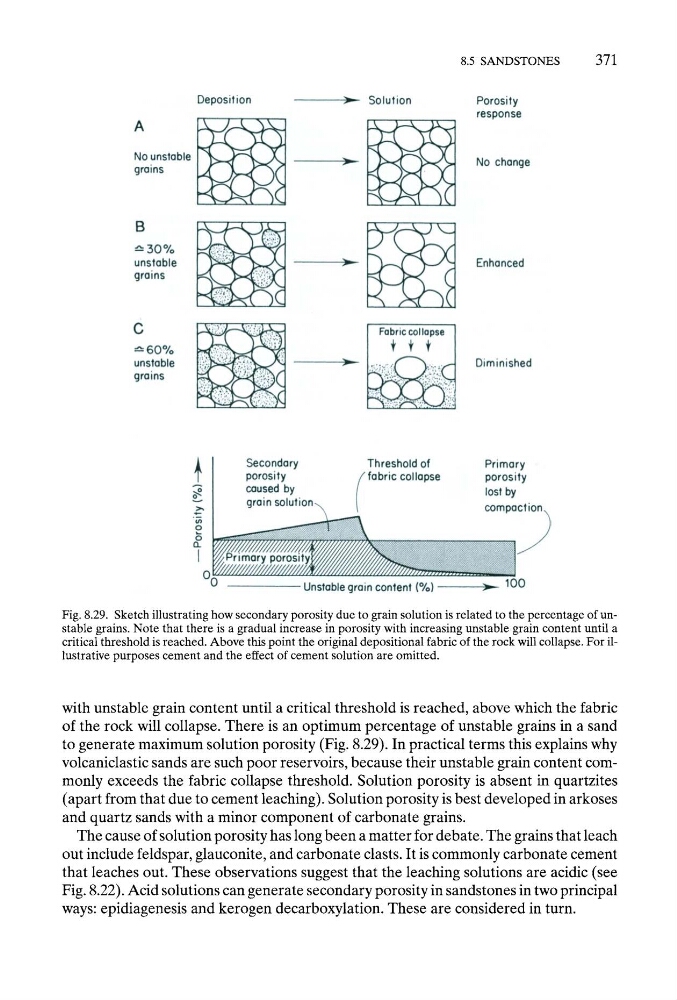
Fig. 8.29. Sketch illustrating how secondary porosity due to grain solution is related to the percentage of unstable grains. Note that there is a gradual increase in porosity with increasing unstable grain content until a
critical threshold is reached. Above this point the original depositional fabric of the rock will collapse. For illustrative purposes cement and the effect of cement solution are omitted.
with unstable grain content until a critical threshold is reached, above which the fabric
of the rock will collapse. There is an optimum percentage of unstable grains in a sand
to generate maximum solution porosity (Fig. 8.29). In practical terms this explains why
volcaniclastic sands are such poor reservoirs, because their unstable grain content commonly exceeds the fabric collapse threshold. Solution porosity is absent in quartzites
(apart from that due to cement leaching). Solution porosity is best developed in arkoses
and quartz sands with a minor component of carbonate grains.
The cause of solution porosity has long been a matter for debate. The grains that leach
out include feldspar, glauconite, and carbonate clasts. It is commonly carbonate cement
that leaches out. These observations suggest that the leaching solutions are acidic (see
Fig. 8.22). Acid solutions can generate secondary porosity in sandstones in two principal
ways: epidiagenesis and kerogen decarboxylation. These are considered in turn.
371
Fig. 8.29. Sketch illustrating how secondary porosity due to grain solution is related to the percentage of unstable grains. Note that there is a gradual increase in porosity with increasing unstable grain content until a
critical threshold is reached. Above this point the original depositional fabric of the rock will collapse. For illustrative purposes cement and the effect of cement solution are omitted.
with unstable grain content until a critical threshold is reached, above which the fabric
of the rock will collapse. There is an optimum percentage of unstable grains in a sand
to generate maximum solution porosity (Fig. 8.29). In practical terms this explains why
volcaniclastic sands are such poor reservoirs, because their unstable grain content commonly exceeds the fabric collapse threshold. Solution porosity is absent in quartzites
(apart from that due to cement leaching). Solution porosity is best developed in arkoses
and quartz sands with a minor component of carbonate grains.
The cause of solution porosity has long been a matter for debate. The grains that leach
out include feldspar, glauconite, and carbonate clasts. It is commonly carbonate cement
that leaches out. These observations suggest that the leaching solutions are acidic (see
Fig. 8.22). Acid solutions can generate secondary porosity in sandstones in two principal
ways: epidiagenesis and kerogen decarboxylation. These are considered in turn.