

370
8 ALLOCHTHONOUS SEDIMENTS
kaolinite crystals. These changes occur in low pH conditions in several ways. Meteoric
water may flush recently deposited sands during a marine regression or lithified rocks
undergoing weathering. The permeable kaolinitic zone may then be preserved beneath
an unconformity. Kaolinization may also be caused by carbonic acid-rich waters produced by the devolatilization of coal beds.
Chlorite is a ferro-magnesian rich clay mineral that is produced by the weathering of
basic igneous rocks, such as gabbro and basalt. It is stable in reducing alkaline fluids and
is susceptible to oxidation. Chlorite is only found at the earth's surface today at high
polar latitudes where chemical weathering is negligible. Authigenic chlorite cement in
sandstones has a characteristic platey habit (Fig. 8.27D). Because of its high iron and
magnesium content it is commonly found in volcaniclastic sandstones.
8.5.3.4 Porosity Enhancement by Solution
There is considerable evidence for solution porosity development in sandstones. The
petrographic criteria have been outlined by Schmidt et aL (1977). The evidence includes
cement or grains in various stages of leaching. Poikilotopic calcite cements sometimes
leach out to form sands with excellent porosity. This is because when the calcite cement
originally grew it corroded the quartz and thus diminished grain size. The postsolution
fabric thus has a catenary pore system with excellent continuity. When grains leach out
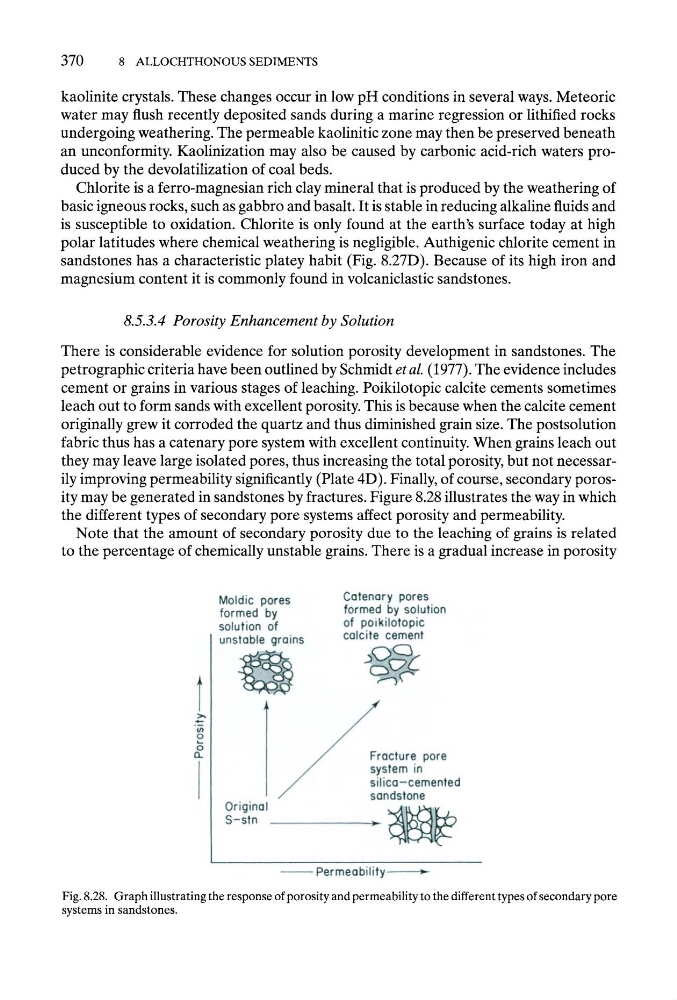
they may leave large isolated pores, thus increasing the total porosity, but not necessarily improving permeability significantly (Plate 4D). Finally, of course, secondary porosity may be generated in sandstones by fractures. Figure 8.28 illustrates the way in which
the different types of secondary pore systems affect porosity and permeability.
Note that the amount of secondary porosity due to the leaching of grains is related
to the percentage of chemically unstable grains. There is a gradual increase in porosity
Fig. 8.28. Graph illustrating the response of porosity and permeability to the different types of secondary pore
systems in sandstones.
8 ALLOCHTHONOUS SEDIMENTS
kaolinite crystals. These changes occur in low pH conditions in several ways. Meteoric
water may flush recently deposited sands during a marine regression or lithified rocks
undergoing weathering. The permeable kaolinitic zone may then be preserved beneath
an unconformity. Kaolinization may also be caused by carbonic acid-rich waters produced by the devolatilization of coal beds.
Chlorite is a ferro-magnesian rich clay mineral that is produced by the weathering of
basic igneous rocks, such as gabbro and basalt. It is stable in reducing alkaline fluids and
is susceptible to oxidation. Chlorite is only found at the earth's surface today at high
polar latitudes where chemical weathering is negligible. Authigenic chlorite cement in
sandstones has a characteristic platey habit (Fig. 8.27D). Because of its high iron and
magnesium content it is commonly found in volcaniclastic sandstones.
8.5.3.4 Porosity Enhancement by Solution
There is considerable evidence for solution porosity development in sandstones. The
petrographic criteria have been outlined by Schmidt et aL (1977). The evidence includes
cement or grains in various stages of leaching. Poikilotopic calcite cements sometimes
leach out to form sands with excellent porosity. This is because when the calcite cement
originally grew it corroded the quartz and thus diminished grain size. The postsolution
fabric thus has a catenary pore system with excellent continuity. When grains leach out
they may leave large isolated pores, thus increasing the total porosity, but not necessarily improving permeability significantly (Plate 4D). Finally, of course, secondary porosity may be generated in sandstones by fractures. Figure 8.28 illustrates the way in which
the different types of secondary pore systems affect porosity and permeability.
Note that the amount of secondary porosity due to the leaching of grains is related
to the percentage of chemically unstable grains. There is a gradual increase in porosity
Fig. 8.28. Graph illustrating the response of porosity and permeability to the different types of secondary pore
systems in sandstones.