

8.5 SANDSTONES
365
Fig 8.23 -- Continued
boundaries have been described by many geologists (e.g., Fothergill, 1955; Fuchtbauer,
1967; Moncure et aL,1984; Sullivan and McBride, 1991; Carvalho et al., 1995). Selley
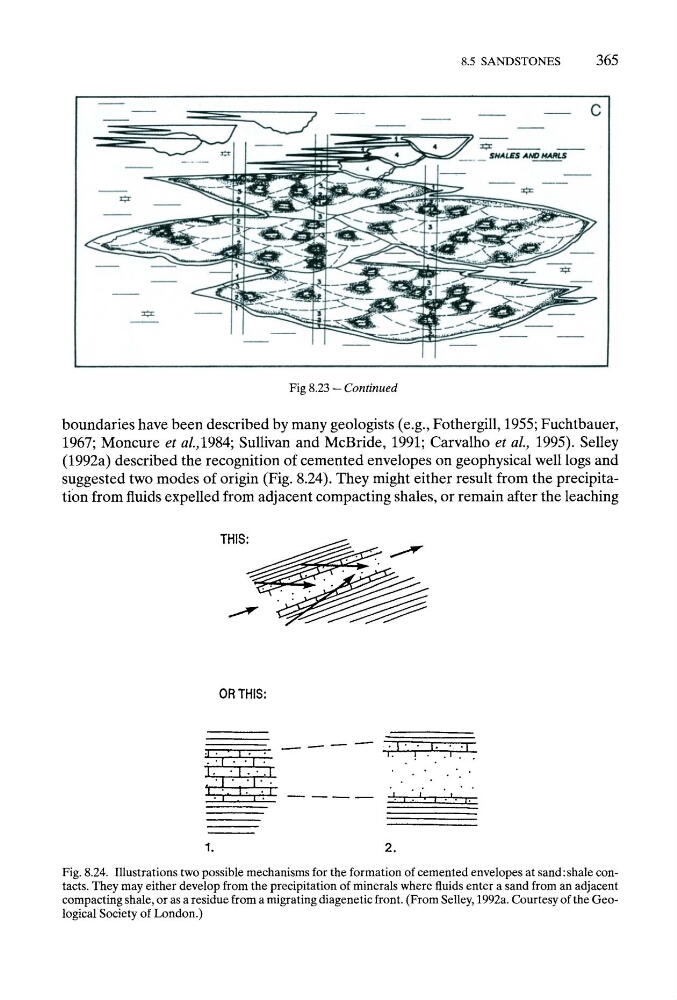
(1992a) described the recognition of cemented envelopes on geophysical well logs and
suggested two modes of origin (Fig. 8.24). They might either result from the precipitation from fluids expelled from adjacent compacting shales, or remain after the leaching
THIS: ~ ~ : : : ~ . .
~ - ~ .
"7.
9
~ . . f j . ~
OR THIS:
~
~-"-"
- - ~
i" 9 I. 9 I
I
!
9
.I
.
,
9
o
~
~
9
o
,
9
!
9
].
1~
2~
Fig. 8.24. Illustrations two possible mechanisms for the formation of cemented envelopes at sand:shale contacts. They may either develop from the precipitation of minerals where fluids enter a sand from an adjacent
compacting shale, or as a residue from a migrating diagenetic front. (From Selley, 1992a. Courtesy of the Geological Society of London.)
365
Fig 8.23 -- Continued
boundaries have been described by many geologists (e.g., Fothergill, 1955; Fuchtbauer,
1967; Moncure et aL,1984; Sullivan and McBride, 1991; Carvalho et al., 1995). Selley
(1992a) described the recognition of cemented envelopes on geophysical well logs and
suggested two modes of origin (Fig. 8.24). They might either result from the precipitation from fluids expelled from adjacent compacting shales, or remain after the leaching
THIS: ~ ~ : : : ~ . .
~ - ~ .
"7.
9
~ . . f j . ~
OR THIS:
~
~-"-"
- - ~
i" 9 I. 9 I
I
!
9
.I
.
,
9
o
~
~
9
o
,
9
!
9
].
1~
2~
Fig. 8.24. Illustrations two possible mechanisms for the formation of cemented envelopes at sand:shale contacts. They may either develop from the precipitation of minerals where fluids enter a sand from an adjacent
compacting shale, or as a residue from a migrating diagenetic front. (From Selley, 1992a. Courtesy of the Geological Society of London.)