

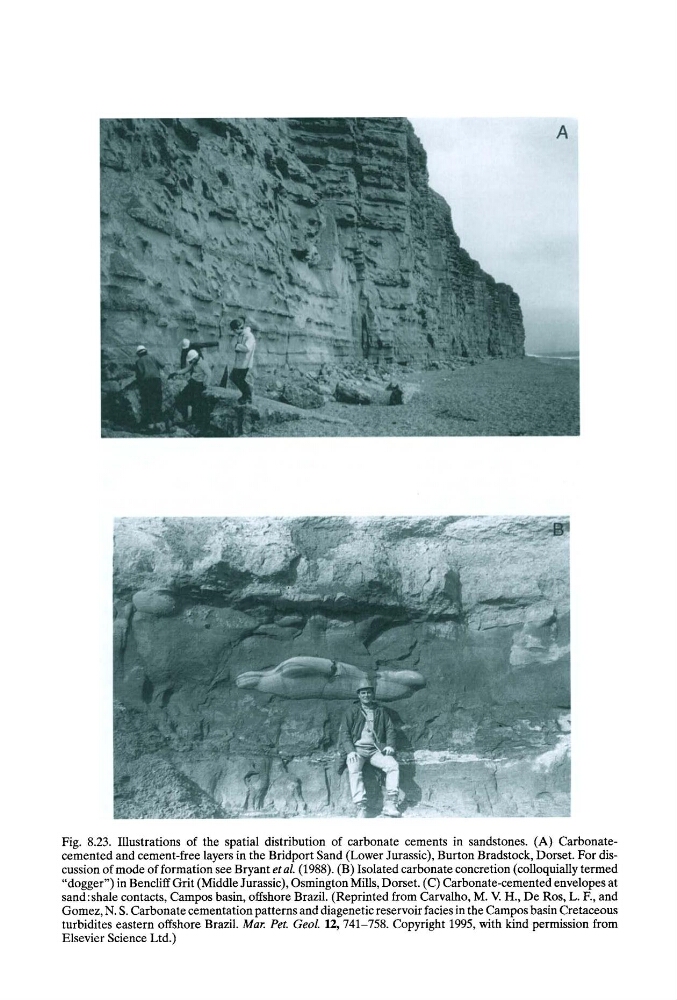
Fig. 8.23. Illustrations of the spatial distribution of carbonate cements in sandstones. (A) Carbonatecemented and cement-free layers in the Bridport Sand (Lower Jurassic), Burton Bradstock, Dorset. For discussion of mode of formation see Bryant et al. (1988). (B) Isolated carbonate concretion (colloquially termed
"dogger") in Bencliff Grit (Middle Jurassic), Osmington Mills, Dorset. (C) Carbonate-cemented envelopes at
sand:shale contacts, Campos basin, offshore Brazil. (Reprinted from Carvalho, M. V. H., De Ros, L. E, and
Gomez, N. S. Carbonate cementation patterns and diagenetic reservoir facies in the Campos basin Cretaceous
turbidites eastern offshore Brazil. Mar. Pet. Geol. 12, 741-758. Copyright 1995, with kind permission from
Elsevier Science Ltd.)
"dogger") in Bencliff Grit (Middle Jurassic), Osmington Mills, Dorset. (C) Carbonate-cemented envelopes at
sand:shale contacts, Campos basin, offshore Brazil. (Reprinted from Carvalho, M. V. H., De Ros, L. E, and
Gomez, N. S. Carbonate cementation patterns and diagenetic reservoir facies in the Campos basin Cretaceous
turbidites eastern offshore Brazil. Mar. Pet. Geol. 12, 741-758. Copyright 1995, with kind permission from
Elsevier Science Ltd.)