

366
8 ALLOCHTHONOUS SEDIMENTS
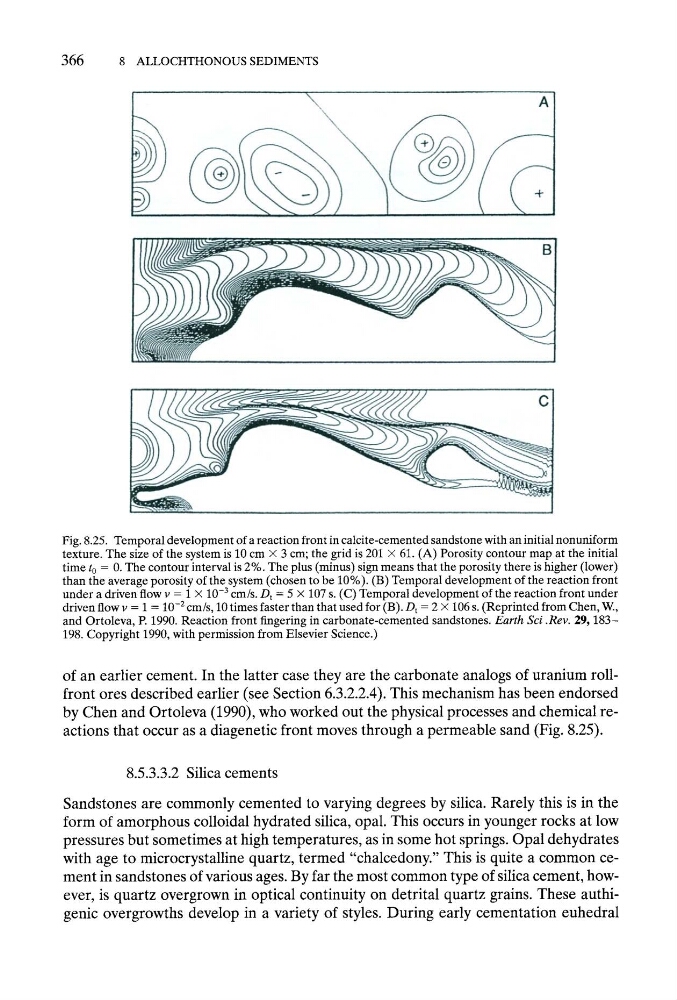
Fig. 8.25. Temporal development of a reaction front in calcite-cemented sandstone with an initial nonuniform
texture. The size of the system is 10 cm x 3 cm; the grid is 201 x 61. (A) Porosity contour map at the initial
time to = 0. The contour interval is 2%. The plus (minus) sign means that the porosity there is higher (lower)
than the average porosity of the system (chosen to be 10%). (B) Temporal development of the reaction front
under a driven flow v = 1 x 1 0 -3 c m / s . D t -- 5 X 10⁷ s. (C) Temporal development of the reaction front under
driven flow v = 1 = 10 -2 cm/s, 10 times faster than that used for (B). D t = 2 x 10⁶ s. (Reprinted from Chen, W.,
and Ortoleva, P. 1990. Reaction front fingering in carbonate-cemented sandstones. Earth Sci .Rev. 29, 183198. Copyright 1990, with permission from Elsevier Science.)
of an earlier cement. In the latter case they are the carbonate analogs of uranium rollfront ores described earlier (see Section 6.3.2.2.4). This mechanism has been endorsed
by Chen and Ortoleva (1990), who worked out the physical processes and chemical reactions that occur as a diagenetic front moves through a permeable sand (Fig. 8.25).
8.5.3.3.2 Silica cements
Sandstones are commonly cemented to varying degrees by silica. Rarely this is in the
form of amorphous colloidal hydrated silica, opal. This occurs in younger rocks at low
pressures but sometimes at high temperatures, as in some hot springs. Opal dehydrates
with age to microcrystalline quartz, termed "chalcedony." This is quite a common cement in sandstones of various ages. By far the most common type of silica cement, however, is quartz overgrown in optical continuity on detrital quartz grains. These authigenic overgrowths develop in a variety of styles. During early cementation euhedral
8 ALLOCHTHONOUS SEDIMENTS
Fig. 8.25. Temporal development of a reaction front in calcite-cemented sandstone with an initial nonuniform
texture. The size of the system is 10 cm x 3 cm; the grid is 201 x 61. (A) Porosity contour map at the initial
time to = 0. The contour interval is 2%. The plus (minus) sign means that the porosity there is higher (lower)
than the average porosity of the system (chosen to be 10%). (B) Temporal development of the reaction front
under a driven flow v = 1 x 1 0 -3 c m / s . D t -- 5 X 10⁷ s. (C) Temporal development of the reaction front under
driven flow v = 1 = 10 -2 cm/s, 10 times faster than that used for (B). D t = 2 x 10⁶ s. (Reprinted from Chen, W.,
and Ortoleva, P. 1990. Reaction front fingering in carbonate-cemented sandstones. Earth Sci .Rev. 29, 183198. Copyright 1990, with permission from Elsevier Science.)
of an earlier cement. In the latter case they are the carbonate analogs of uranium rollfront ores described earlier (see Section 6.3.2.2.4). This mechanism has been endorsed
by Chen and Ortoleva (1990), who worked out the physical processes and chemical reactions that occur as a diagenetic front moves through a permeable sand (Fig. 8.25).
8.5.3.3.2 Silica cements
Sandstones are commonly cemented to varying degrees by silica. Rarely this is in the
form of amorphous colloidal hydrated silica, opal. This occurs in younger rocks at low
pressures but sometimes at high temperatures, as in some hot springs. Opal dehydrates
with age to microcrystalline quartz, termed "chalcedony." This is quite a common cement in sandstones of various ages. By far the most common type of silica cement, however, is quartz overgrown in optical continuity on detrital quartz grains. These authigenic overgrowths develop in a variety of styles. During early cementation euhedral