

8.5 SANDSTONES
351
Quartz and feldspar
0.5
I00
- '
200
~, _
Median
grain
size
(mm.)
0.4
0.5
~,
Lithic grains
02
OI
%
Micas
Heavy minerals)
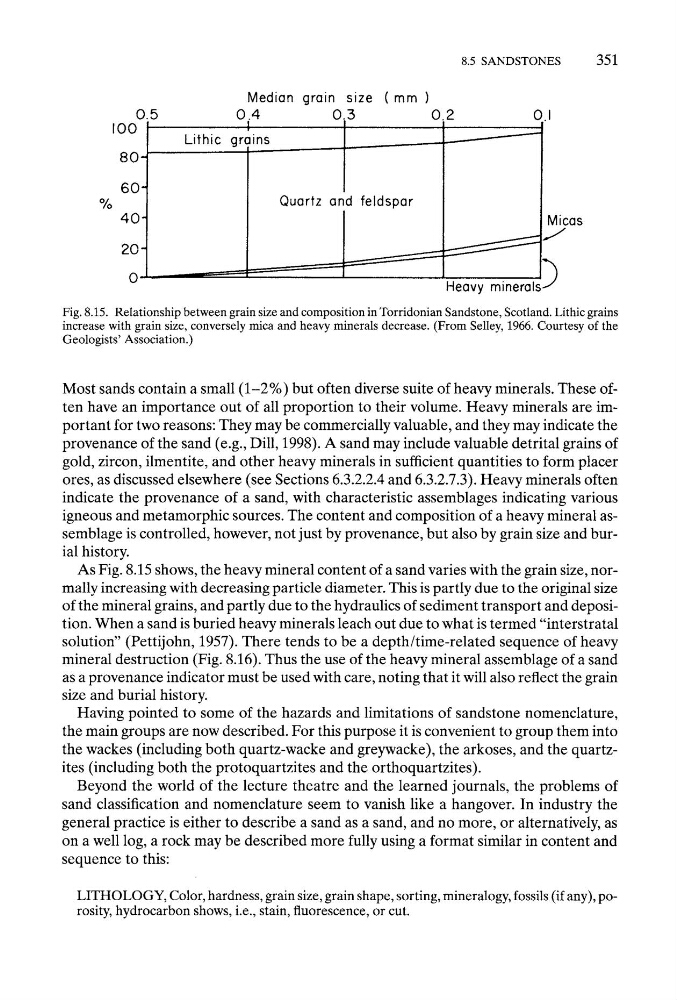
Fig. 8.15. Relationship between grain size and composition in Torridonian Sandstone, Scotland. Lithic grains
increase with grain size, conversely mica and heavy minerals decrease. (From Selley, 1966. Courtesy of the
Geologists' Association.)
Most sands contain a small (1-2 %) but often diverse suite of heavy minerals. These often have an importance out of all proportion to their volume. Heavy minerals are important for two reasons: They may be commercially valuable, and they may indicate the
provenance of the sand (e.g., Dill, 1998). A sand may include valuable detrital grains of
gold, zircon, ilmentite, and other heavy minerals in sufficient quantities to form placer
ores, as discussed elsewhere (see Sections 6.3.2.2.4 and 6.3.2.7.3). Heavy minerals often
indicate the provenance of a sand, with characteristic assemblages indicating various
igneous and metamorphic sources. The content and composition of a heavy mineral assemblage is controlled, however, not just by provenance, but also by grain size and burial history.
As Fig. 8.15 shows, the heavy mineral content of a sand varies with the grain size, normally increasing with decreasing particle diameter. This is partly due to the original size
of the mineral grains, and partly due to the hydraulics of sediment transport and deposition. When a sand is buried heavy minerals leach out due to what is termed "interstratal
solution" (Pettijohn, 1957). There tends to be a depth/time-related sequence of heavy
mineral destruction (Fig. 8.16). Thus the use of the heavy mineral assemblage of a sand
as a provenance indicator must be used with care, noting that it will also reflect the grain
size and burial history.
Having pointed to some of the hazards and limitations of sandstone nomenclature,
the main groups are now described. For this purpose it is convenient to group them into
the wackes (including both quartz-wacke and greywacke), the arkoses, and the quartzites (including both the protoquartzites and the orthoquartzites).
Beyond the world of the lecture theatre and the learned journals, the problems of
sand classification and nomenclature seem to vanish like a hangover. In industry the
general practice is either to describe a sand as a sand, and no more, or alternatively, as
on a well log, a rock may be described more fully using a format similar in content and
sequence to this:
LITHOLOGY, Color, hardness, grain size, grain shape, sorting, mineralogy, fossils (if any), porosity, hydrocarbon shows, i.e., stain, fluorescence, or cut.
351
Quartz and feldspar
0.5
I00
- '
200
~, _
Median
grain
size
(mm.)
0.4
0.5
~,
Lithic grains
02
OI
%
Micas
Heavy minerals)
Fig. 8.15. Relationship between grain size and composition in Torridonian Sandstone, Scotland. Lithic grains
increase with grain size, conversely mica and heavy minerals decrease. (From Selley, 1966. Courtesy of the
Geologists' Association.)
Most sands contain a small (1-2 %) but often diverse suite of heavy minerals. These often have an importance out of all proportion to their volume. Heavy minerals are important for two reasons: They may be commercially valuable, and they may indicate the
provenance of the sand (e.g., Dill, 1998). A sand may include valuable detrital grains of
gold, zircon, ilmentite, and other heavy minerals in sufficient quantities to form placer
ores, as discussed elsewhere (see Sections 6.3.2.2.4 and 6.3.2.7.3). Heavy minerals often
indicate the provenance of a sand, with characteristic assemblages indicating various
igneous and metamorphic sources. The content and composition of a heavy mineral assemblage is controlled, however, not just by provenance, but also by grain size and burial history.
As Fig. 8.15 shows, the heavy mineral content of a sand varies with the grain size, normally increasing with decreasing particle diameter. This is partly due to the original size
of the mineral grains, and partly due to the hydraulics of sediment transport and deposition. When a sand is buried heavy minerals leach out due to what is termed "interstratal
solution" (Pettijohn, 1957). There tends to be a depth/time-related sequence of heavy
mineral destruction (Fig. 8.16). Thus the use of the heavy mineral assemblage of a sand
as a provenance indicator must be used with care, noting that it will also reflect the grain
size and burial history.
Having pointed to some of the hazards and limitations of sandstone nomenclature,
the main groups are now described. For this purpose it is convenient to group them into
the wackes (including both quartz-wacke and greywacke), the arkoses, and the quartzites (including both the protoquartzites and the orthoquartzites).
Beyond the world of the lecture theatre and the learned journals, the problems of
sand classification and nomenclature seem to vanish like a hangover. In industry the
general practice is either to describe a sand as a sand, and no more, or alternatively, as
on a well log, a rock may be described more fully using a format similar in content and
sequence to this:
LITHOLOGY, Color, hardness, grain size, grain shape, sorting, mineralogy, fossils (if any), porosity, hydrocarbon shows, i.e., stain, fluorescence, or cut.