

352
8 ALLOCHTHONOUS SEDIMENTS
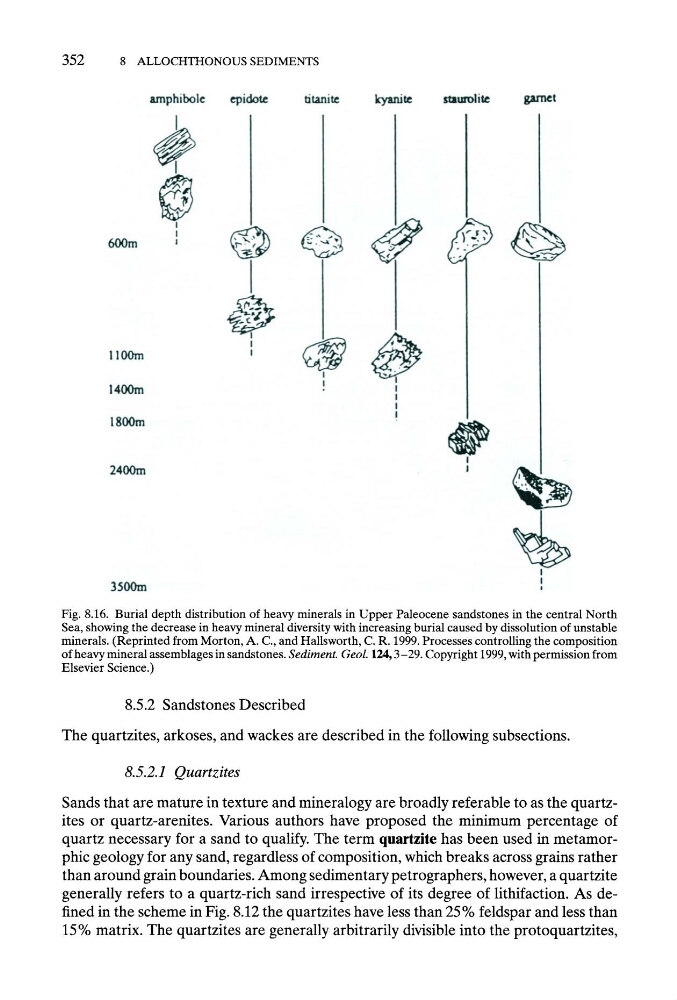
Fig. 8.16. Burial depth distribution of heavy minerals in Upper Paleocene sandstones in the central North
Sea, showing the decrease in heavy mineral diversity with increasing burial caused by dissolution of unstable
minerals. (Reprinted from Morton, A. C., and Hallsworth, C. R. 1999. Processes controlling the composition
of heavy mineral assemblages in sandstones. Sediment. GeoL 124, 3-29. Copyright 1999, with permission from
Elsevier Science.)
8.5.2 Sandstones Described
The quartzites, arkoses, and wackes are described in the following subsections.
8.5.2.1 Quartzites
Sands that are mature in texture and mineralogy are broadly referable to as the quartzites or quartz-arenites. Various authors have proposed the minimum percentage of
quartz necessary for a sand to qualify. The term quartzite has been used in metamorphic geology for any sand, regardless of composition, which breaks across grains rather
than around grain boundaries. Among sedimentary petrographers, however, a quartzite
generally refers to a quartz-rich sand irrespective of its degree of lithifaction. As defined in the scheme in Fig. 8.12 the quartzites have less than 25 % feldspar and less than
15 % matrix. The quartzites are generally arbitrarily divisible into the protoquartzites,
8 ALLOCHTHONOUS SEDIMENTS
Fig. 8.16. Burial depth distribution of heavy minerals in Upper Paleocene sandstones in the central North
Sea, showing the decrease in heavy mineral diversity with increasing burial caused by dissolution of unstable
minerals. (Reprinted from Morton, A. C., and Hallsworth, C. R. 1999. Processes controlling the composition
of heavy mineral assemblages in sandstones. Sediment. GeoL 124, 3-29. Copyright 1999, with permission from
Elsevier Science.)
8.5.2 Sandstones Described
The quartzites, arkoses, and wackes are described in the following subsections.
8.5.2.1 Quartzites
Sands that are mature in texture and mineralogy are broadly referable to as the quartzites or quartz-arenites. Various authors have proposed the minimum percentage of
quartz necessary for a sand to qualify. The term quartzite has been used in metamorphic geology for any sand, regardless of composition, which breaks across grains rather
than around grain boundaries. Among sedimentary petrographers, however, a quartzite
generally refers to a quartz-rich sand irrespective of its degree of lithifaction. As defined in the scheme in Fig. 8.12 the quartzites have less than 25 % feldspar and less than
15 % matrix. The quartzites are generally arbitrarily divisible into the protoquartzites,